
Ayr Cathedral
Ayr Cathedral, officially the Cathedral Church of Saint Margaret, is the Roman Catholic cathedral for the Diocese of Galloway in Scotland. It became a cathedral in 2007, succeeding the Good Shepherd Cathedral, and is notable for its significant renovations in the late 1990s and early 2000s, which modernized its interior while incorporating symbolic stained-glass windows.
Key Facts
- ›Ayr Cathedral was designated as a cathedral in 2007.
- ›The church was originally designed by architect James Dempster.
- ›Significant renovations occurred in the late 1990s and early 2000s, including the refurbishment of the sanctuary and the installation of new furnishings and stained-glass windows.
- ›The 'Water of Life' window serves as a memorial to those who died in the Pan Am Flight 103 disaster.
- ›The cathedral houses Victorian stained-glass windows dating from 1827 in the sanctuary, depicting the Virgin Mary, Jesus the Good Shepherd, Saint Joseph, and Saint Margaret of Scotland.

Gothic Revival
- Modern Stained-Glass Windows Depicting 'Divine Light' and 'Water of Life'
- Memorial Window For Pan Am Flight 103 Disaster Victims
- Original Victorian Stained-Glass Windows From 1827 In the Sanctuary
- Celtic Knot Patterns In Nave Windows Symbolizing Eternity
- Refurbished Sanctuary With Modern Furnishings
19th Century, 20th Century, 21st Century
James Dempster, Susan Bradbury, Austinsmithlord Architects, Michael Mancini
About Ayr Cathedral
Ayr Cathedral, officially known as the Cathedral Church of Saint Margaret, is the principal Roman Catholic place of worship for the Diocese of Galloway in Ayr, Scotland. Its designation as a cathedral occurred in 2007, following the closure of the Good Shepherd Cathedral, marking a new chapter in its long history. The church, originally established in the early 19th century, has undergone significant transformations, most notably a comprehensive renovation and re-dedication in the late 1990s and early 2000s.
History and Development
The foundation stone for St Margaret's Church was laid in 1826, with the building officially opened in 1827. Over its nearly two centuries of existence, the structure has evolved considerably. The 1960s and 1970s saw remodelling in response to Vatican II, altering the sanctuary's layout to facilitate a more active congregational role in Mass. In the mid-1990s, the church's fabric required substantial repair due to issues like water ingress and general wear and tear. These concerns prompted a major renovation program, initiated by Father Patrick Keegans, which led to the church's thorough makeover and re-opening on March 31, 2000. This period of renewal included refurbishing the sanctuary, installing new furnishings, stained-glass windows, an organ, and improved lighting and heating, supported by grants and community fundraising.
The transition to a cathedral status in 2007 was a significant ecclesiastical event for the Diocese of Galloway. This move was preceded by a period where the diocese's cathedral seat had been in Dumfries, but demographic shifts and the destruction of St Andrew's Cathedral in Dumfries by fire in 1961 led to the use of the Good Shepherd Church in Ayr as a temporary cathedral. Persistent issues with the Good Shepherd building and a decline in attendance led Bishop Maurice Taylor to petition for the transfer of the cathedral seat to St Margaret's. His successor, Bishop John Cunningham, finalized this petition to Pope Benedict XVI, resulting in St Margaret's becoming the cathedral.
Architecture and Notable Features
While the original design is attributed to architect James Dempster, the cathedral's interior has been significantly shaped by modern interventions. The nave features striking stained-glass windows designed by Susan Bradbury, including the 'Divine Light' and 'Water of Life' windows. The latter notably serves as a memorial to the victims of the Pan Am Flight 103 disaster. These contemporary works contrast with the Victorian stained-glass windows found in the sanctuary, dating from 1827, which depict the Virgin Mary, Jesus the Good Shepherd, Saint Joseph, and Saint Margaret of Scotland. The sanctuary itself was redesigned in 2000, with further adjustments in 2007 to accommodate its cathedral status, including the bishop's chair, known as the cathedra, crafted by Michael Mancini. The Stations of the Cross also employ symbolic imagery and color to depict Christ's passion.
Source: Wikipedia ↗
Frequently Asked Questions
When did Ayr Cathedral become a cathedral?
Ayr Cathedral was officially designated as a cathedral on September 14, 2007, following the closure of the Good Shepherd Cathedral in Ayr. This change occurred on the Feast of the Triumph of the Cross.
What major renovations has Ayr Cathedral undergone?
The church underwent substantial renovations in the late 1990s and early 2000s. These works included refurbishing the sanctuary, installing new furnishings, a central aisle, stained-glass windows, an organ, and a larger sacristy, along with updated lighting and heating.
What is significant about the 'Water of Life' window?
The 'Water of Life' window is a memorial to all those who died in the Pan Am Flight 103 disaster. It was gifted by the American relatives of those involved, acknowledging the close ties the previous cathedral administrator had with their families.
What are the original stained-glass windows in the sanctuary?
Behind the high altar are four original stained-glass windows from 1827. These depict, from left to right, the Virgin Mary, Jesus the Good Shepherd, Saint Joseph, and Saint Margaret of Scotland.
Who designed the modern stained-glass windows at Ayr Cathedral?
The modern stained-glass windows in the nave, created around the Millennium year, were designed by Susan Bradbury. She also designed the renovated window on the west side of the cathedral fronting John Street, which was completed in 2016.
Related Cathedrals

Abercorn
Abercorn is a village and civil parish in West Lothian, Scotland, historically significant for its 7th-century monastery which served as the seat of Bishop Trumwine, the sole bishop of the Northumbrian see of the Picts. While the monastery is long gone, the parish church partially dates from the 12th century and contains notable private aisles and mausoleums. Abercorn also held a short-lived bishopric in the 7th century and was the site of a castle from the 12th century.

Aberdeen Cathedral
St Andrew's Cathedral is a prominent cathedral of the Scottish Episcopal Church located in Aberdeen, Scotland. It serves as the seat for the Bishop of Aberdeen and Orkney and is recognized as a Category A listed building. The cathedral holds historical significance as a center for Episcopalian worship in Scotland, particularly following periods of legal restriction.
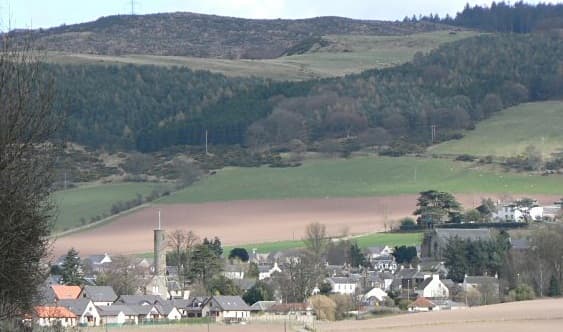
Abernethy, Perth and Kinross
Abernethy, Perth and Kinross, is a historic village in Scotland that was a significant religious and political center for the Picts. Its most prominent surviving medieval structure is the Abernethy Round Tower, one of only two such Irish-style towers remaining in Scotland, which likely served a monastic purpose. The village's strategic location near the confluence of the Rivers Earn and Tay and its historical importance are key to understanding its development.