
Abercorn
Christian·Scotland
Abercorn is a village and civil parish in West Lothian, Scotland, historically significant for its 7th-century monastery which served as the seat of Bishop Trumwine, the sole bishop of the Northumbrian see of the Picts. While the monastery is long gone, the parish church partially dates from the 12th century and contains notable private aisles and mausoleums. Abercorn also held a short-lived bishopric in the 7th century and was the site of a castle from the 12th century.
Key Facts
- ›Site of the 7th-century monastery and bishopric of Abercorn, seat of Bishop Trumwine.
- ›The current parish church has elements dating from the 12th century.
- ›Notable private aisles were built for the Dalyell, Hamilton, and Hope families.
- ›The Hope mausoleum was designed by architect William Burn.
- ›Older burial monuments include Norse 'hogback' grave markers and 7th-century Northumbrian cross fragments.
- ›Abercorn Castle existed from the 12th century but is now an earth mound after being sacked in 1455.

Scottish Baronial Style
7th-Century Monastery Site, 12th-Century Church Elements, Private Family Aisles, Hope Mausoleum, Norse 'Hogback' Grave Markers, 7th-Century Northumbrian Cross Fragments, Site of Abercorn Castle
7th Century, 12th Century
William Bruce, William Burn
About Abercorn
Abercorn, historically known in Old English as Æbbercurnig, is a village and civil parish located in West Lothian, Scotland, near the south coast of the Firth of Forth. Its historical importance is primarily rooted in its ecclesiastical past, particularly as the site of a significant 7th-century monastery.
Ecclesiastical History
The monastery at Abercorn is mentioned by the English monk and historian Bede as the seat of Bishop Trumwine. Trumwine was appointed "Bishop of the Picts" in 681 by Theodore of Tarsus, Archbishop of Canterbury, making Abercorn a residential bishopric for a brief period. This was part of a broader reorganization of the Northumbrian church. However, following the defeat and death of King Ecgfrith of Northumbria at the Battle of Dun Nechtain approximately four years later, Trumwine was forced to flee his Pictish bishopric, and the diocese ceased to be a residential one. Today, the Catholic Church lists Abercorn as a titular see.
Architecture and Remains
The present-day parish church in Abercorn has elements dating back to the 12th century. A notable architectural feature of the church is the inclusion of private aisles built for the three major families of the area: the Dalyells, the Hamiltons, and later the Hopes. The Hope mausoleum, a significant addition, was designed by architect William Burn. The churchyard contains older burial monuments, including rare Norse "hogback" grave markers and fragments of 7th-century Northumbrian crosses. A small museum adjacent to the churchyard displays prominent examples of medieval gravestones.
Castle and Secular History
Abercorn was also the site of a castle from the 12th century, which passed through several prominent families including the Avenels, Grahams, Mures, and finally the Clan Douglas. This castle was besieged and sacked in 1455 by King James II during his campaign against the "Black Douglases." After passing to the Seton family, the castle fell into disrepair and is now only marked by an earth mound, with its site having been excavated by archaeologists in 1963. The lands of Abercorn were granted to Claud Hamilton in the 16th century, and his descendants played a role in Ulster affairs. The estate was later sold to the Hope family, who became Earls of Hopetoun and constructed Hopetoun House nearby. The Factor's house, an L-shaped building in the Scottish baronial style, was built around 1855.
Source: Wikipedia ↗
Frequently Asked Questions
What is the historical significance of Abercorn?
Abercorn was a significant ecclesiastical site in the 7th century, serving as the location of a monastery and the seat of Bishop Trumwine, the only bishop of the Northumbrian see of the Picts. It was also the location of a short-lived bishopric.
What remains of the original monastery or castle?
The 7th-century monastery is no longer extant, though its location is known to be near the present-day church. Abercorn Castle, which existed from the 12th century, was sacked in the 1455 and is now marked only by an earth mound.
What can be seen at the present-day church?
The parish church has parts dating from the 12th century. It features private aisles built for prominent local families, the Hope mausoleum designed by William Burn, and older burial monuments such as Norse 'hogback' grave markers.
Is Abercorn an active religious site?
The parish church is still in use. Historically, Abercorn served as a bishopric, and it is currently listed by the Catholic Church as a titular see.
What notable people are buried in Abercorn?
Notable burials in Abercorn include Very Rev Hugh Meiklejohn, the poet Ian Hamilton Finlay, and Sir Robert Dalyell, 8th Baronet.
Related Cathedrals

Aberdeen Cathedral
St Andrew's Cathedral is a prominent cathedral of the Scottish Episcopal Church located in Aberdeen, Scotland. It serves as the seat for the Bishop of Aberdeen and Orkney and is recognized as a Category A listed building. The cathedral holds historical significance as a center for Episcopalian worship in Scotland, particularly following periods of legal restriction.
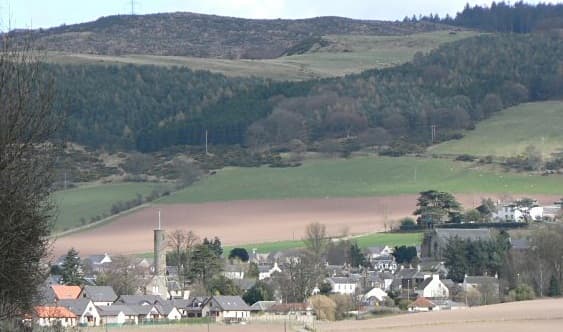
Abernethy, Perth and Kinross
Abernethy, Perth and Kinross, is a historic village in Scotland that was a significant religious and political center for the Picts. Its most prominent surviving medieval structure is the Abernethy Round Tower, one of only two such Irish-style towers remaining in Scotland, which likely served a monastic purpose. The village's strategic location near the confluence of the Rivers Earn and Tay and its historical importance are key to understanding its development.

Ayr Cathedral
Ayr Cathedral, officially the Cathedral Church of Saint Margaret, is the Roman Catholic cathedral for the Diocese of Galloway in Scotland. It became a cathedral in 2007, succeeding the Good Shepherd Cathedral, and is notable for its significant renovations in the late 1990s and early 2000s, which modernized its interior while incorporating symbolic stained-glass windows.