
Aberdeen Cathedral
Aberdeen and Orkney·Scottish Episcopal Church·Scotland
St Andrew's Cathedral is a prominent cathedral of the Scottish Episcopal Church located in Aberdeen, Scotland. It serves as the seat for the Bishop of Aberdeen and Orkney and is recognized as a Category A listed building. The cathedral holds historical significance as a center for Episcopalian worship in Scotland, particularly following periods of legal restriction.
Key Facts
- ›The congregation's earliest records date back to 1716, with worship spaces evolving from private chapels to dedicated buildings.
- ›The present church building opened in 1817, designed by Archibald Simpson in the Perpendicular Gothic style.
- ›Significant additions include the chancel by George Edmund Street (1880) and the porch by Robert Lorimer (1911).
- ›Ninian Comper embellished the interior in the 1930s, adding a vaulted ceiling with decorative panels and a gold-painted baldachino.
- ›The cathedral was temporarily closed due to structural issues and financial difficulties in 2020, reopening in December 2021.
- ›It is the cathedral for the Diocese of Aberdeen and Orkney within the Scottish Episcopal Church.

Perpendicular Gothic
- Facade of Sandstone Ashlar
- Rear of Snecked Granite Rubble
- Vaulted Ceiling With Decorative Panels Depicting Us State and Local Family Arms
- Gold-Painted Baldachino In the Chancel
- Carved Oak Screen In the Chancel
19th Century, 20th Century
Archibald Simpson, George Edmund Street, Robert Lorimer, Ninian Comper
About Aberdeen Cathedral
St Andrew's Cathedral, Aberdeen
St Andrew's Cathedral, also known as the Cathedral Church of Saint Andrew, is the principal cathedral of the Scottish Episcopal Church in the city of Aberdeen, Scotland. It serves as the ecclesiastical seat for the Bishop of Aberdeen and Orkney, who oversees the Diocese of Aberdeen and Orkney. The cathedral is recognized for its architectural significance and its role in the history of Episcopalianism in Scotland.
History and Development
The congregation that worships at St Andrew's Cathedral has its earliest documented origins in 1716. For many years, Episcopalians in Scotland faced legal restrictions, including limitations on building new churches and the requirement to surrender existing ones, particularly after the deposition of James VII. Worship initially took place in private chapels, with Bishop John Skinner's house in Long Acre featuring a chapel room from 1776. Following the repeal of restrictive laws in 1792, Saint Andrew's Chapel was constructed next to Skinner's house, serving the congregation for a quarter of a century.
The present church building was opened in 1817, designed by the prominent Scottish architect Archibald Simpson. Simpson's design incorporated the local granite for which Aberdeen is famous, though the facade facing King Street was constructed from sandstone for economic reasons, against Simpson's wishes. The original structure comprised a nave and flanking aisles. Over time, the cathedral underwent further architectural development. The chancel was added by George Edmund Street in 1880, and a porch was designed by Robert Lorimer in 1911. In the 1930s, the cathedral was renovated and embellished by Ninian Comper, who created a decorative scheme that includes a vaulted ceiling adorned with panels depicting the coats of arms of the then 48 US states and various local families. The chancel features a striking gold-painted baldachino and a carved oak screen. An extension to the building was opened in 1938 by Joseph Kennedy, the US ambassador, accompanied by his son John F. Kennedy.
Status and Worship
St Andrew's Cathedral was elevated to cathedral status in 1914. It is a Category A listed building, signifying its importance in Scotland's architectural heritage. The cathedral has experienced periods of closure; it was temporarily shut in September 2020 due to structural issues and financial concerns, but reopened for worship on December 5, 2021. Regular services are held on Sundays and Thursdays.
Historically, the cathedral was known for its Anglo-Catholic tradition until the late 1970s and early 1980s. Following a declaration by the then provost, Donald Howard, in 1982, worship practices evolved towards a more 'broad' churchmanship, while still maintaining the dignity appropriate for a cathedral.
Notable Connections
An important historical event linked to the site is the consecration of Samuel Seabury as the first bishop of the Episcopal Church in the United States of America. This consecration took place in an upper room of John Skinner's house around 500 meters from the current cathedral site, in 1784. The approximate location of this house is now marked by a granite tablet on the wall of Marischal College. This event was commemorated by renovations and embellishments to the cathedral in the 1930s.
Source: Wikipedia ↗
Frequently Asked Questions
When was St Andrew's Cathedral built?
The present church building opened in 1817. However, its origins as a congregation can be traced back to 1716, with earlier meeting places evolving into dedicated chapels before the current structure was erected.
Who designed St Andrew's Cathedral?
The original building was designed by Archibald Simpson in the Perpendicular Gothic style. Later additions and embellishments were made by George Edmund Street, Robert Lorimer, and Ninian Comper.
What is the architectural style of St Andrew's Cathedral?
The cathedral is primarily designed in the Perpendicular Gothic style. The facade facing King Street features sandstone ashlar, while the rear is constructed from snecked granite rubble, reflecting Aberdeen's local stone.
Has St Andrew's Cathedral always been a cathedral?
No, the present church building, which opened in 1817, was raised to cathedral status in 1914. It has been the see of the Bishop of Aberdeen and Orkney since then.
Why was St Andrew's Cathedral temporarily closed?
The cathedral was temporarily closed from September 2020 due to problems with the fabric of the building and financial difficulties. It reopened for worship on December 5, 2021.
Related Cathedrals

Abercorn
Abercorn is a village and civil parish in West Lothian, Scotland, historically significant for its 7th-century monastery which served as the seat of Bishop Trumwine, the sole bishop of the Northumbrian see of the Picts. While the monastery is long gone, the parish church partially dates from the 12th century and contains notable private aisles and mausoleums. Abercorn also held a short-lived bishopric in the 7th century and was the site of a castle from the 12th century.
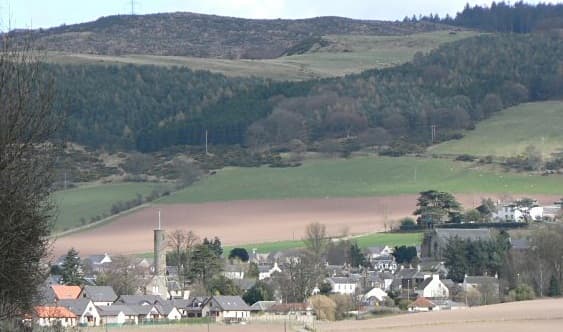
Abernethy, Perth and Kinross
Abernethy, Perth and Kinross, is a historic village in Scotland that was a significant religious and political center for the Picts. Its most prominent surviving medieval structure is the Abernethy Round Tower, one of only two such Irish-style towers remaining in Scotland, which likely served a monastic purpose. The village's strategic location near the confluence of the Rivers Earn and Tay and its historical importance are key to understanding its development.

Ayr Cathedral
Ayr Cathedral, officially the Cathedral Church of Saint Margaret, is the Roman Catholic cathedral for the Diocese of Galloway in Scotland. It became a cathedral in 2007, succeeding the Good Shepherd Cathedral, and is notable for its significant renovations in the late 1990s and early 2000s, which modernized its interior while incorporating symbolic stained-glass windows.