
Albenga Cathedral
Albenga-Imperia·Roman Catholic·Italy
Albenga Cathedral, officially the Cathedral of Saint Michael the Archangel, is a Roman Catholic cathedral in Albenga, Italy, serving as the seat of the Diocese of Albenga-Imperia. Occupying a site with a church since the late 4th or early 5th century, its present medieval structure dates primarily from around 1100, with significant rebuilding in the late 12th century and later modifications, notably in 1582. A restoration in the 1970s aimed to restore its medieval appearance, and the bell tower was substantially rebuilt in the late 14th century.
Key Facts
- ›A church has been on the site since the turn of the 4th to 5th century.
- ›The present structure is medieval, dating primarily from around 1100.
- ›Major rebuilding occurred in the second half of the 12th century and again in 1582.
- ›The bell tower was rebuilt in its current form in the 1390s.
- ›It preserves the relics of Saint Veranus, who played a role in Albenga's Christianization.
- ›The interior features 15th-century apse frescos and 19th-century ceiling frescos by Maurizio and Tommaso Carrega.

- Relics of Saint Veranus
- 15th-Century Apse Frescos
- 19th-Century Ceiling Frescos By Maurizio and Tommaso Carrega
- Medieval Bell Tower Rebuilt In the 1390s
Antonio De Francia, Serafino Mignano, Antonio Campeggi, Tomaso Caressia, Oberto Caressia, Giacomo Di Como, Antonio Da Gaeta
About Albenga Cathedral
Albenga Cathedral, formally known as the Cathedral of Saint Michael the Archangel (Cattedrale di San Michele Arcangelo) and also referred to as the Duomo di Albenga, stands as a significant religious edifice in the city of Albenga, located in the province of Savona, within the Liguria region of Italy. It serves as the episcopal see for the Roman Catholic Diocese of Albenga-Imperia. The site has hosted a place of worship since the turn of the 4th to 5th century, with the present structure being a product of medieval construction and subsequent alterations.
History and Construction
The earliest known church on the site dates back to the period between the 4th and 5th centuries, coinciding with the reconstruction of the Roman city. The current medieval structure was built around 1100, originating from a proto-Romanesque phase. It underwent substantial rebuilding in the second half of the 12th century, which largely restored it to a basilica plan with three naves. Further significant modifications occurred in 1582, prompted by the Counter-Reformation, which involved raising the floor, encasing columns, and replacing the wooden roof with vaulted structures. A major restoration project in the 1970s was undertaken to largely return the building to its medieval architectural character.
The bell tower, an integral part of the cathedral complex, was rebuilt in its present form in the 1390s after earlier structures had deteriorated. This extensive reconstruction was funded by the city and involved numerous local and regional craftsmen. The choir also saw significant rebuilding work starting in 1399.
Significance and Features
Albenga Cathedral is notable for preserving the relics of Saint Veranus (San Verano), a figure credited with playing a crucial role in the Christianization of Albenga during the 6th century. The interior of the cathedral is enriched with various artworks, including 15th-century frescos, particularly in the apse, and 19th-century ceiling frescos by Maurizio and Tommaso Carrega. Other notable artworks include a fresco by Il Pancalino and paintings by artists such as Luca Baudo and Giovanni Lanfranco, although some are not publicly displayed for security reasons. The dedication to Saint Michael the Archangel is believed to date back to the cathedral's initial construction, possibly influenced by its commercial ties with the Byzantine Empire.
Source: Wikipedia ↗
Frequently Asked Questions
What is the history of Albenga Cathedral?
A church has existed on the site since the late 4th or early 5th century. The current medieval structure was built around 1100, with significant rebuilding in the late 12th century and again in 1582. A restoration project in the 1970s aimed to return the building to its medieval form.
What is Albenga Cathedral dedicated to?
Albenga Cathedral is dedicated to Saint Michael the Archangel. Tradition holds that the saint was invoked to defeat a snake that was terrorizing the local population.
What architectural styles can be seen in Albenga Cathedral?
While its origins are early Christian and it underwent medieval rebuilding, the structure exhibits Romanesque and Gothic influences. The 1582 modifications introduced elements in line with the Counter-Reformation.
Are there any notable artworks or relics in Albenga Cathedral?
Yes, the cathedral preserves the relics of Saint Veranus. It also houses 15th-century frescos in the apse, 19th-century ceiling frescos by Maurizio and Tommaso Carrega, and various other paintings and sculptures.
When was the bell tower of Albenga Cathedral built?
The bell tower was significantly rebuilt in its present form in the 1390s. Prior to this, a bell tower existed, with its lower part incorporated into the church during Romanesque-Gothic renovations.
Related Cathedrals
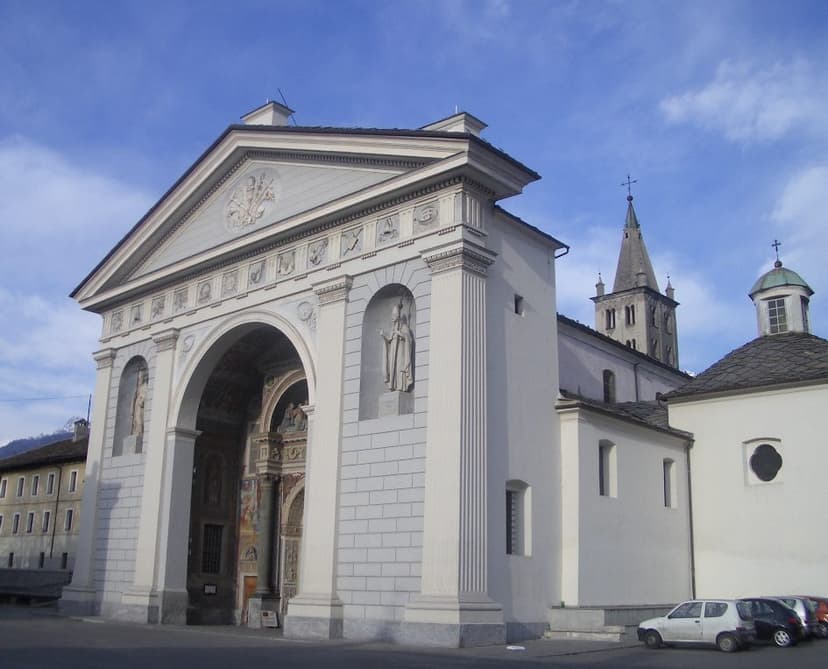
Aosta Cathedral
Aosta Cathedral, also known as the Cathedral of Santa Maria Assunta and San Giovanni Battista, is a Roman Catholic cathedral in Aosta, Italy, with origins dating back to the 4th century. It serves as the episcopal seat for the Diocese of Aosta and has undergone significant architectural modifications throughout its history, reflecting various styles from its Romanesque foundations to its Neoclassical facade.
Aquileia Cathedral
The Basilica di Santa Maria Assunta in Aquileia is the principal church of the town, with its origins dating back to the fourth century. The current basilica was constructed in the eleventh century and subsequently rebuilt in the thirteenth century, showcasing a Romanesque-Gothic architectural style. It is renowned for its significant 4th-century mosaic pavement and early Christian frescoes.
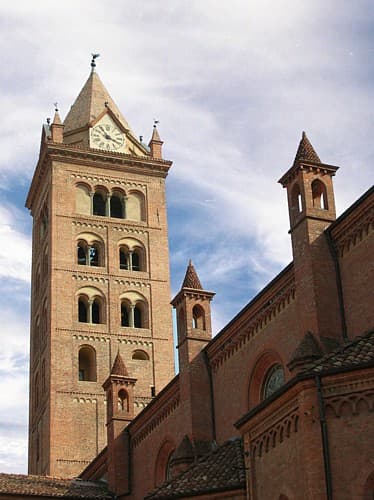
Alba Cathedral
Alba Cathedral, officially the Cattedrale di San Lorenzo, is a Roman Catholic cathedral in Alba, Italy, dedicated to Saint Lawrence and serving as the episcopal seat of the Diocese of Alba. Its current Romanesque structure, largely dating from the 12th century, has undergone significant remodelling throughout its history, most notably in the late Gothic period and extensive renovations in the 19th century.