
Alba Cathedral
Diocese of Alba·Roman Catholic·Italy
Alba Cathedral, officially the Cattedrale di San Lorenzo, is a Roman Catholic cathedral in Alba, Italy, dedicated to Saint Lawrence and serving as the episcopal seat of the Diocese of Alba. Its current Romanesque structure, largely dating from the 12th century, has undergone significant remodelling throughout its history, most notably in the late Gothic period and extensive renovations in the 19th century.
Key Facts
- ›The earliest structure on the site dates to the late 5th century, with a subsequent Romanesque building erected on its ruins.
- ›The current cathedral's core structure was built in the first half of the 12th century.
- ›Between the 12th and 15th centuries, the cathedral was reshaped in the late Gothic architectural style.
- ›Major renovations in 1652 followed earthquake damage, including the reconstruction of the nave's ceiling and the addition of side aisles.
- ›The last significant restoration occurred between 1867 and 1878, modifying both the exterior and interior Décor.
- ›The cathedral is renowned for its 1512 wood-carved chorus stalls by Bernardino Fossati.
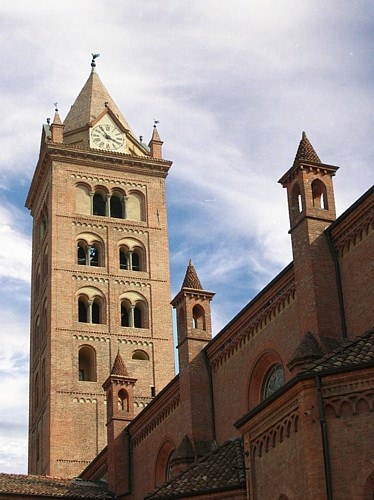
- Wood-Carved Chorus Stalls By Bernardino Fossati
- 12th-Century Belfry
- Crypt
- Three Portals From the Original Edifice
- Ancient Baptismal Font
Edoardo Arborio Mella, Bernardino Fossati, Ugo Della Piana
About Alba Cathedral
Alba Cathedral, officially known as the Cattedrale di San Lorenzo, is the principal Roman Catholic church in Alba, a city in the province of Cuneo, Piedmont, Italy. It serves as the episcopal seat for the Diocese of Alba. The cathedral stands in the Piazza del Risorgimento, commonly called Piazza Duomo, amidst the city's cobbled streets.
History and Architecture
The history of Alba Cathedral spans over a millennium, with the earliest structure on the site dating back to the late 5th century. A subsequent Romanesque building was constructed on these ancient foundations. The current edifice, largely of red brick, was initiated in the first half of the 12th century, likely incorporating elements from Roman-era sacred sites. Between the 12th and 15th centuries, the cathedral underwent transformations reflecting late Gothic architectural trends.
A significant period of rebuilding and restoration occurred in the 15th century under Bishop Andrea Novelli, who found the cathedral in disrepair. More extensive repairs were undertaken in 1652 to address damage caused by earthquakes in 1626, which had led to the collapse of the nave's ceiling. This reconstruction included the addition of two side aisles and was followed by the last major restoration between 1867 and 1878, overseen by engineer Edoardo Arborio Mella. This comprehensive work modified the exterior and interior décor, including roofing, aisle vaults, the apse, façade rehabilitation, and the addition of side windows.
Notable Features
Alba Cathedral is particularly celebrated for its 16th-century wood-carved chorus stalls, created by Bernardino Fossati in 1512. These masterfully crafted stalls feature thirty-five seats arranged in two semicircular rows, including an Episcopal stall. The design incorporates Renaissance marquetry and inlaid wood scenes that depict varied views of Alba's development, often with invented architectural features. The belfry, dating from the 12th century, is notable for its original tower and buttresses. Recent archaeological excavations have uncovered an ancient baptismal font and numerous children's graves from the 16th to 18th centuries, reflecting historical burial practices within the cathedral precincts.
Source: Wikipedia ↗
Frequently Asked Questions
When was Alba Cathedral first built?
The earliest structure on the site of Alba Cathedral appears to have been built at the end of the 5th century. A subsequent Romanesque structure was built on its ruins, with the current building dating to the first half of the 12th century.
What are the main architectural styles of Alba Cathedral?
Alba Cathedral exhibits Romanesque architecture from its 12th-century construction. It was later reshaped in the late Gothic architectural style between the 12th and 15th centuries. More recent modifications in the 19th century also influenced its appearance.
What are the notable features of Alba Cathedral?
The cathedral is well known for its intricately carved wood chorus stalls from 1512, created by Bernardino Fossati. These stalls feature semicircular rows of seating with elaborate Renaissance marquetry and inlaid wood scenes depicting the city of Alba.
Has Alba Cathedral undergone significant renovations?
Yes, Alba Cathedral has undergone several major renovations. Significant work was done in 1652 after earthquake damage, and a substantial restoration between 1867 and 1878 by Edoardo Arborio Mella reshaped much of its current appearance.
What was found during recent archaeological excavations at Alba Cathedral?
During restoration work in 2007, an ancient baptismal font was discovered. Approximately 100 graves, primarily of children dating from the 16th to 18th centuries, were also found, consistent with the historical practice of reusing ancient baptistery spaces for burials.
Related Cathedrals

Albenga Cathedral
Albenga Cathedral, officially the Cathedral of Saint Michael the Archangel, is a Roman Catholic cathedral in Albenga, Italy, serving as the seat of the Diocese of Albenga-Imperia. Occupying a site with a church since the late 4th or early 5th century, its present medieval structure dates primarily from around 1100, with significant rebuilding in the late 12th century and later modifications, notably in 1582. A restoration in the 1970s aimed to restore its medieval appearance, and the bell tower was substantially rebuilt in the late 14th century.

Asti Cathedral
Asti Cathedral, officially the Cathedral of Santa Maria Assunta and San Gottardo, is the principal church of the Diocese of Asti in Piedmont, Italy. It is a significant example of Gothic architecture in the region and a notable instance of Lombard Romanesque style in northern Italy, boasting considerable length and impressive dimensions.

Ardagh
Ardagh is a historic village in County Longford, Ireland, with origins tracing back to pre-Christian worship and a significant Christian settlement established by Saint Patrick. Its development was heavily influenced by the Featherston family in the 18th and 19th centuries, leading to a village layout designed by J. Rawson Carroll, reputedly inspired by a Swiss village aesthetic. The area retains important Early Christian sites, most notably the ruined Cathedral of St. Mel, which has a history marked by destruction and rebuilding.