
Aquileia Cathedral
The Basilica di Santa Maria Assunta in Aquileia is the principal church of the town, with its origins dating back to the fourth century. The current basilica was constructed in the eleventh century and subsequently rebuilt in the thirteenth century, showcasing a Romanesque-Gothic architectural style. It is renowned for its significant 4th-century mosaic pavement and early Christian frescoes.
Key Facts
- ›The original church was founded in the 4th century.
- ›The current basilica was built in the 11th century and partially rebuilt in the 13th century.
- ›Features a notable mosaic pavement from the 4th century.
- ›Contains fresco decorations from the 4th, 11th, and 12th centuries.
- ›The facade is in a Romanesque-Gothic style.
- ›The Cemetery of the Fallen, containing ten unnamed soldiers of World War I, is located behind the apse.
Romanesque-Gothic
4th-Century Mosaic Pavement, 12th-Century 'Crypt of the Frescoes', Cemetery of the Fallen, Burial Site of Saint Hermagoras, Burial Site of Maria Bergamas
About Aquileia Cathedral
The Basilica di Santa Maria Assunta, also known as the Patriarchal Basilica of Saint Mary of the Assumption, stands as the principal church in the town of Aquileia, located in the Province of Udine, Italy. Its historical significance is rooted in its origins, with the first church on the site dating back to the fourth century. The current basilica, however, was primarily constructed in the eleventh century and subsequently underwent partial rebuilding in the thirteenth century, reflecting evolving architectural styles and needs.
Architecture and Art
The basilica's facade presents a notable example of Romanesque-Gothic style. It is connected by a portico to adjoining structures, including the remains of a 5th-century baptistery. The interior is characterized by a nave and two aisles, but its most celebrated feature is the remarkable mosaic pavement originating from the 4th century. Further artistic treasures include a wooden ceiling from 1526 and fresco decorations spanning various eras. These frescoes are found from the 4th century in the St. Peter's chapel, from the 11th century within the apse itself, and from the 12th century in the "Crypt of the Frescoes" located beneath the presbytery. The latter contains a significant cycle depicting the origins of Christianity in Aquileia and the history of Saint Hermagoras, recognized as the city's first bishop.
Historical Context and Surroundings
Adjacent to the 11th-century Romanesque chapel of the Holy Sepulchre, the left aisle showcases flooring from different historical periods. The lowest layer is from a Roman villa dating to the age of Augustus, followed by a typical cocciopesto pavement, and finally an upper layer bearing signs of damage from Attila's fire, adorned with geometrical decorations. Externally, behind the 9th-century campanile and the apse, lies the Cemetery of the Fallen. This solemn site serves as the resting place for ten unnamed soldiers of World War I. Maria Bergamas, a figure associated with the selection of Italy's Unknown Soldier and who lost her son in World War I, is also buried here. Saint Hermagoras, the first bishop, is likewise interred within the complex, underscoring the site's deep religious and historical connections.
Source: Wikipedia ↗
Frequently Asked Questions
What is the history of Aquileia Cathedral?
The original church in Aquileia dates back to the fourth century. The current basilica was constructed in the eleventh century and then partially rebuilt again in the thirteenth century, with various decorative elements added over centuries.
What are the main architectural styles of Aquileia Cathedral?
The facade of the cathedral exhibits a Romanesque-Gothic style. The interior features a nave and two aisles, and significant elements like the wooden ceiling date from the early 16th century.
What are the notable artistic features within the cathedral?
The cathedral is distinguished by its remarkable mosaic pavement from the 4th century. It also houses fresco decorations from various periods, including the 4th century in the St. Peter's chapel and the 11th century in the apse.
Are there any historical figures or events associated with Aquileia Cathedral's burial sites?
Saint Hermagoras, the first bishop of Aquileia, is buried within the cathedral complex. Additionally, the Cemetery of the Fallen behind the apse holds ten unnamed soldiers from World War I, and Maria Bergamas, who selected the Unknown Soldier for Italy, is also interred there.
What is the significance of the mosaic pavement?
The mosaic pavement is a significant artistic and historical feature dating back to the 4th century. It provides insight into early Christian art and the history of Aquileia during that period.
Related Cathedrals

Albenga Cathedral
Albenga Cathedral, officially the Cathedral of Saint Michael the Archangel, is a Roman Catholic cathedral in Albenga, Italy, serving as the seat of the Diocese of Albenga-Imperia. Occupying a site with a church since the late 4th or early 5th century, its present medieval structure dates primarily from around 1100, with significant rebuilding in the late 12th century and later modifications, notably in 1582. A restoration in the 1970s aimed to restore its medieval appearance, and the bell tower was substantially rebuilt in the late 14th century.
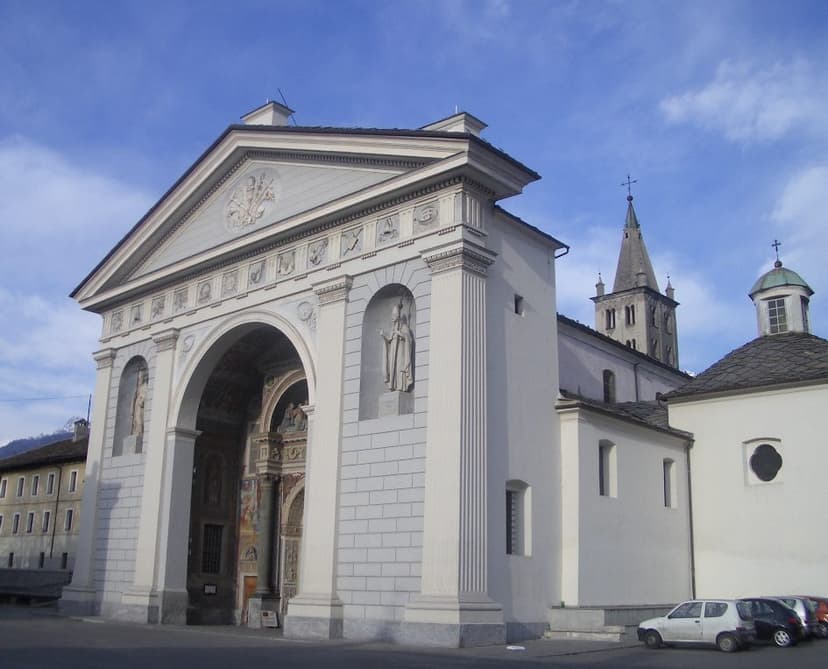
Aosta Cathedral
Aosta Cathedral, also known as the Cathedral of Santa Maria Assunta and San Giovanni Battista, is a Roman Catholic cathedral in Aosta, Italy, with origins dating back to the 4th century. It serves as the episcopal seat for the Diocese of Aosta and has undergone significant architectural modifications throughout its history, reflecting various styles from its Romanesque foundations to its Neoclassical facade.

Ardagh
Ardagh is a historic village in County Longford, Ireland, with origins tracing back to pre-Christian worship and a significant Christian settlement established by Saint Patrick. Its development was heavily influenced by the Featherston family in the 18th and 19th centuries, leading to a village layout designed by J. Rawson Carroll, reputedly inspired by a Swiss village aesthetic. The area retains important Early Christian sites, most notably the ruined Cathedral of St. Mel, which has a history marked by destruction and rebuilding.