
Saichō
Japan·Tendai·Male·8th century
Saichō was a Japanese Buddhist monk and the founder of the Japanese Tendai school, a significant tradition that integrated Chinese Tiantai teachings with Esoteric Buddhism. He is credited with establishing the Tendai headquarters at Enryaku-ji on Mount Hiei, which became a major center for Buddhist practice in Japan. Saichō's work laid the foundation for later Japanese Buddhist movements, including Pure Land and Zen.
Key Facts
- ›Founded the Japanese Tendai school of Buddhism.
- ›Introduced the Chinese Tiantai school and adapted it to the Tendai tradition in Japan.
- ›Established the Tendai headquarters at Enryaku-ji on Mount Hiei near Kyoto.
- ›Integrated Tiantai teachings with practices from Chinese Esoteric Buddhism.
- ›Championed a new ordination system based on Bodhisattva precepts.
- ›His teachings influenced the development of later Japanese Buddhist traditions like Pure Land and Zen.

Important Relationships
- Gyōhyō
- Emperor Kanmu
- Kūkai
- Wake no Hiroyo
- Gishin
- Daosui
Ganmon, Ehyō Tendaishū, Kenkairon
Mount Hiei, Enryaku-Ji, ōMi, Nara, Kyoto, Tiantai Mountain, Ningbo, Yuezhou
Chinese Tiantai School, Chinese Esoteric Buddhism, Dao-Xuan, Zhiyi
Classical Chinese, Classical Japanese
Bodhisattva Precepts, Monastic Precepts
Founder of A School
About Saichō
Saichō (767–822), posthumously known as Dengyō Daishi, was a pivotal figure in the history of Japanese Buddhism, celebrated for founding the Japanese Tendai school. He was instrumental in introducing and adapting the Chinese Tiantai tradition to Japan, establishing its principal center at Enryaku-ji on Mount Hiei, which became a major hub for Buddhist study and practice.
Life and Historical Context
Born Hirono in Ōmi (present-day Shiga Prefecture), Saichō became a novice monk at age 14, receiving the ordination name Saichō. His early education was influenced by Gyōhyō, a disciple of the Chinese Tiantai monk Dao-xuan. By age 20, Saichō was fully ordained in the official provincial temple system but soon retreated to Mount Hiei for intensive study. His retreat and subsequent development of a monastic community on the mountain brought him to the attention of the imperial court, especially as Mount Hiei's location northeast of the new capital, Kyoto, was considered protective.
In 804, Saichō journeyed to Tang China, where he studied the Chinese Tiantai school under Daosui and also received initiations in Esoteric Buddhism. He returned to Japan in 805 with numerous Buddhist texts, eager to propagate his teachings. His efforts led to the official recognition of his Tendai school by Emperor Kanmu in 806, allowing for annual ordinands on Mount Hiei.
Major Contributions
Saichō's most significant contribution was the establishment of the Japanese Tendai school, characterized by its syncretic approach. He integrated the exoteric teachings of Tiantai, particularly the emphasis on the Lotus Sutra and meditation (shikan), with the esoteric practices (mikkyō) of Chinese Esoteric Buddhism. This synthesis, termed "enmitsuzenkai" (union of the Perfect, Esoteric, Meditation, and Precepts), provided a comprehensive path to enlightenment, aiming for Buddhahood in this very life.
He also championed a new ordination system based on the Mahayana Bodhisattva precepts, seeking to establish a distinct Mahayana ordination platform separate from the older Vinaya traditions. This reform faced considerable opposition from established Buddhist schools in Nara but was eventually granted by Emperor Saga in 822, shortly after Saichō's death.
Important Relationships
Saichō developed a close relationship with fellow monk Kūkai, the future founder of the Shingon school. They traveled together to China, shared an interest in esoteric Buddhism, and collaborated to introduce these practices to Japan. Saichō also supported Kūkai's establishment of the Shingon center at Takaosan-ji.
Legacy
Saichō's Tendai school laid a crucial foundation for the development of subsequent Japanese Buddhist traditions, including Pure Land and Zen Buddhism. His emphasis on the universality of Buddhist teachings and the integration of diverse practices profoundly shaped the landscape of Japanese religious thought and practice, leaving an indelible mark on its history. The "Inextinguishable Dharma Lamp" at Enryaku-ji, lit by Saichō, has remained lit for over 1200 years, symbolizing the enduring legacy of his tradition.
Source: Wikipedia ↗
Frequently Asked Questions
Who was Saichō?
Saichō (767–822) was a highly influential Japanese Buddhist monk. He is recognized as the founder of the Japanese Tendai school, a major lineage that blended various Buddhist traditions.
What is Saichō most famous for?
Saichō is most famous for introducing the Chinese Tiantai school to Japan and adapting it into the Tendai tradition. He also established the Tendai headquarters at Enryaku-ji on Mount Hiei, which became a central institution in Japanese Buddhism.
What did Saichō teach?
Saichō's teachings emphasized the integration of Tiantai doctrines on meditation, study, precepts, and ritual with the practices of Chinese Esoteric Buddhism. He also advocated for an ordination system based on Mahayana Bodhisattva precepts.
What was Saichō's relationship with Kūkai?
Saichō developed a friendship and intellectual collaboration with Kūkai, the founder of the Shingon school. Together, they worked to introduce esoteric Buddhism to Japan, and Saichō supported Kūkai's early endeavors.
When did Saichō live?
Saichō lived from 767 to 822 CE. He was born in Ōmi Province and died at the age of 56.
What is the significance of Mount Hiei in relation to Saichō?
Mount Hiei became the spiritual and institutional center of Saichō's Tendai school. He founded the monastery Enryaku-ji there, which grew into a major complex and a powerful force in Japanese Buddhism for centuries.
Related Buddhists

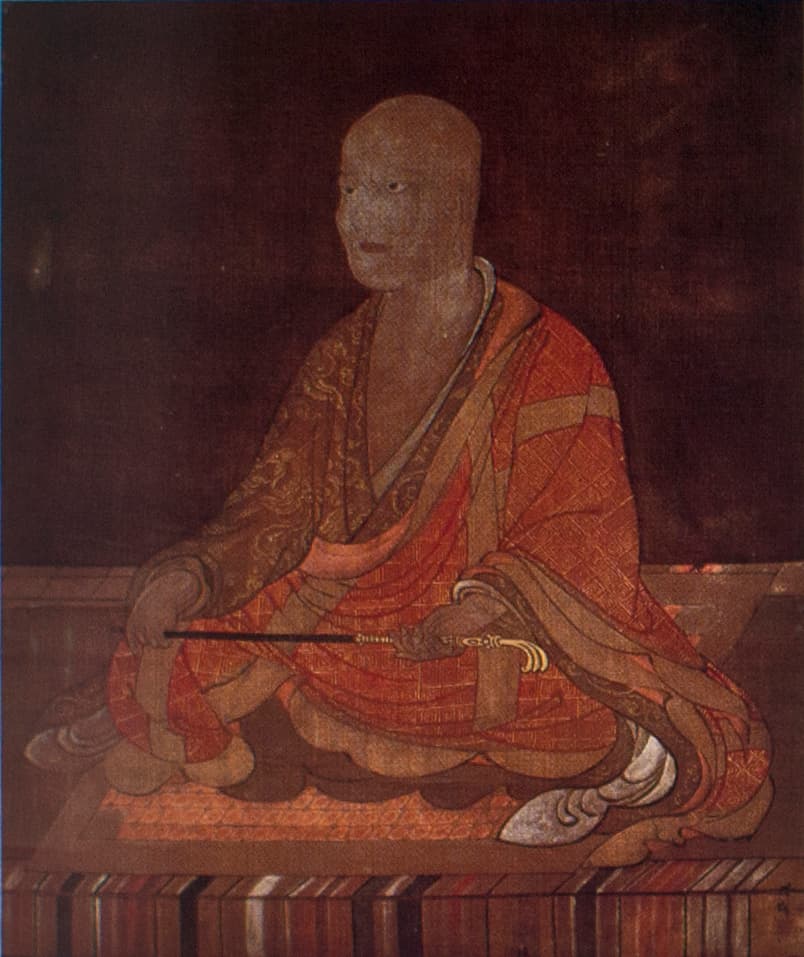
Kūkai
Kūkai was a pivotal Japanese Buddhist monk, calligrapher, and poet who founded the esoteric Shingon school of Buddhism. He traveled to Tang China, where he studied under Huiguo and became a master of Chinese Vajrayana Buddhism. Upon his return to Japan, Kūkai established Shingon, deeply influencing Japanese religious and cultural life, and is revered as a bodhisattva.
Rōben
Rōben (689–773) was a pivotal Japanese Buddhist monk of the Kegon sect and the clerical founder of the Tōdai-ji temple in Nara. He played a crucial role in establishing the Kegon school in Japan and overseeing the construction and consecration of the Great Buddha statue at Tōdai-ji. His life spanned a formative period for Buddhism in Japan, contributing significantly to its institutional and doctrinal development.
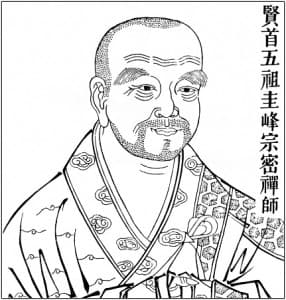
Guifeng Zongmi
Guifeng Zongmi was a highly influential Tang dynasty Chinese Buddhist monk, scholar, and patriarch of both the Huayan and Chan schools. He is renowned for his efforts to harmonize various Buddhist teachings, particularly Chan and Huayan, with Taoism and Confucianism, aiming to create a comprehensive spiritual vision. His extensive writings serve as a crucial resource for understanding the diverse Chan schools of his era.