
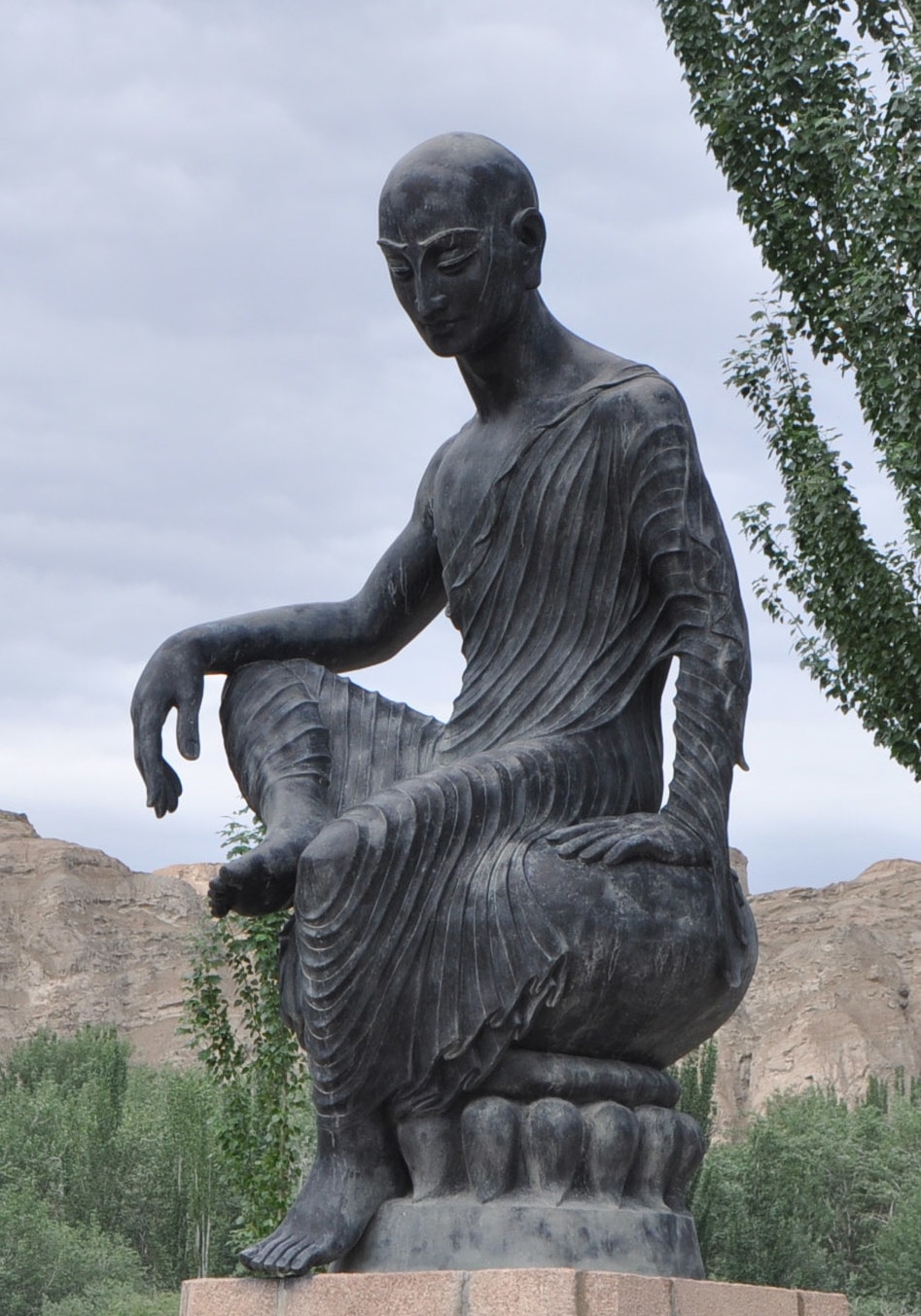
Kumārajīva
Kumārajīva was a pivotal 4th and 5th-century Buddhist monk, scholar, missionary, and translator from Kucha, known for his highly influential translations of Sanskrit Buddhist texts into Chinese. He is credited with introducing the Madhyamaka philosophy to China and his clear, meaning-focused translation style revolutionized Chinese Buddhism, with his renderings remaining in widespread use today.
Key Facts
- ›Born in the Kingdom of Kucha (present-day Xinjiang, China) in 344 CE.
- ›Studied various Buddhist schools before becoming an adherent of Mahayana Buddhism and the Mādhyamaka doctrine.
- ›Captured and imprisoned by a warlord for many years, during which he likely learned Chinese.
- ›Settled in Chang'an in 401 CE under the patronage of the later Qin dynasty, leading a translation team.
- ›His translations of Mahayana sutras and treatises, such as the Lotus Sutra and the Middle Treatise, are still revered today.
- ›Introduced the Madhyamaka school of Buddhist philosophy into China, which became known as Sanlun.
Important Relationships
- Yao Xing (Emperor of Later Qin)
- Sengrui (student and collaborator)
- Daosheng (student and collaborator)
- Sengzhao (student and collaborator)
- Daorong (student and collaborator)
- Vajracchedikā PrajñāPāRamitā SūTra Translation
- Saddharma PuṇḍArīKa SūTra Translation
- Vimalakirti Nirdesa Sutra Translation
- MadhyamakaśāStra Translation
- MahāPrajñāPāRamitopadeśA Translation
- Commentary On the VimalakīRti-Nirdesa-SūTra
- Shixiang Lun
Kucha, Chang'An
NāGāRjuna, BuddhasvāMin
Sanskrit, Chinese
Monastic Ordination
4th century, 5th century
About Kumārajīva
Kumārajīva (344–413 CE)
Kumārajīva was a highly influential Buddhist monk, scholar, missionary, and translator of the 4th and 5th centuries CE. Born in the Kingdom of Kucha (in present-day Xinjiang, China), he became renowned as one of the most significant figures in the translation of Buddhist scriptures into Chinese, profoundly shaping the development of literary Buddhist Chinese.
Life and Historical Context
Kumārajīva was born into a family deeply connected to Buddhism; his father was an Indian monk, and his mother was a Kuchean princess. He initially studied the teachings of the Sarvastivadin schools before converting to Mahayana Buddhism and delving into the Mādhyamaka philosophy of Nāgārjuna. His early life involved extensive study and skilled debate across North India, Kashmir, and Kucha.
His journey to China was fraught with challenges. After being captured by the warlord Lü Guang, Kumārajīva was held captive for many years, during which time he is thought to have become proficient in the Chinese language. He was eventually brought to the Later Qin capital of Chang'an in 401 CE, where he was given the title of "National Preceptor" by Emperor Yao Xing.
Major Contributions
In Chang'an, Kumārajīva led a large, court-sponsored translation team responsible for rendering numerous Sanskrit Buddhist texts into Chinese. His translation methodology prioritized clarity and conveying the intended meaning over strict literalism, a style that proved immensely popular and enduring. His renderings of seminal Mahayana sutras, such as the Lotus Sutra and the Diamond Sutra, and key philosophical treatises, like those expounding Mādhyamaka thought, are still widely used in Chinese Buddhism today.
Kumārajīva is credited with introducing the Madhyamaka school of Buddhist philosophy into China, which became known as the Sanlun, or "Three Treatise school." His work not only enriched the Chinese Buddhist canon but also corrected misunderstandings of core Buddhist concepts like emptiness and not-self, which had been influenced by Neo-Taoist philosophy.
Legacy
The translations associated with Kumārajīva have had an unparalleled success in the Sinitic Buddhist tradition. Even when later, more literal translations became available, Kumārajīva's versions remained the preferred choice in devotional, exegetical, and literary contexts across East Asia. His influence extended to the development of the Chinese language itself, through his innovative transcription system for rendering Sanskrit terms. In the modern era, his corpus of translations continues to be a foundational element in the global spread of Buddhist modernism.
Source: Wikipedia ↗
Frequently Asked Questions
When and where was Kumārajīva born?
Kumārajīva was born in 344 CE in the Kingdom of Kucha, which is located in present-day Aksu Prefecture, Xinjiang, China. His father was an Indian monk and his mother was a member of the Kuchean royal family.
What Buddhist traditions did Kumārajīva follow?
Kumārajīva initially studied teachings of the Sarvastivadin schools and later converted to Mahayana Buddhism, focusing on the Mādhyamaka doctrine of Nāgārjuna. He received full monastic ordination at the age of 20.
How did Kumārajīva end up in China?
Kumārajīva's fame reached China, prompting Emperor Fu Jian of the Former Qin Dynasty to arrange for his transport. However, after the emperor's defeat, his general Lü Guang conquered Kucha and captured Kumārajīva, imprisoning him for years before he was eventually brought to Chang'an in 401 CE by Emperor Yao Xing of the Later Qin.
What was Kumārajīva's primary role in China?
In Chang'an, Kumārajīva was appointed "National Preceptor" and led a court-sponsored translation team. He was responsible for translating numerous Sanskrit Buddhist texts into Chinese, significantly shaping the development of literary Buddhist Chinese.
What is Kumārajīva's most significant contribution to Buddhism?
Kumārajīva is considered one of the greatest translators of Chinese Buddhism. His translations, known for their clarity and fidelity to meaning, introduced key Mahayana texts and the Madhyamaka philosophy to China, and his work remains highly influential in East Asian Buddhism.
What philosophical school did Kumārajīva introduce to China?
Kumārajīva introduced the Madhyamaka school of Buddhist philosophy into China. This school would later be known as Sanlun, meaning the "Three Treatise school," due to the foundational texts translated by Kumārajīva and his team.
What are some of the key texts translated by Kumārajīva?
Among the most important sutras translated by Kumārajīva and his team are the Vajracchedikā Prajñāpāramitā Sūtra (Diamond Sutra), the Saddharma Puṇḍarīka Sūtra (Lotus Sutra), and the Vimalakirti Nirdesa Sutra. He also translated key treatises of the Madhyamaka school, such as Nāgārjuna's Mūlamadhyamakakārikā.
Related Buddhists
Sanghapala
Sanghapala (466–524 CE) was a prominent Khmer monk from Funan, known for his significant contributions to the translation of Buddhist scriptures into Chinese. He is recognized as one of the few Cambodian monks whose translated works are included in the Chinese Tripitaka, particularly his canonical rendering of the Vimuttimagga, or Path to Freedom.
Nakamura Hajime
Hajime Nakamura was a prominent Japanese Orientalist, Indologist, and philosopher renowned for his extensive academic work on Vedic, Hindu, and Buddhist scriptures. He is most celebrated in Japan for his complete translation of the Pali Tripitaka into Japanese, which remains a definitive work. Nakamura significantly influenced the study of Indic philosophy in Japan and across Asia through his meticulous scholarship and numerous publications.
Jñānagupta
Jñānagupta was a Buddhist monk from Gandhara who traveled to China during the Sui dynasty. He is credited with translating 39 scriptures into Chinese, totaling 192 fascicles, and is recognized for his contributions to the dissemination of Buddhist texts in East Asia.