
Huineng
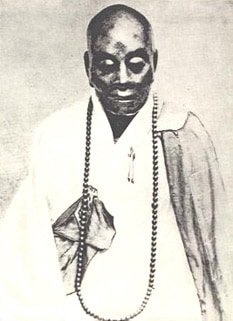
Huineng was a pivotal, though semi-legendary, figure in early Chinese Chan Buddhism, revered as the Sixth Patriarch. Despite his illiteracy and humble origins, tradition states he attained sudden enlightenment upon hearing the Diamond Sutra and was secretly chosen as the successor to the Fifth Patriarch, Daman Hongren. He is credited with founding the "Sudden Enlightenment" Southern Chan school, emphasizing immediate insight over gradual practice, and his teachings, recorded in the influential Platform Sutra, continue to shape East Asian Buddhist thought.
Key Facts
- ›Revered as the Sixth Patriarch or Sixth Ancestor of Chan Buddhism.
- ›Attributed founder of the "Sudden Enlightenment" Southern Chan school.
- ›His teachings are primarily recorded in the influential Platform Sutra.
- ›Traditionally, he was an uneducated layman who achieved sudden awakening.
- ›Scholarly consensus suggests his biography was largely constructed by his disciple Shenhui.
- ›Key teachings include "no-thought," "non-attribute," and "non-abiding."
Important Relationships
- Daman Hongren (Fifth Patriarch)
- Shenxiu
- Shenhui
Platform Sutra of the Sixth Patriarch
Nanhai, Huangmei District, Tayu Mountains
Classical Chinese
About Huineng
Dajian Huineng, commonly known as the Sixth Patriarch of Chan Buddhism, is a central figure in the early history of Chinese Chan, also known as Zen. While semi-legendary, tradition holds that Huineng, an uneducated layman, achieved sudden enlightenment upon hearing the Diamond Sutra. He is said to have been recognized by the Fifth Patriarch, Daman Hongren, as his successor, despite the public favor shown to another disciple. This succession is foundational to the "Sudden Enlightenment" Southern Chan school, which emphasizes immediate spiritual insight.
Biography and Sources
The primary sources for Huineng's life, such as the Platform Sutra and the Transmission of the Lamp, are viewed with skepticism by modern scholars. Many believe Huineng's extensive biography is a legendary narrative constructed to reflect religious developments a century after his death, with his significance likely amplified by his disciple Shenhui.
According to his autobiography within the Platform Sutra, Huineng's father was from Fanyang but was exiled, leaving Huineng and his mother in poverty. They moved to Nanhai, where Huineng sold firewood. His spiritual awakening began when he heard the Diamond Sutra being recited, prompting him to seek out the Fifth Patriarch in Huangmei.
The Poem Contest and Succession
Upon reaching the Fifth Patriarch, Daman Hongren, Huineng impressed him with his understanding of Buddha-nature, despite being deemed a "barbarian from the south." Assigned menial tasks, Huineng later demonstrated his profound insight in a poem contest intended to select Hongren's successor. While Shenxiu, a senior disciple, offered a poem reflecting a gradual approach to spiritual cultivation, Huineng, though illiterate, composed a verse that conveyed a more immediate realization of inherent Buddha-nature. The Platform Sutra describes Hongren secretly transmitting the Dharma, robe, and bowl to Huineng that night, designating him the Sixth Patriarch and urging him to escape to avoid persecution.
Teachings
The Platform Sutra is the most important text detailing Huineng's teachings. Key doctrines attributed to him include "no-thought" (wunian), "non-attribute" or "non-form" (wuxiang), and "non-abiding" (wuzhu). "No-thought" is not about ceasing to think but about a pure, unattached mind that functions freely. "Non-attribute" affirms human experience and the world of characteristics, suggesting freedom from attributes while being amidst them. "Non-abiding" advocates for not clinging to any experience in the past, present, or future, emphasizing a dynamic flow rather than static quiescence.
Huineng also taught that meditation and wisdom are not sequential but form an inseparable essence-function relationship, akin to a lamp and its light. This unified approach is considered a hallmark of his "sudden" path to enlightenment, contrasting with the "gradual" practices sometimes associated with other Chan lineages.
Source: Wikipedia ↗
Frequently Asked Questions
Who was Huineng and why is he significant in Chan Buddhism?
Huineng is considered the Sixth Patriarch of Chan Buddhism and a central, albeit semi-legendary, figure in its early history. He is significant for founding the "Sudden Enlightenment" Southern Chan school, which emphasized immediate attainment of enlightenment.
What is the Platform Sutra and its connection to Huineng?
The Platform Sutra of the Sixth Patriarch is attributed to Huineng's teachings and is a highly influential text in East Asian Buddhism. It is said to record his life, lectures, and interactions with disciples, though modern scholarship suggests it was compiled over time.
What does Huineng's teaching of 'no-thought' entail?
Huineng's teaching of 'no-thought' (wunian) refers to a pure, unattached mind that functions freely without hindrance. It does not mean suppressing thoughts but rather maintaining an open, non-conceptual state that allows for direct experience of reality.
What is the difference between the Northern and Southern Chan schools according to tradition?
Traditionally, the Northern Chan school is associated with gradual enlightenment, while Huineng's Southern School is linked to sudden enlightenment. However, this distinction is considered a polemical exaggeration by modern scholars.
What role did the Diamond Sutra play in Huineng's awakening?
According to tradition, Huineng experienced sudden awakening upon hearing a recitation of the Diamond Sutra. This encounter led him to seek out the Fifth Patriarch of Chan Buddhism.
Related Buddhists
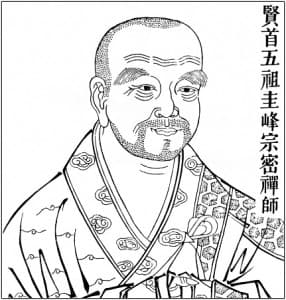
Guifeng Zongmi
Guifeng Zongmi was a highly influential Tang dynasty Chinese Buddhist monk, scholar, and patriarch of both the Huayan and Chan schools. He is renowned for his efforts to harmonize various Buddhist teachings, particularly Chan and Huayan, with Taoism and Confucianism, aiming to create a comprehensive spiritual vision. His extensive writings serve as a crucial resource for understanding the diverse Chan schools of his era.
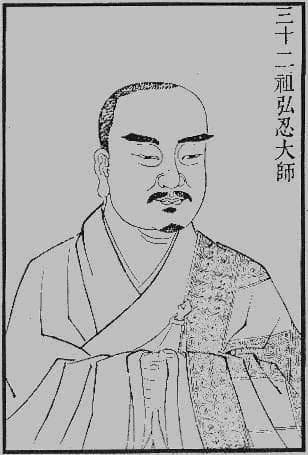
Daman Hongren
Daman Hongren (601–674) was the fifth Patriarch of Chan Buddhism, succeeding Dayi Daoxin and transmitting the lineage to Huineng. His teachings, known as the "East Mountain Teachings," emphasized meditation practice and the purification of the mind from discriminating thoughts. Hongren is considered a pivotal figure in the development of early Chinese Chan Buddhism, with his teachings influencing the tradition as it moved into urban centers and the imperial court.
Dayi Daoxin
Dayi Daoxin (580–651) was the fourth Chán Buddhist Patriarch, significant for establishing the "East Mountain Teachings" and developing stable monastic communities. His teachings emphasized meditation and integrating practice into daily life, influencing the future development of Chan Buddhism in China.