
Zen Mountain Monastery
Monastery·United States·20th century·Zen Buddhism (Rinzai and Sōtō)
Zen Mountain Monastery is a significant Zen Buddhist training center located in the Catskill Mountains of New York. Founded in 1980 by John Daido Loori, it serves as the main house for the Mountains and Rivers Order and combines Rinzai and Sōtō Zen traditions. The monastery is recognized for its comprehensive training matrix, various supporting structures, and its role in disseminating Buddhist teachings through publications and outreach programs.
Key Facts
- ›Founded in 1980 by John Daido Loori as the Zen Arts Center, later becoming Zen Mountain Monastery.
- ›Combines the Rinzai and Sōtō Zen traditions, with both having been transmitted to Loori.
- ›The main building, constructed between 1935 and 1938, was designated a historic landmark.
- ›Houses the Mountains and Rivers Order, an organization inspired by Dogen's teachings.
- ›Offers a comprehensive training matrix known as the eight Gates of Zen.
- ›Operates various outreach programs including the National Buddhist Prison Sangha and the Zen Environmental Studies Institute.

Important Relationships
- John Daido Loori
- Mountains and Rivers Order
- Dogen
Main House, Sangha House, Jizo House, Eight Gates of Zen Training Matrix, Zen Environmental Studies Institute, National Buddhist Prison Sangha
- Founded In 1980
- Main Building Designated A Historic Landmark In 1994
- Sangha House Completed In 2012
- Jizo House Completed In 2021
Arts and Crafts
About Zen Mountain Monastery
Zen Mountain Monastery (Doshinji), meaning "Temple of the Way of Reality," is a prominent Zen Buddhist monastery and training center situated on a 220-acre forested property in the Catskill Mountains of Mount Tremper, New York. Founded in 1980 by John Daido Loori, it initially began as the Zen Arts Center and has since grown into a significant institution for Zen practice and study.
History and Development
The site itself has a history dating back to the 1930s when it was established as Camp Wapanachki. The primary structures, including the main house and chapel, were built in an Arts and Crafts style between approximately 1935 and 1938. The main building, constructed with local bluestone and white oak, was later designated a historic landmark at both national and state levels in 1994. John Daido Loori purchased the property on September 30, 1980, for $100,000.
Training and Practice
Zen Mountain Monastery is known for its comprehensive training program, guided by Daido Roshi's Eight Gates of Zen matrix. This matrix outlines eight key areas of practice: zazen (seated meditation), face-to-face teaching, liturgy, moral and ethical teachings, work practice, body practice, art practice, and academic study. These practices are undertaken by both lay students and monastics, with lay practitioners often engaging in weekend retreats and sesshin (meditation intensives) at the monastery or practicing at home. The curriculum also includes a wide array of activities such as painting, poetry, shakuhachi performance, kyūdō (Japanese archery), and qigong. The monastery is home to monastic practitioners who have taken vows of simplicity, selflessness, stability, service, and accomplishing the Buddha's Way, dedicating themselves entirely to the monastery's mission.
The Mountains and Rivers Order
Zen Mountain Monastery serves as the main house of the Mountains and Rivers Order, an organization founded by John Daido Loori in 1980. This order is inspired by the teachings of Dogen, as articulated in the Mountains and Rivers Sutra. The Order encompasses several branches, including Dharma Communications, which handles publications and supplies for practitioners; the Society of Mountains and Rivers, comprising affiliate sitting groups; the National Buddhist Archives, dedicated to preserving the history of Buddhism in America; the Zen Environmental Studies Institute, which focuses on environmental mindfulness and research; the National Buddhist Prison Sangha, providing spiritual resources to inmates; and the Fire Lotus Temple, a residential Zen training facility in New York City.
Buildings and Grounds
Beyond the historic Main House, the monastery grounds feature several other important structures. The Sangha House, completed in 2012, provides facilities for events, retreats, a store, and various practice rooms. In 2021, the new Jizo House was constructed to better accommodate retreat participants, particularly those with mobility issues, and includes an infirmary and end-of-life quarters. Administrative offices, designed by Michelle Yoshin Lacaditto, were built in 2000 to centralize operations. A traditional Japanese tea house facilitates tea ceremony practice, while hermitages offer secluded spaces for deep practice. The grounds also include gardens for produce and flowers, as well as an orchard. The monastery cemetery is the final resting place for its abbots and other monastics and lay students.
Source: Wikipedia ↗
Frequently Asked Questions
When was Zen Mountain Monastery founded?
Zen Mountain Monastery was founded in 1980 by John Daido Loori. It was initially established as the Zen Arts Center before evolving into its current form.
What Zen traditions are practiced at Zen Mountain Monastery?
The monastery integrates both the Rinzai and Sōtō Zen traditions. John Daido Loori, the founder, received Dharma transmission in both of these lineages.
What are some of the key buildings at Zen Mountain Monastery?
Notable structures include the Main House, which is a historic landmark, the Sangha House completed in 2012, and the Jizo House, built to enhance accessibility. The monastery also has administrative offices, a tea house, hermitages, and gardens.
What is the Eight Gates of Zen training matrix?
The Eight Gates of Zen is a training framework developed by Daido Roshi. It encompasses zazen, face-to-face teaching, liturgy, moral and ethical teachings, work practice, body practice, art practice, and academic study.
What is the Mountains and Rivers Order?
The Mountains and Rivers Order is an organization founded by John Daido Loori in 1980, serving as the umbrella for Zen Mountain Monastery and its associated branches. It is inspired by the teachings of Dogen as found in the Mountains and Rivers Sutra.
Related Buddhist Temples

Abhayagiri Buddhist Monastery
Abhayagiri Buddhist Monastery is a Theravada Buddhist monastery in Redwood Valley, California, belonging to the Thai Forest Tradition. It focuses on teaching Buddhist ethics and traditional concentration and insight meditation as a path to end suffering. The monastery, whose name means 'fearless mountain' in Pali, was established in the late 1980s and has grown into a significant center for Buddhist practice and teaching in the United States.
Deer Park Buddhist Center and Monastery
Deer Park Buddhist Center and Monastery in Oregon, Wisconsin, is a prominent center for Tibetan Buddhism, founded in 1975 by Geshe Lhundub Sopa. It serves as a monastic and teaching institution, upholding the Dalai Lama's tradition and attracting international students. The center is currently undertaking a significant temple expansion project to house Tibetan art and artifacts, expand educational programs, train new monks, and promote Tibetan freedom.
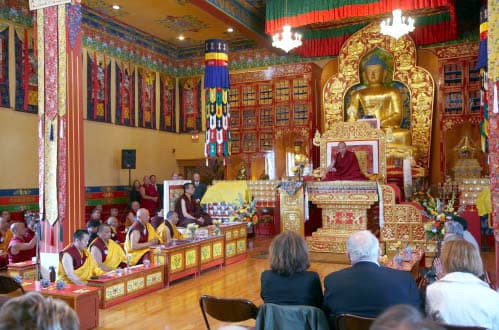
Karma Triyana Dharmachakra
Karma Triyana Dharmachakra is a Tibetan Buddhist monastery located in Woodstock, New York, serving as the North American headquarters for the 17th Gyalwa Karmapa, the spiritual leader of the Karma Kagyu lineage. Founded in 1976 by the 16th Gyalwa Karmapa, it has been a significant center for Tibetan Buddhism in North America, with Khenpo Karthar Rinpoche serving as its abbot for many years.