
Warana Raja Maha Vihara
Warana Raja Maha Vihara is an ancient Buddhist temple located in Thihariya, Gampaha District, Sri Lanka. Recognized as an archaeological protected site, it is believed to have been founded during the reign of King Devanampiyathissa and has undergone significant renovations by various rulers throughout Sri Lankan history. The temple is notable for its multi-level structure, housing cave temples, stupas, and ancient Buddha statues and paintings.
Key Facts
- ›Believed to have been built during the reign of King Devanampiyathissa (307–267 BC).
- ›Underwent later renovations by Kings Valagamba, Nissanka Malla, Kirti Sri Rajasinha, and Parakramabahu VI.
- ›Features a multi-level structure with Pahala maluwa, Meda maluwa, and Ihala maluwa.
- ›Contains drip-led cave temples with ancient stupas, one of which is approximately 800 years old.
- ›Houses numerous Buddha statues and paintings within its cave temples.
- ›Recognized as an archaeological protected site by the Archaeological Department of Sri Lanka.

Important Relationships
- King Devanampiyathissa
- King Valagamba
- Nissanka Malla
- Kirti Sri Rajasinha
- Parakramabahu VI
- Dr. Senarath Paranavithana
Drip-Led Cave Temples, Ancient Stupa, Buddha Statues, Ancient Paintings, Lotus Flower and Floral Canopy Decorations
About Warana Raja Maha Vihara
Warana Raja Maha Vihara is an ancient Buddhist temple situated in Thihariya, within the Gampaha District of Sri Lanka. Its historical roots are deeply embedded in the island's past, with the temple believed to have been constructed during the reign of King Devanampiyathissa, who ruled from 307 to 267 BC. This places its origins in the early Anuradhapura period, a significant era in Sri Lankan history.
History and Renovations
The temple's chronicles indicate that it has been a site of continuous veneration and development, undergoing substantial renovations by various rulers throughout the centuries. Notable among these are King Valagamba, who reigned during periods of turmoil in the 1st century BCE, King Nissanka Malla in the late 12th century, King Kirti Sri Rajasinha in the 18th century, and King Parakramabahu VI in the 15th century. These interventions highlight the temple's enduring importance as a religious and cultural landmark.
A Brahmin inscription found on the premises, as interpreted by Dr. Senarath Paranavithana in his "Inscriptions of Ceylon, Part I," reads, "Bata-Majhimasa batika bata-Tisadatasa dane," translated as "The gift of Lord Tissadatta, brother of Lord Magjihima." This inscription points to early patronage and the presence of significant figures associated with the temple's establishment or upkeep.
Furthermore, cave temples in the vicinity, such as Uruwala, Maligatenna, Pilikuththuwa, Miriswatta, and Koskandawala, are thought to have formed part of a larger temple complex during the early Anuradhapura period, suggesting Warana Raja Maha Vihara was once a central point within a significant monastic settlement.
Temple Structure and Features
The temple is architecturally designed across three main levels: Pahala maluwa (lower level), Meda maluwa (middle level), and Ihala maluwa (upper level). The first level hosts the Sangawasaya (monastic residence quarters) and the Dharma Hall (preaching hall). The middle level is home to a drip-led cave temple, which houses an ancient Stupa estimated to be around 800 years old. Within this cave temple, numerous statues of the Buddha and ancient paintings adorn the walls and ceiling.
The canopy of the cave is intricately decorated with motifs of lotus flowers and various other floral designs, showcasing the artistic traditions of the time. The uppermost level, Ihala maluwa, also features another Stupa and a cave temple, contributing to the temple's layered and complex Sacred geography.
Recognition and Significance
Warana Raja Maha Vihara is currently recognized by the Archaeological Department of Sri Lanka as an archaeological protected site in the Gampaha District. This designation underscores its importance as a preserved piece of Sri Lanka's rich cultural and religious heritage, attracting visitors interested in its history, architecture, and spiritual significance.
Source: Wikipedia ↗
Frequently Asked Questions
When was Warana Raja Maha Vihara founded?
Warana Raja Maha Vihara is believed to have been built during the reign of King Devanampiyathissa, which spanned from 307 to 267 BC. This indicates its origins date back to the pre-Christian era.
What historical figures were involved in the temple's upkeep?
The temple chronicles indicate that significant renovations were undertaken by several Sri Lankan monarchs. These include King Valagamba, Nissanka Malla, Kirti Sri Rajasinha, and Parakramabahu VI, highlighting its continuous importance through different dynasties.
What are the main architectural features of Warana Raja Maha Vihara?
The temple is organized into three distinct levels: Pahala maluwa, Meda maluwa, and Ihala maluwa. These levels contain structures such as the Sangawasaya, Dharma Hall, drip-led cave temples, and stupas.
What can be found inside the cave temples?
Inside the cave temples, visitors can find many ancient Buddha statues and intricate paintings. The canopy of the cave is notably decorated with lotus flowers and other floral designs.
Is Warana Raja Maha Vihara an archaeological protected site?
Yes, Warana Raja Maha Vihara has been recognized as an archaeological protected site in the Gampaha District by the Archaeological Department of Sri Lanka. This designation underscores its historical and cultural significance.
Related Buddhist Temples

Tissamaharama Raja Maha Vihara
Tissamaharama Raja Maha Vihara is an ancient Buddhist temple situated in Tissamaharama, Southern Province, Sri Lanka. It was established as one of the country's first major Buddhist monasteries and served as a significant educational center for Southern Sri Lanka from the 3rd century BCE to the 11th century CE. The temple is particularly notable for its Tissamaharama Dagoba, one of the largest stupas in Sri Lanka.
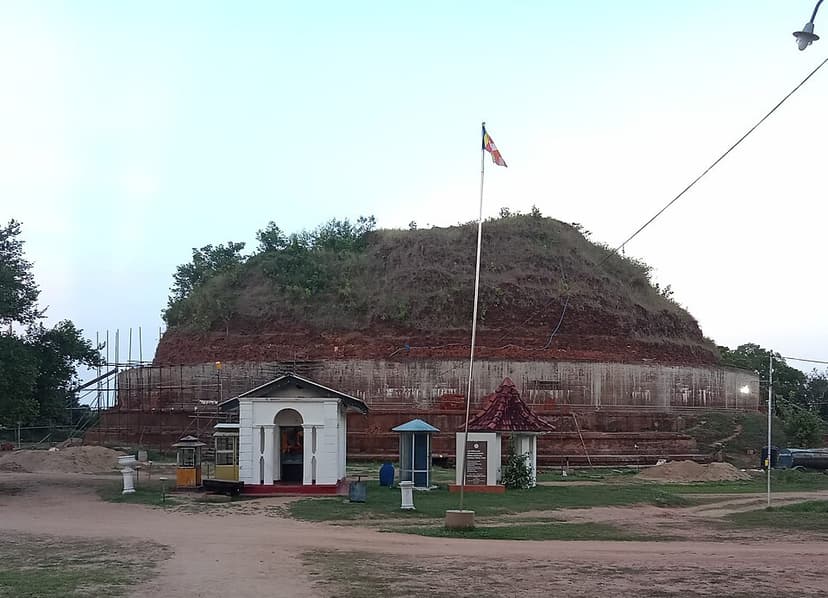
Deeghawapi
Deeghawapi is a significant Buddhist sacred shrine and archaeological site in Sri Lanka, with historical records dating back to the 3rd century BCE. Its importance is deeply intertwined with legends of the Buddha's visits and is frequently mentioned in ancient chronicles and Pali literature. The site has undergone extensive restoration, with reconstruction efforts aiming for completion by the end of 2023.

Kiri Vehera
Kiri Vehera is an ancient stupa located in Kataragama, Sri Lanka, believed to have been constructed in the 3rd century BC by King Mahanaga. It is recognized as one of the 16 most sacred Buddhist pilgrimage sites in ancient Sri Lanka and is a significant religious landmark.