
Tövkhön Monastery
Tövkhön Monastery is one of Mongolia's oldest Buddhist religious sites, originating in the 17th century. Founded by Zanabazar, the spiritual leader of Tibetan Buddhism for the Khalkha people, it served as his personal retreat and a center for artistic and script development. Despite periods of destruction and restoration, it remains an active monastic site and a UNESCO World Heritage site.
Key Facts
- ›Established in 1648 by Zanabazar, the first Jebtsundamba Khutuktu.
- ›Originally named Bayasgalant Aglag Oron (Happy Secluded Place).
- ›Served as Zanabazar's personal retreat for over 30 years, where he created artworks and developed the Soyombo script.
- ›Destroyed in 1688 by Oirat Mongols and again damaged during Stalinist purges in the late 1930s.
- ›Restored in 1773, with religious activities resuming in 1992 and grounds restoration completed in 1997.
- ›Inscribed as a UNESCO World Heritage site in 1996.

Important Relationships
- Zanabazar
Two Original Temples From the 17th Century, Two Stupas From the 17th Century, Additional Temples Built In the 18th Century, New Statue of Gombo Makhagal
Establishment of the Monastery, Construction of First Physical Structures, Destruction By Oirat Mongols, Restoration of the Monastery, Damage During Stalinist Purges, Restart of Religious Activities, Completion of Grounds Restoration, Inscribed As Unesco World Heritage Site
About Tövkhön Monastery
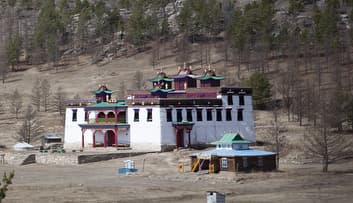
Tövkhön Monastery, located in Övörkhangai Province, Mongolia, is one of the nation's oldest Buddhist monastic complexes. It was initially established in 1648 by Zanabazar, who at the age of fourteen became the first Jebtsundamba Khutuktu and the spiritual leader of Tibetan Buddhism for the Khalkha people in Outer Mongolia. Zanabazar selected a site on the Shireet Ulaan Uul mountain, situated at an elevation of 2,600 meters, deeming it an auspicious location. The first physical structures were erected upon his return from studies in Tibet in 1653.
Originally named Bayasgalant Aglag Oron, meaning 'Happy Secluded Place,' the monastery served as Zanabazar's personal retreat for over three decades. During this period, he was highly productive, creating many of his renowned sculptures and paintings, and notably developing the unique Soyombo script. The monastery's existence has been marked by periods of upheaval. It was destroyed in 1688 during a military campaign by the Oirat Mongols. Following a restoration in 1773, it suffered significant damage in the late 1930s due to the Stalinist purges, an era when Mongolia's communist regime actively worked to dismantle Buddhist institutions.
Despite these historical setbacks, Tövkhön Monastery has seen a resurgence. Religious activities recommenced in 1992, and the monastery's grounds underwent restoration, concluding in 1997. Today, two original temples and two stupas from the 17th century remain, alongside temples constructed in the 18th century. Ceremonies have been held to reconsecrate the site, and a new statue of Gombo Makhagal (Mahakala) has been installed. Recognizing its profound historical and cultural value, Tövkhön Monastery was inscribed as a UNESCO World Heritage site in 1996. The monastery is now home to several monks who reside and practice there full-time.
Source: Wikipedia ↗
Frequently Asked Questions
When was Tövkhön Monastery founded?
Tövkhön Monastery was first established in 1648 by Zanabazar, who was then 14 years old. The initial physical structures were built upon his return from studying in Tibet in 1653.
Who founded Tövkhön Monastery and why was it significant to him?
The monastery was founded by Zanabazar, the spiritual head of Tibetan Buddhism for the Khalkha in Outer Mongolia. He chose the auspicious mountain location and used Tövkhön Monastery as his personal retreat for over 30 years, creating many of his famous works and developing the Soyombo script there.
Has Tövkhön Monastery faced destruction?
Yes, the monastery was destroyed in 1688 by the Oirat Mongols. It suffered further severe damage during the Stalinist purges of the late 1930s when the communist regime sought to suppress Buddhism.
Is Tövkhön Monastery an active religious site today?
Religious activities restarted at Tövkhön Monastery in 1992, and restoration was completed in 1997. Several monks now reside and practice at the monastery full-time.
Is Tövkhön Monastery a UNESCO World Heritage site?
Yes, Tövkhön Monastery was inscribed as a UNESCO World Heritage site in 1996, recognizing its cultural and historical significance.
Related Buddhist Temples

Amarbayasgalant Monastery
Amarbayasgalant Monastery is one of Mongolia's three largest Buddhist monastic centers, established in the early 18th century. It was built to house the remains of Zanabazar, the first spiritual head of Tibetan Buddhism for the Khalkha in Outer Mongolia, and reflects a unified Chinese architectural style with Mongol and Tibetan influences.
Baldan Bereeven Monastery
Baldan Bereeven Monastery is a significant Gelugpa Buddhist monastery located in the Khentii Province of Mongolia. Originally founded in 1654 and modeled after Tibetan monasteries, it grew to become one of Mongolia's largest and most important religious centers, reaching its zenith in the mid-19th century with up to 8,000 monks. Although destroyed by the communist regime in 1937, restoration efforts have been underway since 1990, with three temples currently rebuilt.

Shankh Monastery
Shankh Monastery, also known as Shankh Khiid, is one of Mongolia's oldest and most historically significant Buddhist monasteries, located in Kharkhorin, Övörkhangai Province. Founded in 1647 by Zanabazar, the first spiritual head of Tibetan Buddhism for the Khalkha in Outer Mongolia, it represents the Gelupa school and is renowned for its unique Kalachakra Mandalas.