
Shankh Monastery
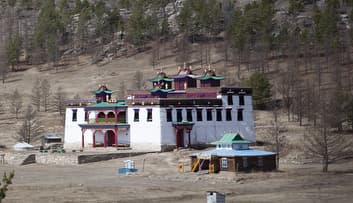
Shankh Monastery, also known as Shankh Khiid, is one of Mongolia's oldest and most historically significant Buddhist monasteries, located in Kharkhorin, Övörkhangai Province. Founded in 1647 by Zanabazar, the first spiritual head of Tibetan Buddhism for the Khalkha in Outer Mongolia, it represents the Gelupa school and is renowned for its unique Kalachakra Mandalas.
Key Facts
- ›Founded in 1647 by Zanabazar, the first spiritual leader of Tibetan Buddhism for the Khalkha Mongols.
- ›Belongs to the Gelupa (Yellow Hat Sect) school of Tibetan Buddhism.
- ›Its main temple features the only seven Kalachakra Mandalas in Mongolia, depicting 722 deities.
- ›The monastery was destroyed by the communist regime in 1937 but began restoration after the 1990 Democratic Revolution.
- ›At its peak, it housed over 1500 monks and contained approximately 20 buildings.
- ›Historically, it may have housed the black military banner of Genghis Khan.

Important Relationships
- Zanabazar
- 14th Dalai Lama
- Genghis Khan
- Seven Kalachakra Mandalas Depicting 722 Deities
- Founded By Zanabazar In 1647
- Destroyed By Communist Regime In 1937
- Restoration Efforts Began After 1990 Democratic Revolution
About Shankh Monastery
Shankh Monastery, known in Mongolian as Шанх хийд (Shankh Khiid), is a historically significant Buddhist monastic complex situated in Kharkhorin, within the Övörkhangai Province of Mongolia. Established in 1647 by Zanabazar, the first spiritual leader of Tibetan Buddhism for the Khalkha people in Outer Mongolia, it is recognized as one of the nation's oldest and most important religious sites. The monastery adheres to the Gelupa, or Yellow Hat Sect, tradition of Tibetan Buddhism.
History and Significance
Founded when Zanabazar was a mere 12 years old, Shankh Monastery initially operated as a ger monastery, meaning it was composed of portable felt tents. It underwent several relocations before settling at its present-day site in 1787, at which point it adopted its current name. For an extended period, it was referred to as the "Monastery of the West" (Baruun Khüree).
By the late 19th century, according to ethnographer Aleksei M. Pozdneev, the monastery comprised a main temple built between 1710 and 1790, along with five large, elaborately decorated gers capable of housing approximately 200 individuals. At its zenith, Shankh Monastery was a center for advanced Buddhist studies, including Tantric rituals, particularly Kalachakra, Buddhist philosophy, and astrology. By 1921, on the eve of the Mongolian People's Revolution, the monastery had grown to include around 20 buildings and was home to over 1,500 monks.
Period of Destruction and Restoration
Like many religious institutions in Mongolia, Shankh Monastery faced severe persecution under the country's communist regime. In 1937, it was shut down, and most of its structures were demolished as part of Stalinist purges. Many monks were either executed or sent to Siberian labor camps. Fortunately, a significant portion of the monastery's precious relics were safeguarded by a young novice named Gombo, ensuring their survival.
Following the 1990 Democratic Revolution in Mongolia, a period of renewal for religious and cultural institutions, surviving novices returned to Shankh. They commenced restoration work on the main temple. Further support for the revival of Buddhism in the country came in 1993 when the 14th Dalai Lama dispatched three monks to Shankh Monastery.
Notable Features
The main temple of Shankh Monastery is particularly celebrated for its seven Kalachakra Mandalas. These mandalas are unique within Mongolia, as they collectively depict all 722 Kalachakra deities, making them a singular artistic and religious treasure.
Historical accounts suggest that at one point, the black military banner of Genghis Khan may have been housed at the monastery, though its current whereabouts are unknown.
Source: Wikipedia ↗
Frequently Asked Questions
When was Shankh Monastery founded?
Shankh Monastery was founded in 1647 by Zanabazar, who was the first spiritual head of Tibetan Buddhism for the Khalkha in Outer Mongolia. He was only 12 years old at the time of its establishment.
What is unique about Shankh Monastery's main temple?
The main temple of Shankh Monastery is distinguished by its seven Kalachakra Mandalas. These mandalas are the only ones of their kind in Mongolia and portray all 722 Kalachakra deities.
What happened to Shankh Monastery during the communist era?
During the communist regime, Shankh Monastery was closed down in 1937, and most of its structures were destroyed. Many monks were executed or sent to labor camps, though some precious relics were hidden and survived.
What is the significance of the Kalachakra Mandalas at Shankh Monastery?
The Kalachakra Mandalas at Shankh Monastery are significant because they are the only complete set of their kind in Mongolia, depicting all 722 Kalachakra deities. They are a central feature of the monastery's main temple.
When did restoration efforts begin at Shankh Monastery?
Restoration efforts at Shankh Monastery began after the 1990 Democratic Revolution in Mongolia. Surviving novices returned to the site and initiated the rebuilding of the main temple.
Related Buddhist Temples
Baldan Bereeven Monastery
Baldan Bereeven Monastery is a significant Gelugpa Buddhist monastery located in the Khentii Province of Mongolia. Originally founded in 1654 and modeled after Tibetan monasteries, it grew to become one of Mongolia's largest and most important religious centers, reaching its zenith in the mid-19th century with up to 8,000 monks. Although destroyed by the communist regime in 1937, restoration efforts have been underway since 1990, with three temples currently rebuilt.

Tövkhön Monastery
Tövkhön Monastery is one of Mongolia's oldest Buddhist religious sites, originating in the 17th century. Founded by Zanabazar, the spiritual leader of Tibetan Buddhism for the Khalkha people, it served as his personal retreat and a center for artistic and script development. Despite periods of destruction and restoration, it remains an active monastic site and a UNESCO World Heritage site.

Amarbayasgalant Monastery
Amarbayasgalant Monastery is one of Mongolia's three largest Buddhist monastic centers, established in the early 18th century. It was built to house the remains of Zanabazar, the first spiritual head of Tibetan Buddhism for the Khalkha in Outer Mongolia, and reflects a unified Chinese architectural style with Mongol and Tibetan influences.