
Sera Monastery
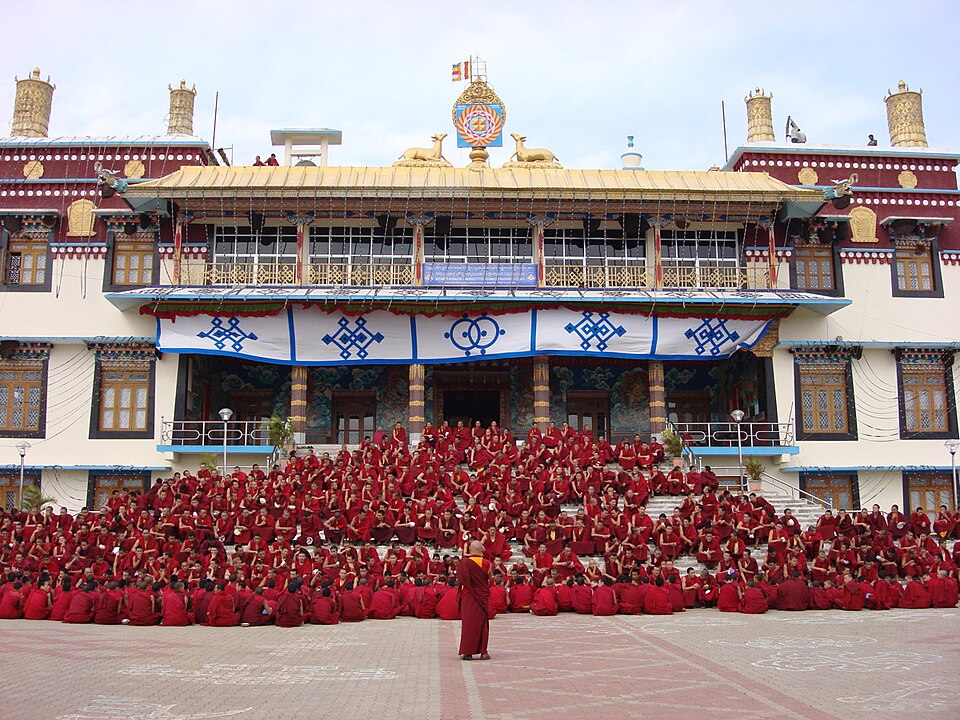
Sera Monastery is one of the "great three" Gelug university monasteries in Tibet, founded in 1419 by Jamchen Chojey Sakya Yeshe, a disciple of Je Tsongkhapa. It was a significant center for Buddhist learning and practice, housing thousands of monks and known for its rigorous philosophical training. Following the 1959 revolt, the original monastery suffered severe damage, leading many monks to establish a parallel Sera Monastery in Bylakuppe, India, which continues to propagate Buddhist teachings globally.
Key Facts
- ›Founded in 1419 by Jamchen Chojey Sakya Yeshe, a disciple of Je Tsongkhapa.
- ›One of the "great three" Gelug university monasteries of Tibet.
- ›Originally housed approximately 6,000 monks before 1959.
- ›Suffered severe damage during the 1959 revolt, with colleges destroyed and many monks killed.
- ›A parallel Sera Monastery was established in Bylakuppe, India, by surviving monks.
- ›Known for its rigorous philosophical studies (tsennyi mtshan nyid grwa tshang) culminating in a geshe degree.
Important Relationships
- Je Tsongkhapa
- Jamchen Chojey Sakya Yeshe
- King Nedong Dagpa Gyaltsen
- 14th Dalai Lama
Great Assembly Hall, Sera Je Dratsang, Sera Me Dratsang, Ngakpa Dratsang, Choding Khang
- Founded In 1419 By Jamchen Chojey Sakya Yeshe.
- Suffered Severe Damage During the 1959 Revolt In Lhasa.
- Establishment of A Parallel Monastery In Bylakuppe, India, After 1959.
Tibetan
About Sera Monastery
Sera Monastery, known in Tibetan as "Wild Roses Monastery" (se ra dgon pa), stands as one of the "great three" Gelug university monasteries of Tibet, holding significant historical and religious importance. Located just north of Lhasa, it was founded in 1419 by Jamchen Chojey Sakya Yeshe, a prominent disciple of the revered Buddhist master Je Tsongkhapa. The monastery was designed as a complex of structures, including a Great Assembly Hall and three main colleges, dedicated to rigorous Buddhist scholarship and practice.
History and Significance
The founding of Sera Monastery was a pivotal moment in the development of the Gelug school of Tibetan Buddhism. It quickly grew into a renowned center of learning, attracting thousands of monks who engaged in a comprehensive 20-year program of philosophical study, culminating in the prestigious geshe degree. The monastery's curriculum encompassed the study of Buddhist doctrines, with specific colleges like Sera Je and Sera Me focusing on philosophical knowledge and the Ngakpa Dratsang dedicated to tantric ritual. Before 1959, Sera was home to approximately 6,000 monks and was a vibrant hub for monastic life and scholarly debate.
The monastery's history is deeply intertwined with the turbulent events of the 20th century. During the 1959 revolt in Lhasa, Sera Monastery suffered extensive damage, with its colleges destroyed and many monks killed. This period marked a profound turning point, leading to the exile of many monks, including those from Sera, who sought refuge in India. Upon their arrival, with the support of the Indian government, they established a parallel Sera Monastery in Bylakuppe, Mysore, Karnataka. This new establishment, comprising Sera Me and Sera Je colleges and a Great Assembly Hall, has become a vital center for Tibetan Buddhism in exile, continuing the monastic traditions and spreading Buddhist teachings globally.
Source: Wikipedia ↗
Frequently Asked Questions
What is the origin of the name 'Sera Monastery'?
The origin of the name 'Sera Monastery' is attributed to the fact that during its construction, the hill behind the monastery was covered with blooming wild roses, which are called 'sera' in Tibetan. An alternate etymology suggests the location was surrounded by raspberry shrubs that formed a 'fence'.
What are the main colleges within Sera Monastery?
Sera Monastery comprises three main colleges: Sera Je Dratsang, Sera Me Dratsang, and Ngakpa Dratsang. Sera Je and Sera Me were established for philosophical and monastic university training, while Ngakpa Dratsang was devoted to tantric ritual studies.
What happened to Sera Monastery after the 1959 revolt?
During the 1959 revolt in Lhasa, Sera Monastery sustained severe damage, with its colleges destroyed and many monks killed. Many survivors fled to India, where they established a parallel Sera Monastery in Bylakuppe, Mysore.
What is the significance of the Great Assembly Hall (Tsokchen)?
The Great Assembly Hall, known as Tsokchen or Coqen Hall, is a four-story structure where religious rituals and rites are conducted. It housed chapels with statues of various Buddhas, Bodhisattvas, and important lamas, as well as treasured scriptures.
What is the current status of the Sera Monastery in India?
The Sera Monastery in Bylakuppe, India, now houses over 3,000 Buddhist monks and has established Dharma centers globally, actively propagating Buddhist knowledge and missionary activities.
Related Buddhist Temples
Drongtse Monastery
Drongtse Monastery was a significant Gelug Buddhist monastery located in Tsang, Tibet, historically situated northwest of Gyantse. Although almost entirely destroyed during the Cultural Revolution, it has undergone partial restoration with its Assembly Hall rebuilt in the 1980s, though many main buildings remain in ruins. The monastery was notable for its congregation hall, which housed ancient gilt images, including a depiction of Jowo Shakyamuni.

Khorzhak Monastery
Khorzhak Monastery, also known as Korchak Monastery, is a significant Buddhist site located in western Tibet near the Indian border. It is renowned for its large red wall inscribed with the "Om Mani Padme Hum" mantra and holds historical importance as a former Kagyu monastery.
Samding Monastery
Samding Monastery, known as "The Temple of Soaring Meditation," is a significant 13th-century Tibetan Buddhist monastery located on a peninsula overlooking Yamdrok Lake. It holds unique importance as the seat of Dorje Pakmo, the highest-ranking female incarnation in Tibet and a spiritual figure associated with the Bodong, Nyingma, and Shangpa Kagyu schools.