
Drongtse Monastery
Drongtse Monastery was a significant Gelug Buddhist monastery located in Tsang, Tibet, historically situated northwest of Gyantse. Although almost entirely destroyed during the Cultural Revolution, it has undergone partial restoration with its Assembly Hall rebuilt in the 1980s, though many main buildings remain in ruins. The monastery was notable for its congregation hall, which housed ancient gilt images, including a depiction of Jowo Shakyamuni.
Key Facts
- ›Formerly one of the most important Gelug monasteries in Tsang, Tibet.
- ›Located 19 km northwest of Gyantse.
- ›Almost totally destroyed during the Cultural Revolution, but partially restored.
- ›The Assembly Hall was rebuilt in the 1980s.
- ›The congregation hall contained old gilt images, including a copy of Jowo Shakyamuni.
- ›Associated with figures like Lhatsun Chenpo, Rinchen Gyatso, the 5th Dalai Lama, and the Thirty-Second Ganden Tripa, Tsultrim Chopel.
Important Relationships
- Sarat Chandra Das
- Lhatsun Chenpo
- Rinchen Gyatso
- Tsongkhapa
- 5th Dalai Lama
- Güshi Khan
- King of Tsang
- Lobsang Palden Chophel
- Sengchen Lama
- Tsultrim Chopel
- Lobzang Tsultrim
- Padmasambhava
- Tara
- Amitayus
- Tashilhunpo
- Congregation Hall
- Gilt Image of Jowo Shakyamuni
- Picture of the 5th Dalai Lama With GüShi Khan
- Rock-Carved Images of Padmasambhava, Tara, and Amitayus In A Small Chapel
- Almost Totally Destroyed During the Cultural Revolution
- Assembly Hall Rebuilt In the 1980s
About Drongtse Monastery
Drongtse Monastery, also known by its Pinyin name Zhongze, was historically one of the most important monasteries of the Gelug school in the Tsang region of Tibet. Situated approximately 19 km northwest of Gyantse and 14 km north of Tsechen Monastery, it held a prominent position prior to its near-total destruction during the Cultural Revolution.
History and Restoration
The monastery, originally a four-storied structure perched on a rocky eminence, was visited by Sarat Chandra Das in 1881, who noted its wall was already partly ruined. While the exact founding date remains undocumented, some historical accounts attribute its establishment to Lhatsun Chenpo (Je Lha-tsun), with other sources suggesting Rinchen Gyatso founded it in the same year, fulfilling a prophecy. Later, it was adopted as a branch monastery of Tashilhunpo. The monastery was also the birthplace of Lobsang Palden Chophel, known as the Sengchen ('Lion') Lama. Figures such as the Thirty-Second Ganden Tripa, Tsultrim Chopel, and Lobzang Tsultrim received their monastic education at Drongtse.
Notable Features and Current State
Drongtse Monastery's congregation hall (du-khang) was capable of seating about eighty monks and contained significant religious artifacts. Among these was a very old gilt image of Jowo Shakyamuni, reputedly a copy made by an Indian artist of the revered image in Lhasa's Jokhang Temple. The hall also housed a painting depicting the 5th Dalai Lama receiving political authority over Tibet from the Mongol conqueror Güshi Khan after the deposition of the king of Tsang in 1642. Behind the monastery, a small chapel features rock-carved images of Padmasambhava, Tara, and Amitayus, among other deities. Despite extensive damage during the Cultural Revolution, Drongtse Monastery has undergone partial restoration. The Assembly Hall was rebuilt in the 1980s, though many of the main buildings continue to be in a state of ruin.
Source: Wikipedia ↗
Frequently Asked Questions
What is Drongtse Monastery?
Drongtse Monastery was a prominent Tibetan Buddhist monastery of the Gelug school in the Tsang region of Tibet. It was historically a significant religious site, known for its congregation hall and valuable religious artifacts.
Where is Drongtse Monastery located?
Drongtse Monastery is situated 19 km northwest of Gyantse and 14 km north of Tsechen Monastery, along the 'Southern Friendship Highway' towards Shigatse in Tibet.
What is the current state of Drongtse Monastery?
The monastery was heavily damaged during the Cultural Revolution and is largely in ruins. However, partial restoration efforts have been made, with the Assembly Hall being rebuilt in the 1980s.
Who founded Drongtse Monastery?
Historical accounts vary regarding its founder. Some sources attribute its founding to Lhatsun Chenpo (Je Lha-tsun), while others credit the yogin Rinchen Gyatso in the same year, fulfilling a prophecy.
What notable religious figures are associated with Drongtse Monastery?
The monastery was the birthplace of Lobsang Palden Chophel, also known as the Sengchen ('Lion') Lama. Furthermore, the Thirty-Second Ganden Tripa, Tsultrim Chopel, and Lobzang Tsultrim received their monastic education there.
Related Buddhist Temples
Sera Monastery
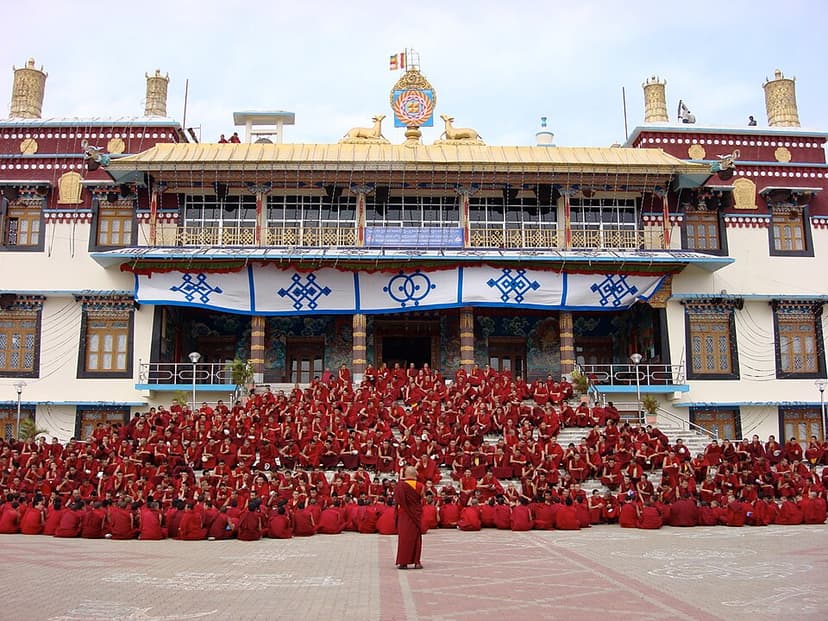
Sera Monastery is one of the "great three" Gelug university monasteries in Tibet, founded in 1419 by Jamchen Chojey Sakya Yeshe, a disciple of Je Tsongkhapa. It was a significant center for Buddhist learning and practice, housing thousands of monks and known for its rigorous philosophical training. Following the 1959 revolt, the original monastery suffered severe damage, leading many monks to establish a parallel Sera Monastery in Bylakuppe, India, which continues to propagate Buddhist teachings globally.

Khorzhak Monastery
Khorzhak Monastery, also known as Korchak Monastery, is a significant Buddhist site located in western Tibet near the Indian border. It is renowned for its large red wall inscribed with the "Om Mani Padme Hum" mantra and holds historical importance as a former Kagyu monastery.

Ralung Monastery
Ralung Monastery, located in the Tsang region of western Tibet, is the historical seat of the Drukpa Lineage of Tibetan Buddhism. Founded in 1180 by Tsangpa Gyare, it holds significant religious importance as the origin point of the Drukpa school, which remains influential in Tibet and Bhutan. The monastery's name, meaning "heart of a lotus," reflects its auspicious and protected location.