
Samding Monastery
Samding Monastery, known as "The Temple of Soaring Meditation," is a significant 13th-century Tibetan Buddhist monastery located on a peninsula overlooking Yamdrok Lake. It holds unique importance as the seat of Dorje Pakmo, the highest-ranking female incarnation in Tibet and a spiritual figure associated with the Bodong, Nyingma, and Shangpa Kagyu schools.
Key Facts
- ›Founded in the 13th century, Samding Monastery is situated on a peninsula jutting into Yamdrok Lake, southwest of Lhasa.
- ›It is the primary seat of Dorje Pakmo, the highest female incarnation in Tibet, who holds a high spiritual rank after the Dalai Lama and Panchen Lama.
- ›The monastery is associated with multiple schools of Tibetan Buddhism: Bodong, Nyingma, and Shangpa Kagyu.
- ›A notable historical event occurred in 1716 when the abbess (Khenmo) and nuns reportedly transformed into sows to defend the monastery from a Mongolian raid.
- ›The monastery was destroyed by Chinese forces after 1959 but is currently undergoing restoration.
- ›Samding Monastery is set at a high altitude of 4,423 meters (14,511 ft) on a hill overlooking Yamdrok Lake.
Important Relationships
- Dalai Lama
- Panchen Lama
- Seat of Dorje Pakmo
- Location On A Peninsula Overlooking Yamdrok Lake
- Tombs of Past Dorje Pakmo Incarnations
- Dried Mortal Remains of Former Dorje Pakmo Incarnations
- Frescoes In the Dus-K'Aṅ Hall Depicting the Career of the Original Dorje P'Ag-Mo
- 1716: Khenmo and Nuns Reportedly Transformed Into Sows To Prevent A Mongolian Raid.
- Post-1959: Monastery Destroyed By China.
- Ongoing: Process of Restoration.
About Samding Monastery
Samding Monastery, meaning "The Temple of Soaring Meditation," is a significant 13th-century Tibetan Buddhist monastery situated on a striking peninsula that extends into Yamdrok Lake, southwest of Lhasa. Its location, perched on a barren hill about 90 meters above the lake, offers dramatic views of the surrounding landscape.
Religious Significance
The monastery holds a unique and paramount place in Tibetan Buddhism as the seat of Dorje Pakmo, the highest female incarnation in Tibet. Dorje Pakmo is revered as Vajravarahi and is considered the consort of the wrathful deity Hayagriva. This lineage of female spiritual leaders places Samding Monastery at the forefront of female religious authority, with Dorje Pakmo ranking as the third highest person in the religious hierarchy, following the Dalai Lama and the Panchen Lama.
The monastery is affiliated with multiple schools of Tibetan Buddhism, including the Bodong, Nyingma, and Shangpa Kagyu traditions. This broad association underscores its historical importance and influence within the diverse tapestry of Tibetan Buddhist practice.
Historical Events and Features
Samding Monastery is historically renowned for a dramatic event in 1716 (or 1717, according to some accounts). During a Mongolian raid, the abbess (Khenmo) and her nuns are said to have transformed themselves into sows to protect the nunnery. This act of divine intervention or profound courage has become a legendary tale associated with the monastery.
Architecturally, the monastery is described as having large stone flags piled in ascending steps leading up the hill. Within its walls, visitors can find an extensive courtyard flanked by conventional buildings, including a hall with tombs of past figures connected to Samding, such as the founder, T'inle Ts'omo. The tomb of T'inle Ts'omo is richly ornamented and features a stone slab with her reputed footprint. A private chamber holds the dried remains of former Dorje Pakmo incarnations, a solemn site that each living abbess must visit once in her lifetime. The dus-k'aṅ hall contains frescoes depicting the life of the original Dorje P'ag-mo and inscriptions detailing her miraculous defense of Samding.
Modern Status
Samding Monastery suffered destruction by Chinese forces after 1959. However, it is currently undergoing a process of restoration, signifying its enduring importance and the ongoing efforts to preserve this vital spiritual and historical site. A branch of Samding Monastery also exists on the island of Yambu in Rombuza Tso, and another sanctuary dedicated to Dorje P'ag-mo is located in northern Tibet.
Source: Wikipedia ↗
Frequently Asked Questions
What is Samding Monastery's historical significance?
Samding Monastery is historically significant as the seat of Dorje Pakmo, the highest female incarnation in Tibet. It is also known for the 1716 event where the abbess and nuns reportedly transformed into sows to protect the monastery from invaders.
Where is Samding Monastery located?
Samding Monastery is located on a narrow peninsula that juts into Yamdrok Lake, southwest of Lhasa and east of Nangkatse in Tibet. It is situated at an altitude of 4,423 meters (14,511 ft).
What Buddhist traditions is Samding Monastery associated with?
Samding Monastery is associated with the Bodong, Nyingma, and Shangpa Kagyu schools of Tibetan Buddhism.
What is the role of Dorje Pakmo at Samding Monastery?
Dorje Pakmo is the highest female incarnation in Tibet and the spiritual head of Samding Monastery. She is considered the third highest-ranking person in Tibetan religious hierarchy.
What is the current status of Samding Monastery?
Samding Monastery was destroyed after 1959 but is currently in the process of being restored. It remains an important religious site.
Related Buddhist Temples

Khorzhak Monastery
Khorzhak Monastery, also known as Korchak Monastery, is a significant Buddhist site located in western Tibet near the Indian border. It is renowned for its large red wall inscribed with the "Om Mani Padme Hum" mantra and holds historical importance as a former Kagyu monastery.
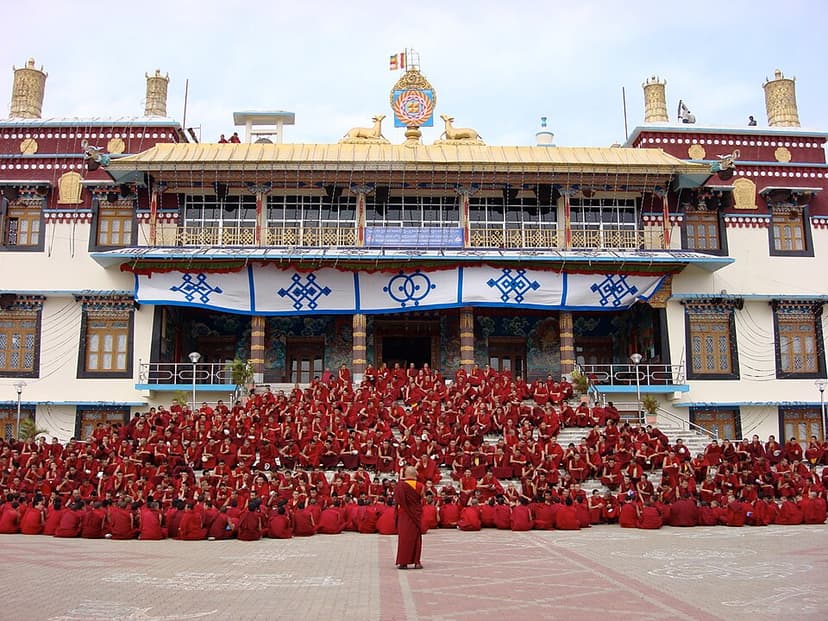
Sera Monastery
Sera Monastery is one of the "great three" Gelug university monasteries in Tibet, founded in 1419 by Jamchen Chojey Sakya Yeshe, a disciple of Je Tsongkhapa. It was a significant center for Buddhist learning and practice, housing thousands of monks and known for its rigorous philosophical training. Following the 1959 revolt, the original monastery suffered severe damage, leading many monks to establish a parallel Sera Monastery in Bylakuppe, India, which continues to propagate Buddhist teachings globally.

Ralung Monastery
Ralung Monastery, located in the Tsang region of western Tibet, is the historical seat of the Drukpa Lineage of Tibetan Buddhism. Founded in 1180 by Tsangpa Gyare, it holds significant religious importance as the origin point of the Drukpa school, which remains influential in Tibet and Bhutan. The monastery's name, meaning "heart of a lotus," reflects its auspicious and protected location.