
Sankissa
Sankissa is an ancient city in India renowned as the sacred site where Gautama Buddha descended from Tushita heavens after preaching to his mother. It is considered one of the eight great pilgrimage sites in Buddhism and holds historical significance with the presence of an Ashoka Pillar capital and ancient stupa ruins.
Key Facts
- ›Sankissa is identified as the location where the Buddha descended to earth after preaching in Tavatimsa heaven.
- ›King Ashoka visited Sankissa around 300 years after the Buddha's Mahaparinirvana and erected an Ashoka Pillar, of which the elephant capital survives.
- ›The site features the ruins of an ancient stupa and a temple dedicated to Vishari Devi.
- ›Chinese pilgrims Xuanzang and Faxian documented the presence of brick and stone ladders built to commemorate the Buddha's descent.
- ›Sankissa is located on the north bank of the Ikkhumati river (Kalinadi) in the Farrukhabad district of Uttar Pradesh, India.
- ›The city is considered one of the 'unchangeable' spots where all Buddhas descend to the human world.

Important Relationships
- King Ashoka
- Gautama Buddha
- Xuanzang
- Faxian
- Moggallana
- Sariputta
- Anuruddha
- Indra
Ashoka Pillar Elephant Capital, Ruins of Ancient Stupa, Temple of Vishari Devi, Ancient Staircase, Ruins of Ancient Buddhist Monasteries
- Descent of Gautama Buddha From Tushita Heavens
- King Ashoka's Visit and Construction of Pillar and Stupa
About Sankissa
Sankissa: The Sacred Descent
Sankissa, also known by variations such as Sankasia, Sankassa, and Sankasya, is an ancient city in India holding profound significance in Buddhist tradition. It is revered as the sacred site where Gautama Buddha descended from the Tushita heavens after a period of teaching his mother and the gods. This momentous event places Sankissa among the eight great pilgrimage sites for Buddhists worldwide.
Historical and Religious Importance
Historical accounts, including those from Chinese pilgrims Xuanzang and Faxian, detail the importance of Sankissa. Around 300 years after the Buddha's Mahaparinirvana, Emperor Ashoka visited the site. He commemorated the Buddha's descent by erecting an Ashoka Pillar, of which the distinctive elephant capital still exists. Ashoka also commissioned the construction of a stupa and a temple at Sankissa, further cementing its status as a sacred destination.
The site is recognized as one of the "unchangeable" locations in the world where all Buddhas are said to descend to the human realm after preaching the Abhidhamma Pitaka in the heavens. The archaeological landscape of Sankissa includes the ruins of this ancient stupa, a temple dedicated to Vishari Devi, and an old staircase. Explorations at the site have also yielded remnants of ancient Buddhist monasteries, alongside monuments reflecting both Buddhist and Hindu traditions. The city is currently identified with Sankisa Basantapura, situated on the northern bank of the Ikkhumati river (Kalinadi) in the Farrukhabad district of Uttar Pradesh.
The Buddha's Descent Narrative
According to Buddhist scriptures, the Buddha's descent at Sankissa occurred on the day of the Mahapavarana festival. Following his performance of the Twin Miracle at Sravasti and a three-month stay in Tavatimsa heaven where he preached the Abhidhamma Pitaka, his return to earth was a grand spectacle. The scriptures describe Indra, the king of gods, creating three ladders for the Buddha's descent: a golden ladder for the gods, a silver ladder for Maha Brahma and his retinue, and a ladder of jewels for the Buddha himself. This descent was witnessed by vast multitudes who had gathered to meet him, covering the earth for thirty leagues around.
Various disciples played a role in welcoming the Buddha back. Sariputta was among the first to greet him, followed by Uppalavanna. This occasion also served as an opportunity for the Buddha to highlight the specific spiritual eminence of his disciples, such as Moggallana's mastery of supranormal knowledge, Anuruddha's clairvoyance, Punna's teaching skills, and Sariputta's profound wisdom, for which the Parosahassa Jataka was taught.
Exploration and Modern Identification
The British explorer Alexander Cunningham surveyed the site in 1842. Sankissa is strategically located in Uttar Pradesh, approximately 250 km from Kanpur Airport, making it accessible for modern-day pilgrims and researchers interested in its rich historical and religious heritage.
Source: Wikipedia ↗
Frequently Asked Questions
What is the significance of Sankissa in Buddhism?
Sankissa is a very important Buddhist pilgrimage site because it is believed to be where Gautama Buddha descended from the Tushita heavens after preaching to his mother. This event is celebrated annually on the Mahapavarana festival.
What historical monuments can be found at Sankissa?
The site contains the ruins of an ancient stupa and a temple dedicated to Vishari Devi. A significant artifact is the elephant capital from an Ashoka Pillar, erected by King Ashoka around 300 years after the Buddha's passing.
When did King Ashoka visit Sankissa?
King Ashoka visited Sankissa approximately 300 years after the Mahaparinirvana of Gautama Buddha. During his visit, he commissioned the construction of a pillar and a stupa to commemorate the Buddha's descent.
Where is Sankissa located?
Sankissa is situated in the Farrukhabad district of Uttar Pradesh, India. It is located on the north bank of the Ikkhumati river (also known as Kalinadi), between the towns of Kampil and Kannauj.
What did ancient Chinese pilgrims report about Sankissa?
Chinese pilgrims Xuanzang and Faxian visited Sankissa and noted the presence of ancient ladders made of brick and stone, built to commemorate the Buddha's descent from heaven. They observed that these ladders were partially submerged in the earth.
Related Buddhist Temples

Bedse Caves
Bedse Caves is a significant Buddhist rock-cut monument complex located in Pune District, Maharashtra, India. Dating back to the 1st century BCE of the Satavahana period, the caves comprise a chaitya (prayer hall) and a vihara (monastery), both featuring intricate carvings and decorative motifs. They are notable for their architectural style and their place within a historically important region of Buddhist cave sites.

Chaukhandi Stupa
The Chaukhandi Stupa is a significant Buddhist monument located in Sarnath, India, a site of great importance for Buddhism. Originally built as a terraced temple, it was later modified to commemorate a historical event, making it a unique blend of religious and historical significance.
Kushinagar
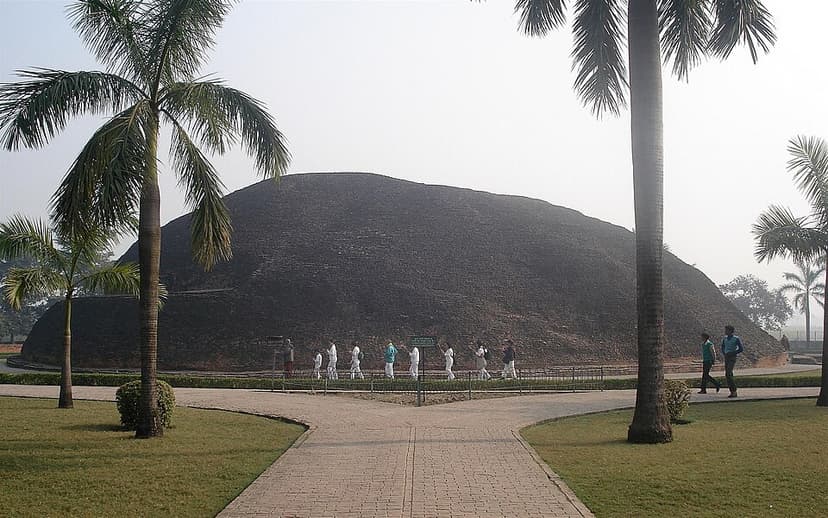
Kushinagar is a significant Buddhist pilgrimage site in Uttar Pradesh, India, renowned as the location where Gautama Buddha is believed to have attained parinirvana. Its historical importance is underscored by archaeological findings and its role in the distribution of Buddha's relics, making it a crucial destination for Buddhists worldwide.