
Bedse Caves
Bedse Caves is a significant Buddhist rock-cut monument complex located in Pune District, Maharashtra, India. Dating back to the 1st century BCE of the Satavahana period, the caves comprise a chaitya (prayer hall) and a vihara (monastery), both featuring intricate carvings and decorative motifs. They are notable for their architectural style and their place within a historically important region of Buddhist cave sites.
Key Facts
- ›The caves were carved during the Satavahana period in the 1st century BCE.
- ›There are two main caves: a chaitya hall (Cave 7) and a vihara (monastery, Cave 11).
- ›The chaitya hall is characterized by an elaborate facade with animal and rider capitals.
- ›The vihara has a unique chamber shape resembling a chaitya, with cells for monks.
- ›An inscription mentions a donation from Pushyanka, son of Ananda Sethi from Nashik.
- ›The caves are located approximately 9 km from the Bhaja Caves and are part of a trilogy of sites in the Mawal Region.

Important Relationships
- Chaitya Arch Motifs
- Elaborate Columns With Animal and Rider Capitals
- Stupa
- Relief Chaitya-Arch Surrounds On Vihara Cells
- Friezes With Railing Patterns
Satavahana
About Bedse Caves
Bedse Caves: A Glimpse into Satavahana Buddhist Art
Bedse Caves, also referred to as Bedsa Caves, represent a notable group of Buddhist rock-cut monuments situated in the Maval taluka of Pune District, Maharashtra, India. Their historical significance is rooted in the Satavahana period, with evidence pointing to their creation in the 1st century BCE. These caves are part of a historically rich region for Buddhist art and architecture, lying approximately 9 kilometers from the well-known Bhaja Caves and in proximity to other significant sites like Karla Caves.
Architectural Highlights
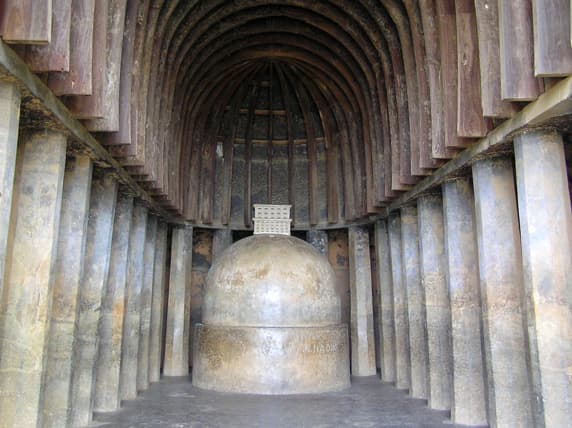
The Bedse Caves complex consists of two primary rock-cut chambers. The more prominent of the two is Cave 7, a chaitya hall, which houses a comparatively large stupa. This chaitya is distinguished by its entrance passage and a verandah adorned with four exceptionally elaborate columns. These columns feature capitals with pairs of animals and riders, described as possessing "solemn grandeur." The side walls of the verandah are decorated with low-relief gavaksha motifs and latticework, mimicking architectural railings, similar to those found in the Karla Caves. In contrast to the facade, the interior of the chaitya hall is noted for its simplicity, featuring plain octagonal columns and lacking the extensive decoration found in some other chaityas. Remnants of decorative ribs on the roof, which were made of actual wood, have been lost to time.
The second main cave, Cave 11, serves as a vihara, or monastery. This cave exhibits a somewhat unusual layout, with its main chamber shaped somewhat like a chaitya, possessing a rectangular plan that rounds off at the far end and a vaulted roof. While this chamber is now open, it is presumed to have originally been enclosed by a wooden screen. Around this central chamber are nine doorways leading to individual cells for monks, each framed by a relief chaitya-arch surround. Friezes depicting railing patterns run along the walls at two different levels. Additionally, there are four more cells located externally, in the area where the screen would have been.
Historical Context and Visitation
An inscription found on one of the gate arches provides a historical detail, stating it was a "Gift of Pushyanka, son of Ananda Sethi from Nashik." The caves were reportedly maintained and even painted until around 1861, with these efforts undertaken by local authorities to please visiting British officers. Unfortunately, these activities led to the loss of remnants of plaster that likely contained murals.
Bedse Caves are considered less known and visited compared to their famous neighbors, Karla and Bhaja. Completing the trilogy of caves in the Mawal Region necessitates a visit to Bedse. Access to the caves involves an easy hike of about 400 steps. The caves face east, making early morning visits ideal for appreciating the carvings in the best light. The rainy season is particularly recommended for visitors seeking lush green landscapes and the spectacle of small waterfalls, offering a less crowded experience to enjoy the natural beauty and the ancient rock-cut architecture.
Source: Wikipedia ↗
Frequently Asked Questions
When were the Bedse Caves built?
The history of the Bedse Caves can be traced back to the Satavahana period, with their construction dating to the 1st century BCE.
What are the main structures within the Bedse Caves?
The complex features two primary rock-cut caves: Cave 7, a chaitya or prayer hall, and Cave 11, a vihara or monastery. There is also a small stupa located outside the main caves.
What is notable about the chaitya hall at Bedse Caves?
Cave 7, the chaitya hall, is recognized for its front verandah which displays four elaborate columns with capitals depicting pairs of animals and riders. The hall itself, however, is relatively plain with octagonal columns.
How can one visit the Bedse Caves?
The caves can be reached from Pune via Kamshet, or through alternative routes via Paud or Somatne-Phata on the Pune-Mumbai NH4 Highway. An easy hike of about 400 steps leads to the site.
What is the best time to visit Bedse Caves?
The rainy season is considered the best time to visit Bedse Caves due to the lush greenery and creation of small waterfalls. Visiting in the early morning is also recommended to appreciate the carvings in sunlight.
Related Buddhist Temples
Bhaja Caves
The Bhaja Caves are a complex of 22 rock-cut Buddhist caves located in Maharashtra, India, dating back to the 2nd century BC. Situated on an ancient trade route, these caves are significant for their early Buddhist architecture, particularly the chaitya (Cave XII) which showcases the evolution of wooden architectural forms in stone. The site is also notable for its stupas, inscriptions, and relief carvings that provide insights into ancient Indian culture, including the use of musical instruments like the tabla.

Chaukhandi Stupa
The Chaukhandi Stupa is a significant Buddhist monument located in Sarnath, India, a site of great importance for Buddhism. Originally built as a terraced temple, it was later modified to commemorate a historical event, making it a unique blend of religious and historical significance.

Batatotalena Cave Vihara
Batatotalena Cave Vihara, also referred to as Diva Guhava (Day Cave) in Buddhist texts, is a significant cave system in Sri Lanka. It is traditionally believed to be the site where the Buddha spent a day after leaving his footprint at Adam's Peak, making it a place of considerable religious importance.