
Bhaja Caves
Caves·India·2nd century BC·Early Buddhist schools
The Bhaja Caves are a complex of 22 rock-cut Buddhist caves located in Maharashtra, India, dating back to the 2nd century BC. Situated on an ancient trade route, these caves are significant for their early Buddhist architecture, particularly the chaitya (Cave XII) which showcases the evolution of wooden architectural forms in stone. The site is also notable for its stupas, inscriptions, and relief carvings that provide insights into ancient Indian culture, including the use of musical instruments like the tabla.
Key Facts
- ›Comprise 22 rock-cut caves dating from the 2nd century BC.
- ›Located on an ancient trade route connecting the Arabian Sea to the Deccan Plateau.
- ›The most prominent excavation is Cave XII, a chaitya hall with a vaulted horseshoe ceiling, reflecting early wooden architectural styles.
- ›Contain a group of 14 stupas, believed to be relics of resident monks.
- ›Inscriptions within the caves provide donor names and dates, with some datable to the 2nd century BC.
- ›Relief carvings depict musicians playing the tabla and dancers, offering evidence of the instrument's early use in India.
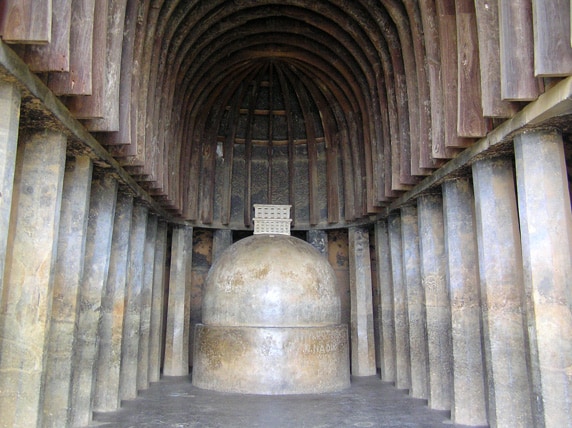
- Chaitya Hall
- Vaulted Horseshoe Ceiling
- Stupas
- Relief Carvings Depicting Musicians and Dancers
- Inscriptions
- Waterfall and Pool
Rock-Cut Architecture, Early Buddhist Architecture
About Bhaja Caves
The Bhaja Caves are a significant complex of 22 rock-cut caves situated in the state of Maharashtra, India, with origins dating back to the 2nd century BC. Perched approximately 400 feet above the village of Bhaja, these caves occupy a strategic position along an ancient trade route that facilitated commerce between the Arabian Sea and the Deccan Plateau, a crucial geographical division in ancient India. The Archaeological Survey of India recognizes the inscriptions and cave temple structures as a Monument of National Importance, underscoring their historical and cultural value.
The caves are affiliated with the Early Buddhist schools that flourished in Maharashtra. Among their most remarkable features are numerous stupas, serving as relics of resident monks who lived and died at the site. The most architecturally significant excavation is Cave XII, a chaitya (or chaityagrha), which stands as a prime example of the early development of this sacred hall. Its design, particularly the vaulted horseshoe ceiling, clearly indicates an awareness of and adaptation from earlier wooden architectural forms. The presence of a pillared verandah in the vihara (Cave XVIII) and unique relief carvings further enhance the site's importance.
Architecturally, the Bhaja Caves share similarities with the nearby Karla Caves. The chaitya hall in Cave XII is distinguished by its open, horseshoe-arched entrance and unique reliefs drawn from Indian mythology. Other caves exhibit a nave and aisle structure surrounding a solid stupa, designed to accommodate circumambulation. Inscriptions found within the caves, some dating as far back as the 2nd century BC, provide invaluable historical data, including the names of donors such as Maharathi Kosikiputa Vihnudata. The sculptures, often adorned with elaborate headdresses and jewelry, may have been brightly painted in antiquity. Notably, carvings depicting a woman playing the tabla and another dancing provide crucial evidence for the early presence of this percussion instrument in India, challenging earlier assumptions about its foreign origins.
A group of 14 stupas, five within and nine outside an irregular excavation, are a notable part of the monument. These stupas are believed to contain the relics of monks, with inscriptions identifying individuals such as Ampinika, Dhammagiri, and Sanghdina, along with their titles like 'Thera' (venerable elder). The stupas themselves are elaborately carved, with two featuring relic boxes. The caves also showcase early Buddhist artistic conventions, initially featuring symbolic representations of the Buddha, which later evolved to include physical depictions after 4 AD. During the monsoon season, a waterfall near the last cave cascades into a small pool, adding a natural element to the historical site.
Source: Wikipedia ↗
Frequently Asked Questions
When were the Bhaja Caves constructed?
The Bhaja Caves were constructed in the 2nd century BC. Evidence from wooden beams within the caves indicates their existence for at least 2200 years.
What is the significance of Cave XII at Bhaja Caves?
Cave XII is a chaitya hall, considered one of the earliest surviving examples of this type. It is notable for its vaulted horseshoe ceiling, imitation of wooden architectural elements, and ancient wooden ribs, showcasing the transition from wooden to rock-cut structures.
What do the carvings at Bhaja Caves reveal about ancient Indian music?
Carvings at Bhaja Caves depict a woman playing the tabla and another dancing. This provides significant evidence that the tabla, an Indian percussion instrument, was in use in India at least 2300 years ago.
What are the stupas at Bhaja Caves and what do they signify?
The Bhaja Caves feature a group of 14 stupas, believed to contain the relics of monks who resided and passed away at the site. Inscriptions on some stupas bear the names of these monks, such as Ampinika, Dhammagiri, and Sanghdina.
Where are the Bhaja Caves located in relation to major cities?
The Bhaja Caves are located near the city of Pune, off the Mumbai-Pune expressway in Maharashtra, India. They are situated approximately 400 feet above the village of Bhaja.
Related Buddhist Temples

Bedse Caves
Bedse Caves is a significant Buddhist rock-cut monument complex located in Pune District, Maharashtra, India. Dating back to the 1st century BCE of the Satavahana period, the caves comprise a chaitya (prayer hall) and a vihara (monastery), both featuring intricate carvings and decorative motifs. They are notable for their architectural style and their place within a historically important region of Buddhist cave sites.

Ajanta Caves
The Ajanta Caves are a series of approximately 30 rock-cut Buddhist cave monuments located in Maharashtra, India, dating from the 2nd century BCE to about 480 CE. Universally recognized as masterpieces of Buddhist religious art, they feature exquisite paintings and sculptures that are among the finest surviving examples of ancient Indian art, particularly noted for their expressive depiction of emotions. These caves served as monasteries and worship halls, offering a monsoon retreat for monks and a resting place for travelers, and are now a UNESCO World Heritage Site.

Abhayagiriya
Abhayagiriya Vihāra was a prominent Buddhist monastic complex and a royal capital in Anuradhapura, Sri Lanka, historically serving as a major center for Theravada, Mahayana, and Vajrayana Buddhism. It was a significant religious and educational institution, attracting scholars from afar and playing a crucial role in the spread of Buddhism internationally, making it a vital pilgrimage site.