
Saddan Cave
Saddan Cave is a significant Buddhist cave temple located in Hpa-An, Kayin State, Myanmar, notable for its extensive collection of hundreds of small Buddha statues. It is the longest cave in Karen State and holds cultural importance, with legends connecting it to the king of elephants and a legendary hunter king.
Key Facts
- ›Saddan Cave is a major Buddhist cave temple housing hundreds of small Buddha statues.
- ›It is the longest cave in Karen State, measuring 107 meters (351 ft) in length.
- ›The cave is located at the southernmost point of the Zwegabin Mountain range in Hpa-An, Myanmar.
- ›It is named after Saddan, a legendary king of elephants, and features a stalagmite known as the 'Stone Pillar of the King of Elephants'.
- ›A Saddan Cave Pagoda festival is held annually on the last day of Thingyan.
- ›Adjacent to the cave exit is a large lake believed to be King Saddan's bathing lake.

Important Relationships
- Saddan (King of Elephants)
- King Paarwana
Hundreds of Small Buddha Statues, Stone Pillar of the King of Elephants, Large Lake At the Exit
- Saddan Cave Pagoda Festival Held Annually On the Last Day of Thingyan
About Saddan Cave
Saddan Cave, known locally as "ဆဒ္ဒန်ဂူ" (Saddan Gu), is a significant Buddhist cave temple located in Hpa-An, Kayin State, Myanmar. It is situated at the southernmost extent of the Zwegabin Mountain range. The cave is distinguished by its impressive size, measuring 107 meters (351 ft) from east to west and reaching a maximum width of 40 meters (130 ft), making it the longest cave in Karen State. Its entrance is described as narrow.
Historical and Legendary Significance
The cave derives its name from Saddan, a legendary king of elephants, and legend states that the largest stalagmite within the cave is known as the "Stone Pillar of the King of Elephants." Further local lore connects Saddan Cave to the legendary King Paarwana, who is said to have used it as a resting place during his time as a hunter. At the cave's exit lies a substantial lake, which is believed in local tradition to be the bathing lake of King Saddan himself.
Religious and Cultural Importance
Saddan Cave is a major center for Buddhist worship and contains hundreds of small Buddha statues. Its religious and cultural significance is further marked by the annual Saddan Cave Pagoda festival, which is celebrated every year on the last day of the Thingyan festival. The cave's location and its associated legends contribute to its status as a place of interest for both religious devotees and visitors.
Source: Wikipedia ↗
Frequently Asked Questions
Where is Saddan Cave located?
Saddan Cave is situated in Hpa-An, Kayin State, Myanmar, at the southernmost point of the Zwegabin Mountain range.
What is significant about Saddan Cave?
It is recognized as the longest cave in Karen State and contains hundreds of small Buddha statues. It also holds mythological significance, being named after a legendary king of elephants and associated with a legendary hunter king.
What are some notable features of Saddan Cave?
The cave is 107 meters long and features a prominent stalagmite called the 'Stone Pillar of the King of Elephants'. At its exit, there is a large lake said to be King Saddan's bathing lake.
When is the Saddan Cave Pagoda festival held?
The Saddan Cave Pagoda festival takes place annually on the last day of Thingyan.
Related Buddhist Temples
Kawgun Cave
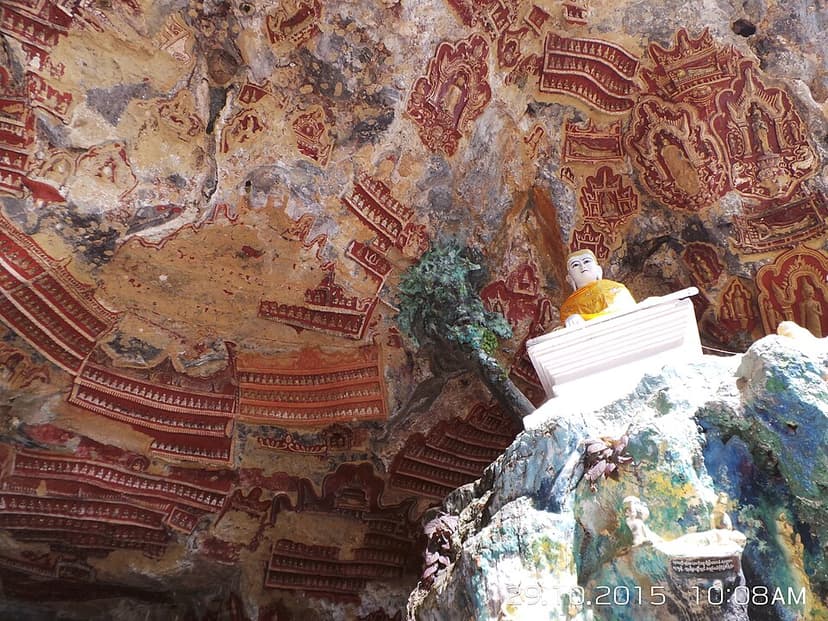
The Kawgun Cave is a significant Buddhist cave temple located in Kayin State, Myanmar, renowned for its walls adorned with thousands of small Buddha statues. Believed to have been constructed around the 7th century, it holds important historical and cultural value, with inscriptions providing insights into its past and the patronage of royalty.

Pindaya Caves
The Pindaya Caves are a significant Buddhist pilgrimage site and tourist attraction located in Shan State, Myanmar. This natural limestone cave system is renowned for housing over 8,000 Buddha images, with some dating back to the late 18th century, showcasing a diverse range of Buddhist iconography and art from the Konbaung era to the present. Scholars are actively promoting its inclusion on the UNESCO World Heritage List.

Jogeshwari Caves
The Jogeshwari Caves are a significant complex of early Hindu cave temples in Mumbai, India, dating back to the sixth century and attributed to the Chalukya dynasty. Considered by some scholars to be the earliest major cave temple in India and the largest in terms of total length, these caves are dedicated to the Hindu deity Jogeshwari and feature a blend of Hindu and Mahayana Buddhist architectural elements.