
Jogeshwari Caves
Cave Temple·India·6th century·Hindu (Pashupata), Mahayana Buddhist
The Jogeshwari Caves are a significant complex of early Hindu cave temples in Mumbai, India, dating back to the sixth century and attributed to the Chalukya dynasty. Considered by some scholars to be the earliest major cave temple in India and the largest in terms of total length, these caves are dedicated to the Hindu deity Jogeshwari and feature a blend of Hindu and Mahayana Buddhist architectural elements.
Key Facts
- ›The Jogeshwari Caves are located in the Mumbai suburb of Jogeshwari, India.
- ›They date back to the sixth century, during the Chalukya dynasty's rule.
- ›The caves are dedicated to the Hindu deity Jogeshwari, after whom the area is named.
- ›They are considered by some to be the earliest major cave temple and largest in India by total length.
- ›The complex exhibits sculptures and pillars of Mahayana Buddhist architecture alongside Hindu iconography.
- ›These caves represent the earliest Pashupata Caves found in Mumbai.

Important Relationships
- Chalukya dynasty
- Lingam
- Idols of Dattatreya, Hanuman, and Ganesh
- Relics of Two Doorkeepers
- Murti and Footprints of Goddess Jogeshwari
- Six Sculptural Panels Depicting Shaivite Episodes
- Sculptures and Pillars of Mahayana Buddhist Architecture
Chalukya, Hindu Cave Temple, Mahayana Buddhist
About Jogeshwari Caves
The Jogeshwari Caves represent a significant early complex of Hindu cave temples located in the Mumbai suburb of Jogeshwari, India. Their construction is attributed to the sixth century, during the period of the Chalukya dynasty. Discovered during the excavation of the more famous Ajanta and Elephanta caves in Maharashtra, Jogeshwari Caves hold a unique place in Indian architectural and religious history.
Historical Significance and Features
According to historical scholarship, Jogeshwari Caves are considered by some to be the earliest major cave temple in India and, in terms of total length, the largest. These caves are dedicated to the Hindu deity Jogeshwari, after whom the locality is named. The deity is revered as a Kuladevi by some Marathi communities and also by certain migrant groups from Gujarat. Architecturally, the caves are notable for their blend of styles, containing both Hindu iconography and elements of Mahayana Buddhist architecture, including sculptures and pillars.
The main hall of the cavernous space is reached via a long flight of stairs. Within the caves, visitors can find numerous pillars and a Lingam at the far end. The walls are adorned with idols of Dattatreya, Hanuman, and Ganesh, alongside relics of two doorkeepers. A murti and the footprints of the goddess Jogeshwari are also present. The cave complex is recognized as containing the earliest Pashupata Caves in Mumbai. Its six sculptural panels illustrate various episodes from Shaivism, such as the marriage of Shiva and Parvati, the slaying of Andhakasura, Shiva accepting Ravana as a disciple, Shiva and Parvati playing dice, Nataraja, and Lakulisha Shiva.
Source: Wikipedia ↗
Frequently Asked Questions
When were the Jogeshwari Caves built?
The Jogeshwari Caves date back to the sixth century. This period places their construction during the era of the Chalukya dynasty.
Who is the main deity worshipped at the Jogeshwari Caves?
The caves are dedicated to the Hindu deity Jogeshwari, also known as Yogeshwari. She is also considered a Kuladevi by some Marathi people and is worshipped by certain migrant groups from Gujarat.
What architectural styles can be found at the Jogeshwari Caves?
The Jogeshwari Caves feature a blend of architectural styles. While primarily Hindu cave temples, they also contain sculptures and pillars indicative of Mahayana Buddhist architecture.
What notable sculptures are present in the Jogeshwari Caves?
The caves contain six sculptural panels depicting episodes from Shaivism, such as the marriage of Shiva and Parvati, Andhakasura Vad, and Shiva accepting Ravana as his disciple. There are also idols of Dattatreya, Hanuman, Ganesh, and relics of doorkeepers, along with a murti and footprints of goddess Jogeshwari.
Related Buddhist Temples
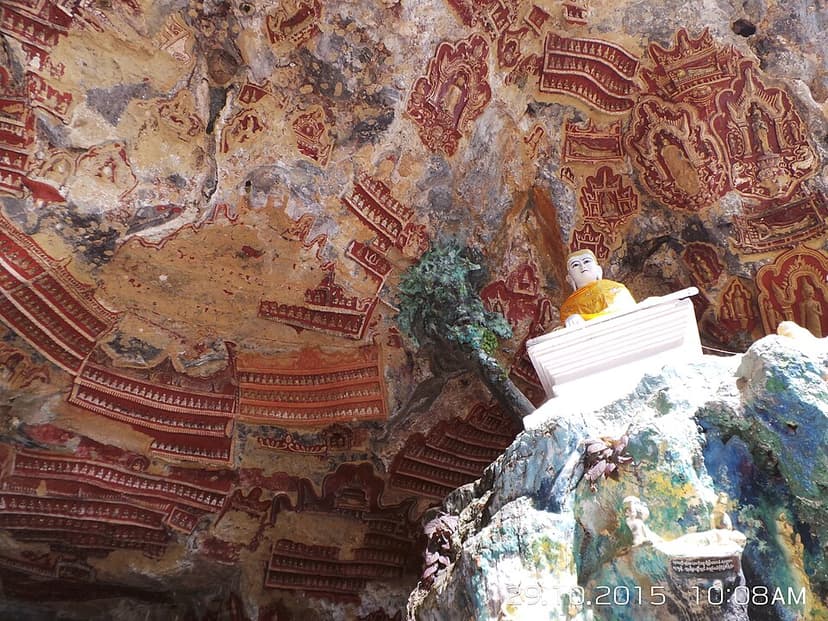
Kawgun Cave
The Kawgun Cave is a significant Buddhist cave temple located in Kayin State, Myanmar, renowned for its walls adorned with thousands of small Buddha statues. Believed to have been constructed around the 7th century, it holds important historical and cultural value, with inscriptions providing insights into its past and the patronage of royalty.

Pindaya Caves
The Pindaya Caves are a significant Buddhist pilgrimage site and tourist attraction located in Shan State, Myanmar. This natural limestone cave system is renowned for housing over 8,000 Buddha images, with some dating back to the late 18th century, showcasing a diverse range of Buddhist iconography and art from the Konbaung era to the present. Scholars are actively promoting its inclusion on the UNESCO World Heritage List.

Saddan Cave
Saddan Cave is a significant Buddhist cave temple located in Hpa-An, Kayin State, Myanmar, notable for its extensive collection of hundreds of small Buddha statues. It is the longest cave in Karen State and holds cultural importance, with legends connecting it to the king of elephants and a legendary hunter king.