
Gangaramaya Temple
Gangaramaya Temple is one of Colombo, Sri Lanka's most significant Buddhist temples, blending modern architecture with cultural heritage. Situated on Beira Lake, it serves as a prominent center for worship, education, and Buddhist welfare activities, attracting visitors with its unique architectural styles and tolerant ethos.
Key Facts
- ›Founded in the late 19th century by Don Bastian de Silva Jayasuriya Goonewardane.
- ›Features an eclectic architectural MIX of Sri Lankan, Thai, Indian, and Chinese styles.
- ›Located on the Beira Lake in Colombo, Sri Lanka.
- ›Includes a Vihara, Cetiya (Pagoda), Bodhitree, museum, library, and educational halls.
- ›The Seema Malaka, designed by Geoffrey Bawa, is a notable tourist attraction.
- ›Involved in Buddhist welfare work, including an orphanage and vocational school.

Important Relationships
- Geoffrey Bawa
- Hikkaduwe Sri Sumangala Thera
- Ratmalana Sri Dharmarama Thero
- Waskaduwa Sri Subhuti Thero
- Weligama Sri Sumangala Thero
- Welivitiye Dhammaratna Thero
- Pandit Batuwantudawe
Seema Malaka, Museum, Library, Bodhitree, Cetiya
Sri Lankan, Thai, Indian, Chinese
About Gangaramaya Temple
Gangaramaya Temple stands as one of the most significant Buddhist temples in Colombo, Sri Lanka, artfully merging modern architectural elements with deep cultural essence. This prominent temple is situated on the picturesque Beira Lake, a location that was once a small hermitage on marshy land. Its establishment in the late 19th century was spearheaded by Don Bastian de Silva Jayasuriya Goonewardane, a shipping merchant who sought a suitable site for Hikkaduwe Sri Sumangala Thera.
Architecture and Features
The architectural character of Gangaramaya Temple is a notable eclecticism, drawing inspiration from Sri Lankan, Thai, Indian, and Chinese traditions. The complex comprises several imposing buildings, including the principal Vihara (temple), a Cetiya (Pagoda), a sacred Bodhitree, and a Vihara Mandiraya. It also features a Seema malaka, an assembly hall for monks, and a Relic Chamber. Beyond its religious structures, the premises encompass a museum, a library, a residential hall, a three-story Pirivena, educational halls, and an alms hall.
A particular highlight for visitors is the architectural design of the Seema Malaka, which was conceived by the renowned architect Geoffrey Bawa and funded through donations from a Muslim sponsor. The original temple grounds were meticulously prepared and enhanced by its founder, who constructed a large 'Chaitya' (Dagaba), a decorative arch (thorana), and a 'Sandakada pahana' modeled after those at Anuradhapura. A sapling from the sacred Sri Maha Bhodiya in Anuradhapura was also planted and nurtured on the grounds.
Historical and Contemporary Significance
Gangaramaya Temple has been a home to many erudite scholars, including Ratmalana Sri Dharmarama Thero, Waskaduwa Sri Subhuti Thero, Weligama Sri Sumangala Thero, Welivitiye Dhammaratna Thero, and Pandit Batuwantudawe. Today, it continues to serve as a vital center for Buddhist worship and education. The temple actively engages in Buddhist welfare initiatives, supporting an old people's home, a vocational school, and an orphanage.
Recognized for its uniquely attractive and tolerant approach towards members of various religions, Gangaramaya Temple has also played a role in propagating the Dhamma internationally. It has been instrumental in the establishment of Buddhist temples and centers in the United States (Staten Island and New York) and Tanzania, demonstrating its commitment to spreading Buddhist teachings globally.
Source: Wikipedia ↗
Frequently Asked Questions
When was Gangaramaya Temple established?
Gangaramaya Temple was completed in the late 19th century. The land was acquired and prepared by Don Bastian de Silva Jayasuriya Goonewardane, who then assisted in building the temple.
What are the main architectural styles found at Gangaramaya Temple?
The temple's architecture is an eclectic blend of Sri Lankan, Thai, Indian, and Chinese styles. This diverse approach is evident in its various imposing buildings.
What notable structures are part of Gangaramaya Temple?
Key features include the main Vihara, a Cetiya (Pagoda), a Bodhitree, a Vihara Mandiraya, and the Seema malaka (assembly hall for monks). It also houses a museum, library, and educational facilities.
Is the Seema Malaka a significant part of Gangaramaya Temple?
Yes, the Seema Malaka is particularly notable for tourists and was designed by Geoffrey Bawa. It was constructed with donations from a Muslim sponsor.
What kind of activities does Gangaramaya Temple engage in today?
Gangaramaya Temple functions as a place of Buddhist worship and a learning center. It is also involved in Buddhist welfare work, such as operating an orphanage and a vocational school.
Does Gangaramaya Temple have international connections?
Yes, the temple has been instrumental in establishing Buddhist centers in other countries, including a temple on Staten Island in the US, a Buddhist Center in New York, and a Buddhist Center in Tanzania.
Related Buddhist Temples
Asokaramaya Buddhist Temple
Asokaramaya Buddhist Temple is a significant religious site in Kalutara, Sri Lanka, established in the 1870s. It was founded to provide a sanctuary for disciples of the revered monk Aluthgama Sangharatne and was generously funded by local resident Elliyas Fernando. Over time, the temple has undergone numerous expansions and renovations, evolving into a complex housing various important structures and relics.

Beligammana Raja Maha Vihara
Beligammana Raja Maha Vihara, also known as Beligammana Pothgul Vihara, is a significant Buddhist temple located in Mawanella, Sri Lanka. Constructed in the early 19th century, it holds the status of an archaeological protected monument, highlighting its historical and cultural importance.
Dodanthale Raja Maha Vihara
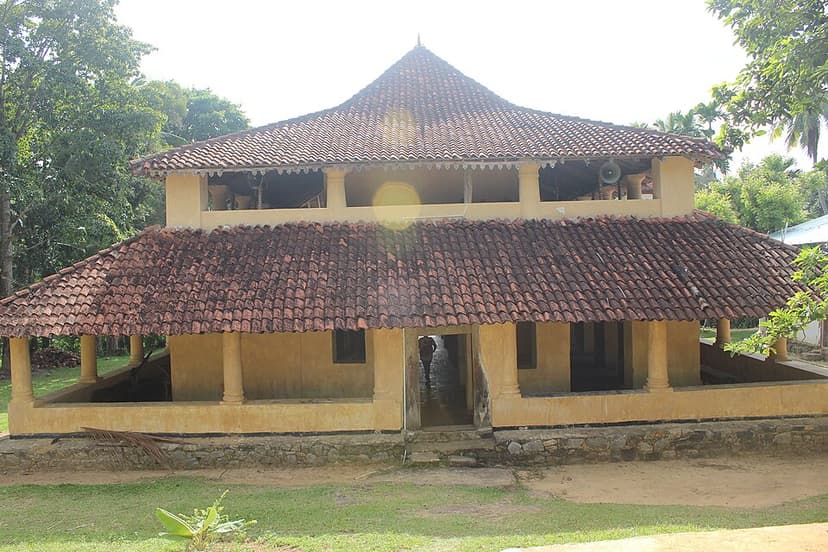
Dodanthale Raja Maha Vihara is a historic Buddhist temple in Mawanella, Kegalle District, Sri Lanka, recognized as an archaeological site by the government. Originally conceived as a royal palace by Adikaram Molligoda, it was converted into a Buddhist Vihara before completion in 1832. The temple is particularly noted for its image house, constructed in the Tempita Vihara tradition with unusually tall pillars and adorned with Kandyan-period murals.