
Seema Malaka
Seema Malaka is a Buddhist temple located in Colombo, Sri Lanka, situated on the Beira Lake. Originally built in the late 19th century, it was redesigned by Geoffrey Bawa in 1976 after the original structure sank. The temple is primarily used for meditation and rest, serving as a serene space apart from typical worship.
Key Facts
- ›Originally constructed in the late 19th century.
- ›Redesigned and reconstructed by architect Geoffrey Bawa in 1976.
- ›Located on three platforms over the Beira Lake, connected by pontoon bridges.
- ›Features wooden finishes, blue-tiled roofs, and architecture resembling the Kandyan era.
- ›Houses seated Buddha statues displaying various mudras and a Bodhi Tree grown from a branch of the Jaya Sri Maha Bodhi.
- ›Includes small shrines dedicated to Hindu deities Shiva, Vishnu, Kataragama deviyo, and Ganesha, as well as shrines to Guanyin.

Important Relationships
- Gangaramaya Temple
- Geoffrey Bawa
- S. H. Musaji
- Ameer S. Musaji
- Jaya Sri Maha Bodhi
- Located On Beira Lake
- Three Platforms Over Water
- Pontoon Bridges
- Blue Color Tiled Roof
- Wooden Finishes
- Seated Buddha Statues
- Bodhi Tree
- Shrines To Shiva, Vishnu, Kataragama Deviyo, Ganesha
- Shrines To Guanyin
- Original Structure Sank Into the Water In the 1970s.
- Redesigned and Reconstructed By Geoffrey Bawa In 1976.
Kandyan Era Resemblance
About Seema Malaka
Seema Malaka is a distinctive Buddhist temple situated in Colombo, Sri Lanka, uniquely positioned on the Beira Lake. This temple serves primarily as a serene space for meditation and rest, rather than for congregational worship.
History and Reconstruction
The original structure of Seema Malaka was established in the late 19th century. However, over time, the original edifice gradually sank into the lake. In response to this, Sri Lankan architect Geoffrey Bawa undertook a significant redesign and reconstruction project in 1976. The rebuilding efforts were made possible by the financial contributions of S. H. Musaji, a Sri Lankan Muslim businessman, and his wife, who funded the project in remembrance of their son, Ameer S. Musaji.
Architectural Design and Features
Geoffrey Bawa's design for Seema Malaka was inspired by the ancient monastic complexes found in the forests of Anuradhapura and Ritigala. The temple is constructed upon three interconnected platforms that extend over the water. These platforms are linked to the mainland and to each other by pontoon bridges, enhancing the sense of floating tranquility. The main roof is adorned with blue tiles, and the temple's aesthetic is characterized by its wooden finishes, incorporating collected spindles and handrails. The overall architectural style bears a resemblance to the Kandyan era.
Each of the three platforms is populated with numerous seated Buddha statues, each depicted in a different mudra (symbolic hand gesture). The central platform is designed as a sheltered space for meditation, featuring wooden paneling. One of the side platforms is home to a Bodhi Tree, which was cultivated from a branch of the sacred Jaya Sri Maha Bodhi tree located in Anuradhapura. Complementing the Buddhist iconography, the four corners of a side platform host small shrines dedicated to the Hindu deities Shiva, Vishnu, Kataragama deviyo, and Ganesha. Additionally, a shrine to Guanyin is located at the temple's entrance, with another statue of Guanyin also present within the complex.
Source: Wikipedia ↗
Frequently Asked Questions
When was Seema Malaka originally built?
Seema Malaka was originally constructed in the late 19th century. The original structure eventually sank into the water.
Who redesigned Seema Malaka?
Sri Lankan architect Geoffrey Bawa was responsible for the redesign and reconstruction of Seema Malaka in 1976. His design drew inspiration from ancient forest monasteries.
What is the primary purpose of Seema Malaka?
Seema Malaka is mainly utilized for meditation and rest, offering a tranquil environment rather than serving as a primary place for worship.
What are some notable architectural features of Seema Malaka?
The temple is built on three platforms over water, connected by pontoon bridges. It features wooden finishes, blue-tiled roofs, and its architecture is inspired by the Kandyan era. Numerous seated Buddha statues are present, along with a Bodhi Tree.
What deities are venerated at Seema Malaka besides Buddha?
In addition to Buddha statues, the temple complex includes small shrines dedicated to the Hindu deities Shiva, Vishnu, Kataragama deviyo, and Ganesha. Shrines dedicated to Guanyin are also found at the entrance and within the complex.
Related Buddhist Temples
Asokaramaya Buddhist Temple
Asokaramaya Buddhist Temple is a significant religious site in Kalutara, Sri Lanka, established in the 1870s. It was founded to provide a sanctuary for disciples of the revered monk Aluthgama Sangharatne and was generously funded by local resident Elliyas Fernando. Over time, the temple has undergone numerous expansions and renovations, evolving into a complex housing various important structures and relics.

Beligammana Raja Maha Vihara
Beligammana Raja Maha Vihara, also known as Beligammana Pothgul Vihara, is a significant Buddhist temple located in Mawanella, Sri Lanka. Constructed in the early 19th century, it holds the status of an archaeological protected monument, highlighting its historical and cultural importance.
Dodanthale Raja Maha Vihara
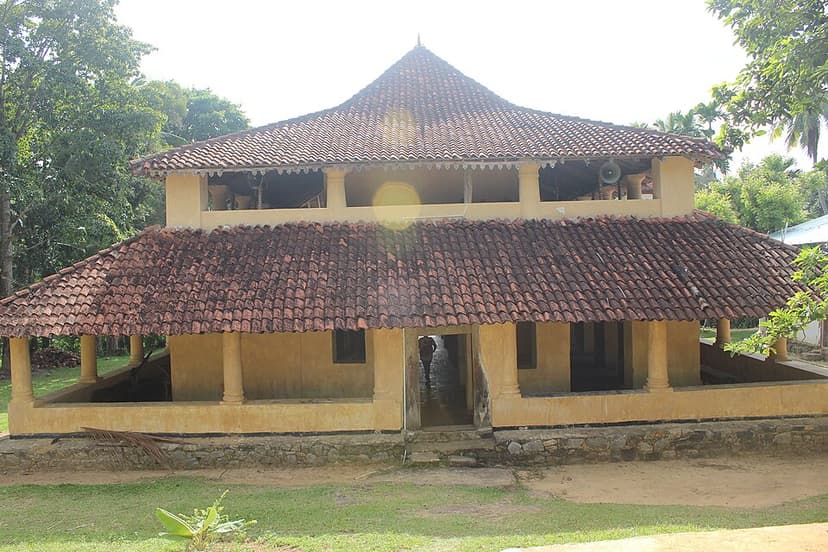
Dodanthale Raja Maha Vihara is a historic Buddhist temple in Mawanella, Kegalle District, Sri Lanka, recognized as an archaeological site by the government. Originally conceived as a royal palace by Adikaram Molligoda, it was converted into a Buddhist Vihara before completion in 1832. The temple is particularly noted for its image house, constructed in the Tempita Vihara tradition with unusually tall pillars and adorned with Kandyan-period murals.