
Dodanthale Raja Maha Vihara
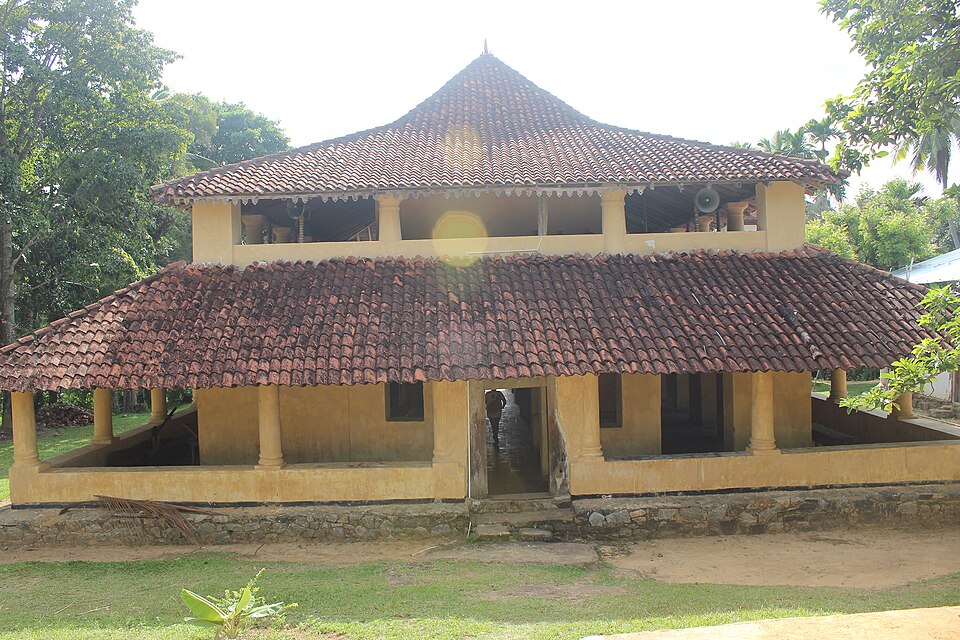
Dodanthale Raja Maha Vihara is a historic Buddhist temple in Mawanella, Kegalle District, Sri Lanka, recognized as an archaeological site by the government. Originally conceived as a royal palace by Adikaram Molligoda, it was converted into a Buddhist Vihara before completion in 1832. The temple is particularly noted for its image house, constructed in the Tempita Vihara tradition with unusually tall pillars and adorned with Kandyan-period murals.
Key Facts
- ›Originally designed as a royal palace by Adikaram Molligoda, intended to house the Tooth Relic on its third storey.
- ›Converted into a Buddhist Vihara and completed in 1832.
- ›Recognized as an archaeological site by the Sri Lankan government on November 10, 1978.
- ›Features a unique image house built in the Tempita Vihara style with tall pillars.
- ›The image house contains three timber-carved Buddha statues and Kandyan-period murals, including a portrait of Kirti Sri Rajasinha.
- ›Preserves an old earthen vessel known as a Pathra, historically used for water or offerings.
Important Relationships
- Adikaram Molligoda
- Kirti Sri Rajasinha
Tempita Vihara Style Image House, Unusually Tall Pillars In the Image House, Kandyan Period Murals, Timber-Carved Buddha Statues, Pathra
- Conversion From Royal Palace To Buddhist Vihara
- Completion of Building In 1832
- Designation As An Archaeological Site In 1978
Tempita Vihara
About Dodanthale Raja Maha Vihara
Dodanthale Raja Maha Vihara, also known as Sri Seneviratne Uposatha Raja Maha Vihara, is a significant historic Buddhist temple located in Mawanella, Kegalle District, Sri Lanka. The temple holds the distinction of being formally recognized by the Sri Lankan government as an archaeological site, a designation declared in 1978. Its name, "Raja Maha Vihara," signifies its historical status as a "Great Royal Temple" or "Great Royal Monastery," indicating past royal patronage or donations.
History and Design
The origins of the Dodanthale Raja Maha Vihara structure are unique, as it was initially designed by chief Adikaram Molligoda to serve as a royal palace. The architectural plans included a ground floor for royal audiences, a first floor for living quarters, and a third floor intended for the sacred Tooth Relic of the Buddha. The site was chosen for its natural defenses, with hills to the north and south and moats on the east and west. Prior to the completion of the third storey, Molligoda decided to convert the building into a Buddhist Vihara. The structure was finished in 1832, standing 15.3 meters (50 ft) long and 12.3 meters (40 ft) wide, with twelve steps leading to its hall. The ground floor now functions as a preaching hall, with two wooden staircases ascending to the second floor. The roof is covered with Koku Ulu tiles.
Image House and Artistic Features
A prominent feature of Dodanthale Raja Maha Vihara is its image house, constructed in the traditional "Tempita Vihara" style. This style is characterized by elevated structures supported by pillars. While most Tempita Vihara buildings feature pillars around 0.9–1.23 meters (3.0–4.0 ft) in height, the pillars at Dodanthale temple are notably taller, reaching approximately 1.84 meters (6.0 ft). This image house is a two-storied edifice, with the lower level serving as a "Bana Maduwa" (preaching hall) and the upper floor as the image house itself. The upper floor, surrounded by a veranda, houses three Buddha statues meticulously carved from timber. The interior walls and ceiling of the image house are adorned with vibrant Kandyan-period murals. Among these artworks, a portrait has been identified as Kirti Sri Rajasinha (reigned 1747–1782), depicted wearing the "Kurulu Padakkama" (Bird pendant). This jewel, made for Adikaram Molligoda, bears a Sinhalese inscription on its reverse. Additionally, an old, large, wide-mouthed earthen vessel known as a "Pathra," traditionally used for holding water or receiving offerings from worshippers, is preserved on the temple premises.
Source: Wikipedia ↗
Frequently Asked Questions
What does "Raja Maha Vihara" signify?
"Raja Maha Vihara" translates to "Great Royal Temple" or "Great Royal Monastery" in English. This designation historically indicates ancient Sri Lankan Buddhist temples that received royal patronage or donations from the king.
What was the original purpose of the Dodanthale Raja Maha Vihara building?
The structure was initially designed by chief Adikaram Molligoda to serve as a royal palace. The ground floor was intended as an audience hall, the first floor for royal residences, and the third floor for housing the Tooth Relic of the Buddha.
When was the Dodanthale Raja Maha Vihara completed?
The building was completed in 1832. It was converted from its original design as a royal palace into a Buddhist Vihara before its final construction.
What is notable about the image house at Dodanthale Raja Maha Vihara?
The image house is well-known for being built in the Tempita Vihara tradition, utilizing pillars that are exceptionally tall at approximately 1.84 meters. It is a two-storied structure, with the ground floor serving as a preaching hall and the upper floor as the image house.
What artistic features can be found in the image house?
The upper floor of the image house is surrounded by a veranda and contains three Buddha statues carved from timber. The inner walls and ceiling are decorated with Kandyan-period murals, including a portrait of King Kirti Sri Rajasinha.
Related Buddhist Temples
Asokaramaya Buddhist Temple
Asokaramaya Buddhist Temple is a significant religious site in Kalutara, Sri Lanka, established in the 1870s. It was founded to provide a sanctuary for disciples of the revered monk Aluthgama Sangharatne and was generously funded by local resident Elliyas Fernando. Over time, the temple has undergone numerous expansions and renovations, evolving into a complex housing various important structures and relics.

Beligammana Raja Maha Vihara
Beligammana Raja Maha Vihara, also known as Beligammana Pothgul Vihara, is a significant Buddhist temple located in Mawanella, Sri Lanka. Constructed in the early 19th century, it holds the status of an archaeological protected monument, highlighting its historical and cultural importance.

Gangaramaya Temple
Gangaramaya Temple is one of Colombo, Sri Lanka's most significant Buddhist temples, blending modern architecture with cultural heritage. Situated on Beira Lake, it serves as a prominent center for worship, education, and Buddhist welfare activities, attracting visitors with its unique architectural styles and tolerant ethos.