
Gandantegchinlen Monastery
Gandantegchinlen Monastery, also known as Gandan Monastery, is a significant Buddhist complex in Ulaanbaatar, Mongolia. Founded in 1809, it endured periods of closure and persecution before re-emerging as the sole active monastery in Mongolia from 1944 to 1989. Today, it stands as the central hub of Buddhism in the country, housing over 100 monks and numerous religious treasures.
Key Facts
- ›Founded in 1809 by the Jebtsundamba Khutuktu lineage.
- ›Closed during Stalinist persecutions in 1939 and reopened in 1944 as the sole active monastery in Mongolia.
- ›Houses a prominent 26.5-meter (87 ft) statue of Avalokiteśvara, dedicated in 1996.
- ›Contains a vast collection of 70,000 Buddhist manuscripts and woodblock prints.
- ›Serves as the spiritual center of Buddhism in Mongolia, with its abbot recognized as the leader of Mongolian Buddhism.
- ›Its name 'Gandantegchinlen' translates from Tibetan as 'complete rejoicing'.

Important Relationships
- Je Tsongkhapa
- Jebtsundamba Khutuktu
- Zanabazar
- Joseph Stalin
- Khorloogiin Choibalsan
- Gabju Demberel Choijamts
- 26.5-Meter Statue of AvalokiteśVara
- Collection of 70,000 Buddhist Manuscripts and Woodblock Prints
- Silver and Gold Statue of Vajradhara Created By Zanabazar
- Monks' Yurts In the Vicinity
- Founded In 1809.
- Closed Amid Persecutions In 1939.
- Reopened In 1944 As the Country's Only Active Monastery.
- Megzed Janraiseg Temple Made A National Cultural Monument In 1961.
- Began Full-Scale Renovation In 1990 Following Religious Freedom.
- New 26.5-Meter Statue of AvalokiteśVara Dedicated In 1996.
About Gandantegchinlen Monastery
Gandantegchinlen Monastery, often referred to as Gandan Monastery, is a prominent Buddhist monastery located in the Bayangol District of Ulaanbaatar, Mongolia. Its name, derived from Tibetan, translates to "complete rejoicing." The monastery's history is marked by significant periods of flourishing and hardship, reflecting the broader religious landscape of Mongolia.
Founding and Early History
The monastery's origins trace back to the early 18th century with the establishment of Buddhist educational centers by the Jebtsundamba Khutuktu. The specific monastery known as Gandantegchinlen began to take shape in 1809 with the construction of Shar Temple, followed by the Lamrin dugan in 1824. Between 1834 and 1838, the fifth Jebtsundamba Khutuktu built a palace named Gandantegchinlen, which eventually lent its name to the monastery itself. Over subsequent decades, various other significant buildings were added, including the Tsogchin dugan and Ochirdari Temple, which housed a notable silver and gold statue of Vajradhara created by Zanabazar.
Persecution and Revival
Gandantegchinlen Monastery faced severe challenges during the Stalinist anti-religious persecutions in Mongolia. It was closed in 1939, and many of its structures were demolished. The monastery's precious statues, including the original Avalokiteśvara statue, were destroyed or melted down. Despite this devastation, Gandan Monastery was reopened in January 1944 by decree of Khorloogiin Choibalsan, becoming the sole active monastery in the country for decades. During this period, it maintained a limited number of monks and continued to hold public services, while also serving other purposes under state control.
Modern Era and Significance
With the advent of religious freedom in Mongolia in 1990, Gandantegchinlen Monastery underwent a comprehensive renovation and expansion. It has since grown to house over 100 resident monks and has become the undisputed center of Buddhism in Mongolia. A significant modern addition is the 26.5-meter (87 ft) statue of Avalokiteśvara, dedicated in 1996, which is a striking feature of the monastery complex. The monastery also preserves an extensive library of Buddhist texts, comprising approximately 70,000 manuscripts and woodblock prints, including rare works in multiple languages. Gandan Monastery continues to be a vital spiritual heart for Mongolian Buddhists and a significant pilgrimage site.
Source: Wikipedia ↗
Frequently Asked Questions
When was Gandantegchinlen Monastery founded?
Gandantegchinlen Monastery was founded in 1809. Its origins are linked to the establishment of Buddhist education centers by the Jebtsundamba Khutuktu in the early 18th century.
What is the significance of the Avalokiteśvara statue at Gandan Monastery?
The monastery features a large statue of Avalokiteśvara, a bodhisattva. The current 26.5-meter statue, dedicated in 1996, is a modern rendition of an earlier, similarly sized statue that was destroyed during persecutions.
What happened to Gandan Monastery during the persecutions?
Gandantegchinlen Monastery was closed in 1939 amidst Stalinist anti-religious persecutions and its buildings were largely razed. It was later reopened in 1944 by dictator Khorloogiin Choibalsan as the country's only active monastery.
What kind of religious texts are housed at Gandan Monastery?
The monastery holds approximately 70,000 Buddhist manuscripts and woodblock prints. These include important works like the 108-volume Ganjuur and the 226-volume Danjuur, in Mongolian, Tibetan, and Sanskrit.
Is Gandantegchinlen Monastery still an active religious site?
Yes, Gandantegchinlen Monastery is the center of Buddhism in Mongolia and is an active monastic residence. It currently houses over 100 resident monks and continues to be a significant site for religious practice and pilgrimage.
Related Buddhist Temples

Erdene Zuu Monastery
Erdene Zuu Monastery, established in 1585, is likely the oldest surviving Buddhist monastery in Mongolia. Located in Kharkhorin, it holds significant historical and religious importance as a center for Tibetan Buddhism and is now part of the Orkhon Valley Cultural Landscape World Heritage Site. Despite facing destruction and conversion into a museum, it has been restored as an active place of worship.
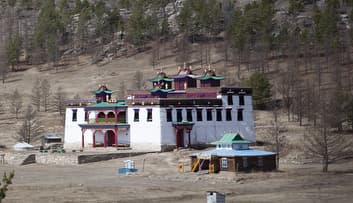
Baldan Bereeven Monastery
Baldan Bereeven Monastery is a significant Gelugpa Buddhist monastery located in the Khentii Province of Mongolia. Originally founded in 1654 and modeled after Tibetan monasteries, it grew to become one of Mongolia's largest and most important religious centers, reaching its zenith in the mid-19th century with up to 8,000 monks. Although destroyed by the communist regime in 1937, restoration efforts have been underway since 1990, with three temples currently rebuilt.

Amarbayasgalant Monastery
Amarbayasgalant Monastery is one of Mongolia's three largest Buddhist monastic centers, established in the early 18th century. It was built to house the remains of Zanabazar, the first spiritual head of Tibetan Buddhism for the Khalkha in Outer Mongolia, and reflects a unified Chinese architectural style with Mongol and Tibetan influences.