
Erdene Zuu Monastery
Erdene Zuu Monastery, established in 1585, is likely the oldest surviving Buddhist monastery in Mongolia. Located in Kharkhorin, it holds significant historical and religious importance as a center for Tibetan Buddhism and is now part of the Orkhon Valley Cultural Landscape World Heritage Site. Despite facing destruction and conversion into a museum, it has been restored as an active place of worship.
Key Facts
- ›Founded in 1585 by Abtai Sain Khan, ruler of the Khalkha Mongols.
- ›Built using stones from the ancient Mongol capital of Karakorum.
- ›Affiliated with the Gelug sect of Tibetan Buddhism.
- ›Suffered damage in 1688 and was ordered destroyed in 1939 by communist leader Khorloogiin Choibalsan.
- ›Restored as a place of worship after the fall of communism in 1990.
- ›Currently functions as both an active Buddhist monastery and a museum.

Important Relationships
- Abtai Sain Khan
- Zanabazar
- 3rd Dalai Lama
- Khorloogiin Choibalsan
- Joseph Stalin
- Henry Wallace
108 Stupas, Chinese-Style Roof Covered With Green Tiles, Kharkhorin Rock, External Wall
- Construction Ordered In 1585 After Meeting With 3rd Dalai Lama.
- Damaged In 1688 During Wars Between Dzungars and Khalkha Mongols.
- Ordered Destroyed In 1939 By Khorloogiin Choibalsan.
- Maintained As A Showpiece For International Visitors From 1944.
- Converted Into Museums In 1947.
- Restored As A Place of Worship After 1990.
Tibetan Buddhist, Chinese-Style Roof
About Erdene Zuu Monastery
Erdene Zuu Monastery, situated in Kharkhorin within Mongolia's Övörkhangai Province, stands as arguably the earliest surviving Buddhist monastery in the nation. Its construction commenced in 1585, ordered by Abtai Sain Khan, a ruler of the Khalkha Mongols and grandfather to Zanabazar, the first Jebtsundamba Khutuktu. The monastery's establishment followed Abtai Sain Khan's meeting with the 3rd Dalai Lama and the subsequent declaration of Tibetan Buddhism as the state religion of Mongolia. The building utilized stones salvaged from the nearby ruins of Karakorum, the ancient capital of the Mongol Empire.
History and Development
Initially, planners aimed to construct a surrounding wall designed to resemble a Tibetan Buddhist rosary, complete with 108 stupas, though historical accounts suggest this objective may not have been fully realized. The monastery's temples were adorned with paintings, and its roofs featured a Chinese style, covered with green tiles. Erdene Zuu endured periods of conflict, sustaining damage in 1688 during wars involving the Dzungars and Khalkha Mongols. Later, in 1939, under the communist regime, leader Khorloogiin Choibalsan ordered its destruction as part of a broader purge that significantly impacted monastic institutions across Mongolia. Despite this, three small temples and the outer wall with its stupas survived the initial destruction.
Preservation and Revival
In a shift of policy, Joseph Stalin later pressured Choibalsan to preserve Erdene Zuu, along with Gandantegchinlen Monastery in Ulaanbaatar, as a symbolic gesture for international visitors to demonstrate religious tolerance by the communist government. Consequently, the temples were converted into museums in 1947 and remained functioning solely as such for the subsequent four decades, with Gandantegchinlen Khiid Monastery serving as Mongolia's only active monastery during this period. Following the collapse of communism in Mongolia in 1990, Erdene Zuu Monastery was returned to the lamas.
Contemporary Significance
Since its return to monastic control, Erdene Zuu has been restored as an active place of worship. Today, it serves a dual role, functioning as a vibrant Buddhist monastery for practitioners and also as a museum open to tourists. The monastery's location within the Orkhon Valley Cultural Landscape has further solidified its status, as it is now included as part of this UNESCO World Heritage Site, underscoring its profound historical and cultural importance to Mongolia and the Buddhist world. Outside the monastery walls, on a nearby hill, stands Kharkhorin Rock, a stone phallus traditionally believed to aid in restraining the sexual impulses of the monks and ensuring their virtuous conduct.
Source: Wikipedia ↗
Frequently Asked Questions
When was Erdene Zuu Monastery built?
Erdene Zuu Monastery was built in 1585. Its construction was ordered by Abtai Sain Khan, ruler of the Khalkha Mongols.
What Buddhist sect is Erdene Zuu Monastery affiliated with?
The monastery is affiliated with the Gelug sect of Tibetan Buddhism. This sect is a prominent school within Tibetan Buddhism.
Has Erdene Zuu Monastery always been an active place of worship?
No, Erdene Zuu Monastery faced significant challenges. It was damaged in wars, ordered destroyed in 1939, and converted into a museum in 1947. It was restored as a place of worship after 1990.
Is Erdene Zuu Monastery a UNESCO World Heritage Site?
Yes, Erdene Zuu Monastery is included within the Orkhon Valley Cultural Landscape World Heritage Site. This designation recognizes the cultural significance of the region.
What materials were used to build Erdene Zuu Monastery?
Stones from the nearby ruins of the ancient Mongol capital of Karakorum were used in its construction. This practice incorporated historical remnants into the new religious structure.
Related Buddhist Temples

Gandantegchinlen Monastery
Gandantegchinlen Monastery, also known as Gandan Monastery, is a significant Buddhist complex in Ulaanbaatar, Mongolia. Founded in 1809, it endured periods of closure and persecution before re-emerging as the sole active monastery in Mongolia from 1944 to 1989. Today, it stands as the central hub of Buddhism in the country, housing over 100 monks and numerous religious treasures.
Chokorgyel Monastery
Chokorgyel Monastery is a significant Gelugpa Buddhist monastery located in Gyatsa County, Tibet. Founded in 1509 by Gedun Gyatso, the 2nd Dalai Lama, it holds historical importance as a meditation site and a vital stopping point for senior lamas journeying to the sacred lake Lhamo La-tso. The monastery was severely damaged multiple times throughout its history, notably by Dzungar Mongols in 1718 and almost completely destroyed during the Cultural Revolution, but has since seen partial rebuilding and renewed monastic residency.
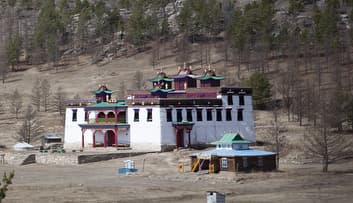
Baldan Bereeven Monastery
Baldan Bereeven Monastery is a significant Gelugpa Buddhist monastery located in the Khentii Province of Mongolia. Originally founded in 1654 and modeled after Tibetan monasteries, it grew to become one of Mongolia's largest and most important religious centers, reaching its zenith in the mid-19th century with up to 8,000 monks. Although destroyed by the communist regime in 1937, restoration efforts have been underway since 1990, with three temples currently rebuilt.