
Dambulla cave temple
The Dambulla cave temple, also known as the Golden Temple of Dambulla, is a significant World Heritage Site in Sri Lanka renowned for its extensive collection of Buddhist statues and murals. This ancient cave monastery complex, dating back to the first century BCE, is celebrated as the largest and best-preserved of its kind in Sri Lanka, offering a comprehensive visual narrative of Buddhist teachings and Sri Lankan history.
Key Facts
- ›The complex comprises five main caves adorned with statues and paintings related to Gautama Buddha and his life.
- ›It houses 153 Buddha statues, three statues of Sri Lankan kings, and four statues of deities.
- ›The murals cover an area of 2,100 square meters and depict scenes such as the temptation by Mara and Buddha's first sermon.
- ›Dambulla cave temple dates back to the first century BCE and has been functional as a monastery since the third and second centuries BC.
- ›Valagamba of Anuradhapura is traditionally credited with converting the caves into a temple in the first century BC.
- ›The site was recognized as a UNESCO World Heritage Site in 1991.

Important Relationships
- Valagamba of Anuradhapura
- Nissanka Malla of Polonnaruwa
- King Kirti Sri Rajasinha
- King Vattagamani Abhaya
- Vishnu
- Ganesha
- Ananda
- Maitreya
- Avalokiteshvara
Over 150 Buddha Statues, Murals Covering 2,100 Sq Meters, Five Main Caves, Rock-Hewn Buddha Statues, Statues of Sri Lankan Kings and Deities
- Conversion Into A Temple By King Valagamba of Anuradhapura
- Gilding of Caves and Addition of Buddha Statues By King Nissanka Malla
- Restoration and Painting By the Kingdom of Kandy
- Reconstruction of Temple Veranda
- Unesco World Heritage Site Designation
Sinhala Sculpture, Sinhala Art, Kandy Style
About Dambulla cave temple
The Dambulla cave temple, also known as the Golden Temple of Dambulla, is a UNESCO World Heritage Site located in the central part of Sri Lanka. This ancient monastic complex is celebrated as the largest and best-preserved cave temple in the country, featuring a remarkable collection of Buddhist statues and murals.
History and Development
The history of the Dambulla cave complex stretches back to prehistoric times, with evidence of human habitation dating from around 2700 years ago. The temple itself is believed to have been established as a monastery by the third and second centuries BC. Tradition holds that King Valagamba of Anuradhapura converted these caves into a temple in the first century BC after seeking refuge there for 15 years from South Indian usurpers. Subsequent rulers, including King Nissanka Malla in the 12th century and the kings of Kandy in the 18th century, contributed to its development and embellishment, adding statues, gilding, and intricate paintings. The architecture was further enhanced in 1938 with the addition of arched colonnades and gabled entrances.
The Five Caves
The Dambulla cave temple consists of five main caves, each a repository of religious art and history. These caves are carved into the base of a 160-meter high rock, offering panoramic views of the surrounding landscape, including the distant rock fortress of Sigiriya. The caves house a total of 153 Buddha statues, three statues of Sri Lankan kings, and four statues of deities, including Vishnu and Ganesha. The murals, covering approximately 2,100 square meters, depict significant events from the life of Gautama Buddha, such as his temptation by the demon Mara and his first sermon, alongside scenes from the country's history.
Artistic and Religious Significance
The shrine rooms within the caves showcase a rich tapestry of Sinhala sculpture and art, spanning various historical periods. The Buddha statues vary in size and posture, with the largest measuring 15 meters in length. The ceilings are adorned with intricate religious images, including depictions of Buddha and bodhisattvas, following the natural contours of the rock. The caves also feature statues of King Valagamba and King Nissanka Malla, acknowledging their patronage. The "Cave of the Divine King" houses a prominent 14-meter rock-hewn Buddha statue, while the "Cave of the Great Kings" contains numerous Buddha statues, as well as representations of gods and kings, and a dagoba with a spring said to possess healing powers. The "Great New Monastery" features ceiling and wall paintings in the Kandy style, dating from the reign of King Kirti Sri Rajasinha.
Conservation and Status
Recognized as a UNESCO World Heritage Site in 1991, Dambulla cave temple is a site of significant cultural and historical importance. Conservation efforts, particularly those undertaken in collaboration with UNESCO since 1982, have focused on preserving the integrity of the ancient complex and its mural schemes, which represent a substantial portion of surviving 18th-century paintings. The site remains an active ritual center, and conservation plans have aimed to improve infrastructure and accessibility while minimizing damage to the surrounding archaeological features. The complex continues to be a major destination for Buddhist pilgrims and a popular tourist attraction.
Source: Wikipedia ↗
Frequently Asked Questions
What is the Dambulla cave temple famous for?
The Dambulla cave temple is famous for being the largest and best-preserved cave temple complex in Sri Lanka. It is renowned for its extensive collection of over 150 Buddha statues and its vast, intricate murals covering the cave ceilings and walls, which depict scenes from Buddhist lore and Sri Lankan history.
When was the Dambulla cave temple established?
The temple complex dates back to the first century BCE, with historical accounts suggesting it was already an important monastery by the third and second centuries BC. King Valagamba of Anuradhapura is traditionally credited with converting the caves into a temple in the first century BC.
What can visitors see inside the Dambulla cave temple?
Visitors can explore five main caves filled with numerous Buddha statues of various sizes and poses, as well as statues of Sri Lankan kings and deities like Vishnu and Ganesha. The ceilings and walls are covered with vibrant murals illustrating Buddha's life, teachings, and significant historical events.
Is the Dambulla cave temple still an active religious site?
Yes, the Dambulla cave monastery remains a functional and active ritual center. Conservation efforts have focused on maintaining its integrity as a living heritage site while improving visitor accessibility and infrastructure.
What is the significance of the statues and paintings at Dambulla?
The statues and paintings at Dambulla are significant for their artistic merit and historical documentation. They represent many epochs of Sinhala sculpture and art, providing visual narratives of Buddhist cosmology, the life of Buddha, and important events in Sri Lankan history.
What is the historical context of the Dambulla cave complex?
Evidence suggests prehistoric Sri Lankans inhabited these caves before Buddhism arrived, with burial sites dating back 2700 years found nearby. The caves were later developed into a major Buddhist monastery and temple complex, with continuous additions and restorations by various rulers over centuries.
Related Buddhist Temples

Dhowa rock temple
The Dhowa Rock Temple (Dowa Raja Maha Viharaya) is a significant heritage-listed rock-cut Buddhist temple in Sri Lanka's Uva Province. Believed to have been constructed in the first century BC by King Valagamba, it is renowned for its large, unfinished Buddha statue carved into a granite cliffside and its vibrant mural paintings.

Wat Phra Pathommachedi
Wat Phra Pathommachedi is a significant Buddhist stupa located in Nakhon Pathom, Thailand, renowned for its immense height and historical depth. Originally believed to be a principal stupa of the ancient Dvaravati kingdom, it has undergone numerous reconstructions and expansions, most notably by King Mongkut in the 19th century, culminating in its current grandeur. The temple complex serves as a vital religious center and a testament to the enduring presence of Buddhism in Southeast Asia.
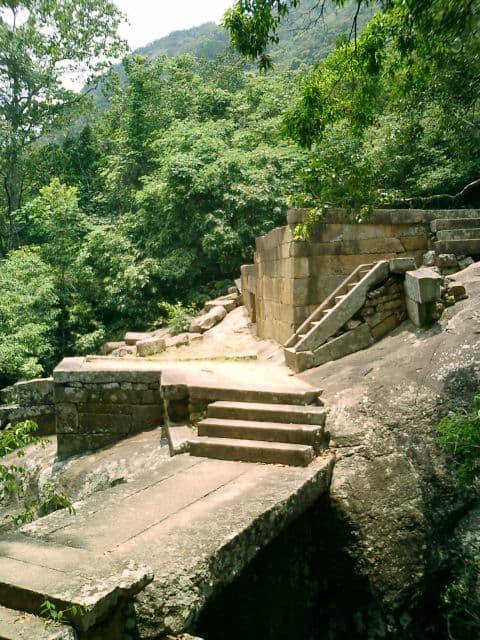
Ritigala Buddhist Monastery
Ritigala Buddhist Monastery is an ancient monastic site located on Ritigala mountain in central Sri Lanka. Its ruins and rock inscriptions date back to the 1st century BCE, indicating a history of Buddhist practice focused on extreme austerity. The monastery is notable for its unique architectural features, absence of traditional icons, and its setting within a strict nature reserve.