
Dhowa rock temple
Rock Temple·Sri Lanka·1st century BC·Mahayana
The Dhowa Rock Temple (Dowa Raja Maha Viharaya) is a significant heritage-listed rock-cut Buddhist temple in Sri Lanka's Uva Province. Believed to have been constructed in the first century BC by King Valagamba, it is renowned for its large, unfinished Buddha statue carved into a granite cliffside and its vibrant mural paintings.
Key Facts
- ›Constructed by King Valagamba in the first century BC.
- ›Located in the central mountains of Uva Province, Sri Lanka.
- ›Features an approximately 11-meter high unfinished Buddha image carved into a rock face.
- ›The image house contains colorful murals and paintings of Buddha.
- ›Formally recognized as an archaeological protected monument in 1996.
- ›The Buddha image is an example of Mahayana sculpture.

Important Relationships
- King Valagamba
Unfinished Buddha Image, Mural Paintings In the Image House, Guardian Statues
- Constructed By King Valagamba While Taking Refuge In Uva Province.
- Recognized As An Archaeological Protected Monument On November 1, 1996.
Rock-Cut
About Dhowa rock temple
The Dhowa Rock Temple, also known as Dowa Raja Maha Viharaya, is a significant heritage-listed rock-cut Buddhist temple located in the central mountains of the Uva Province in Sri Lanka. Situated near the village of Dhowa along the Badulla-Bandarawela main road, it is approximately 210 km east of Colombo and 120 km south of Kandy.
History and Construction
Historical accounts suggest that the temple was constructed by King Valagamba during the first century BC. It is believed to be one of several temples the king established while seeking refuge in the Uva Province during an invasion of the Anuradhapura Kingdom by South Indian forces. Consequently, the temple boasts a history spanning over 2000 years. On November 1, 1996, the Dhowa Rock Temple was formally designated as an archaeological protected monument by the government, as declared in Gazette number 948.
Key Attractions
The most prominent feature of the Dhowa Rock Temple is its impressive, unfinished Buddha image, which stands approximately 11 meters (36 ft) high. This colossal statue is intricately carved directly into the vertical granite rock face and is recognized as an example of Mahayana sculpture.
Image House and Paintings
Within the cave complex, the image house is adorned with numerous colorful murals and paintings depicting various scenes related to the Buddha. The entrance to this sacred space is flanked by two striking guardian statues. One statue is reported to represent the Rakshasa leader Watuka, and the other, Kuvera, is depicted with a bull in its mouth, while the first is with an elephant in its mouth.
Source: Wikipedia ↗
Frequently Asked Questions
When was the Dhowa Rock Temple built?
The Dhowa Rock Temple is believed to have been constructed by King Valagamba in the first century BC. This makes the temple over 2000 years old.
What are the main attractions at Dhowa Rock Temple?
The temple is most famous for its large, unfinished Buddha image, which stands approximately 11 meters high and is carved directly into the granite rock face. Visitors can also explore the image house, which features numerous colorful murals and paintings of Buddha.
Where is the Dhowa Rock Temple located?
The Dhowa Rock Temple is situated in the central mountains of the Uva Province in Sri Lanka. It is adjacent to the village of Dhowa, along the main road between Badulla and Bandarawela.
What is the significance of the guardian statues at the image house entrance?
The entrance to the image house is guarded by two statues, one depicting a figure with an elephant in its mouth and the other with a bull in its mouth. These are reported to represent the Rakshasa leaders Watuka and Kuvera.
Related Buddhist Temples

Dambulla cave temple
The Dambulla cave temple, also known as the Golden Temple of Dambulla, is a significant World Heritage Site in Sri Lanka renowned for its extensive collection of Buddhist statues and murals. This ancient cave monastery complex, dating back to the first century BCE, is celebrated as the largest and best-preserved of its kind in Sri Lanka, offering a comprehensive visual narrative of Buddhist teachings and Sri Lankan history.
Ritigala Buddhist Monastery
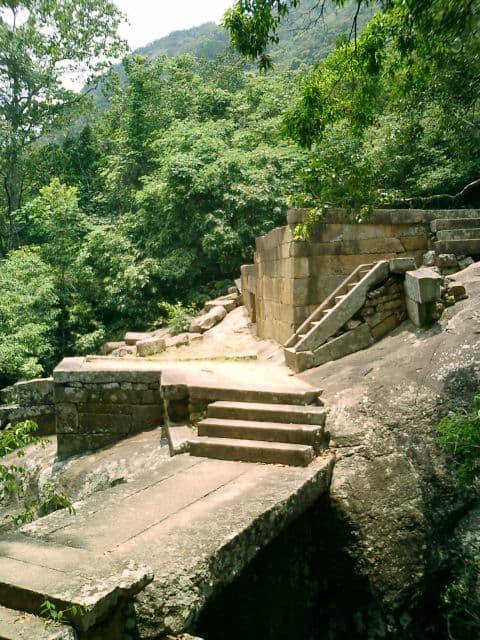
Ritigala Buddhist Monastery is an ancient monastic site located on Ritigala mountain in central Sri Lanka. Its ruins and rock inscriptions date back to the 1st century BCE, indicating a history of Buddhist practice focused on extreme austerity. The monastery is notable for its unique architectural features, absence of traditional icons, and its setting within a strict nature reserve.

Wat Phra Pathommachedi
Wat Phra Pathommachedi is a significant Buddhist stupa located in Nakhon Pathom, Thailand, renowned for its immense height and historical depth. Originally believed to be a principal stupa of the ancient Dvaravati kingdom, it has undergone numerous reconstructions and expansions, most notably by King Mongkut in the 19th century, culminating in its current grandeur. The temple complex serves as a vital religious center and a testament to the enduring presence of Buddhism in Southeast Asia.