
Daifukuji Soto Zen Mission
Daifukuji Soto Zen Mission is a historic Zen Buddhist temple located in Honalo, Hawaii, established in 1914. It served as a vital center for the Japanese immigrant community in the Kona area during the 20th century, blending traditional Japanese architecture with local building methods. The temple is significant for its historical role, its preservation of Buddhist figures, and its recognition on national and state historic registers.
Key Facts
- ›Established in 1914 by Reverend Kaiseki Kodama.
- ›The present temple was constructed starting in 1920 and dedicated in 1921.
- ›Features an Irimoya-style roof, a blend of Japanese and Hawaiian architectural elements.
- ›Houses enshrinements of Gautama Buddha, Dōgen, Keizan, Bodhidharma, and Kannon.
- ›Was temporarily shut down and occupied by the U.S. Army during World War II.
- ›Listed on the Hawaii Register of Historic Places and the National Register of Historic Places.

- Irimoya-Style Roof
- Original Sculptures and Altar Made of Acacia Koa Wood
- Kannon Hall With Kannon Image and 33 Smaller Statuettes
- Small Cemetery Uphill From the Temple
- Statue of Jizō
- Establishment of the Mission In 1914
- Construction of the First Thatched Temple In 1915
- Construction of the Current Temple Beginning In 1920
- Dedication Ceremony and Enshrinement of Buddha Image In 1921
- Addition of Kannon Hall In 1937
- Temple Closure and Occupation By U.S. Army During Wwii
- Re-Opening of the Temple In 1946
- Dedication of Jizō Statue In 1961
- Inclusion On State and National Historic Registers In 1991 and 1994
Traditional Japanese, Hawaiian Building Methods
About Daifukuji Soto Zen Mission
The Daifukuji Soto Zen Mission is a historic Zen Buddhist temple situated in Honalo, within the Kona district of Hawaiʻi Island. Established in 1914, it has played a significant role as a spiritual and social center for the Japanese immigrant community in the Kona area throughout the 20th century.
History and Construction
Reverend Kaiseki Kodama arrived in Kona in 1914, initially holding services at a local store. He undertook extensive travel across the island to gather donations for the construction of a temple. In 1915, a modest thatched structure named Hakuhozan Daifukuji, meaning "Temple of Great Happiness on White Mountain Peak," was erected north of the present site. This name was bestowed by the Zen abbots of Eihei-ji and Sōji-ji in Japan. Reverend Kodama returned in 1918, initiating the construction of the current temple in 1920. A dedication ceremony in May 1921 saw the enshrinement of a Buddha image in the main hall.
The temple's architecture is a thoughtful fusion of traditional Japanese temple design and indigenous Hawaiian construction techniques. Yoshisuke Sasaki, a first-generation Japanese immigrant and local store owner, served as the designer, with Teruyoshi Ikenouchi leading the carpentry. Over subsequent years, living quarters were added, and in 1926, a Japanese language school was established under the third minister, Giko Kanbara, and his wife Shigeko.
Notable Features and Enshrinements
The temple's roof exhibits the traditional Japanese Irimoya style, characterized by its decorated gable design. Central to the main hall is an image of the historical Gautama Buddha. To his right stands a seated figure of Dōgen, and to his left is Keizan, both revered as founders of the Sōtō Zen tradition. An alcove adjacent to the main altar houses figures of Bodai Daruma Daishi (Bodhidharma), credited with bringing Buddhist teachings from India to China, and Daigen Shuri Bosatsu, another bodhisattva. In 1937, the Kannon Hall was added, featuring a statue of Kannon (Guan Yin), the bodhisattva of great compassion, sculpted by Sosaku Miki. This central Kannon is flanked by 33 smaller Kannon statuettes, representing various compassionate manifestations.
Historical Events and Recognition
Following the attack on Pearl Harbor in 1941, the temple was temporarily closed, and Reverend Hozui Nakayama was interned on the mainland as part of the Japanese American internment. The U.S. Army occupied the premises, though lay community members were allowed to conduct funeral services. The temple resumed operations in February 1946 after World War II. A minister's house was constructed around 1950. A small shrine featuring a statue of Jizō (Ksitigarbha) was dedicated on the temple steps in 1961.
Daifukuji Soto Zen Mission has received official recognition for its historical significance. It was added to the state of Hawaii registry of historic places on March 9, 1991, and subsequently listed on the National Register of Historic Places on April 21, 1994. The temple remains a testament to the enduring legacy of Japanese immigrants in Hawaii and the preservation of their cultural and religious heritage.
Source: Wikipedia ↗
Frequently Asked Questions
When was the Daifukuji Soto Zen Mission established?
The Daifukuji Soto Zen Mission was established in 1914. Reverend Kaiseki Kodama arrived in Kona that year and began collecting donations to build a temple.
What is the architectural style of the temple?
The temple is a blend of traditional Japanese architectural forms adapted to local Hawaiian building methods. It features a decorated gable roof in the traditional Japanese temple style known as Irimoya.
What figures are enshrined at Daifukuji Soto Zen Mission?
The main hall enshrines an image of Gautama Buddha, with figures of Dōgen and Keizan to his right and left, respectively. An alcove contains figures of Bodhidharma and Daigen Shuri Bosatsu. The Kannon Hall houses an image of Kannon (Guan Yin) accompanied by smaller Kannon statuettes.
What happened to the temple during World War II?
Following the attack on Pearl Harbor in 1941, the temple was shut down, and its minister, Reverend Hozui Nakayama, was arrested. The U.S. Army occupied the site, though lay members were permitted to hold funeral services.
Is Daifukuji Soto Zen Mission a historic site?
Yes, Daifukuji Soto Zen Mission is recognized as a historic site. It was added to the state of Hawaii registry of historic places in 1991 and to the National Register of Historic Places in 1994.
Related Buddhist Temples
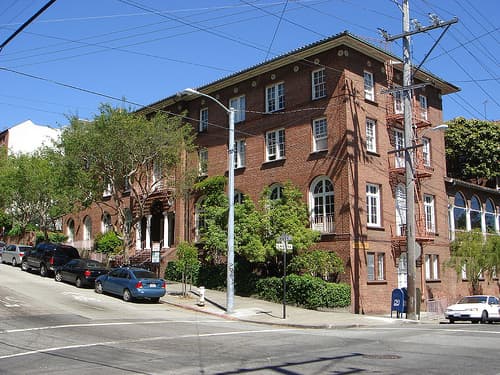
Beginner's Mind Temple
The San Francisco Zen Center (SFZC), established in 1962 by Shunryu Suzuki Roshi and his American students, is a prominent Sōtō Zen organization in the West. Its City Center, also known as Beginner's Mind Temple, is a key practice and retreat center within this network, which also includes Tassajara Zen Mountain Center and Green Gulch Farm Zen Center. SFZC has played a significant role in introducing and developing Zen Buddhism in the United States.

Berkeley Zen Center
Berkeley Zen Center (BZC), officially known as Shogakuji, is a Sōtō Zen Buddhist practice center in Berkeley, California, founded in 1967 as an affiliate of the San Francisco Zen Center. It serves as a residential center for priests, students, and lay practitioners, offering a full schedule of Zen services and teachings.
Chenrezig Tibetan Buddhist Center of Philadelphia
The Chenrezig Tibetan Buddhist Center of Philadelphia (CTBC) is a Tibetan Buddhist community established in 1989 by Lama Losang Samten. The center serves as a place for the study and cultivation of loving-kindness and compassion, offering a non-sectarian and inclusive environment for practitioners. It is named and was blessed by His Holiness the Dalai Lama, reflecting its deep connection to Tibetan Buddhism.