
Chūson-ji
Chūson-ji is a significant Buddhist temple located in Hiraizumi, Iwate Prefecture, Japan. It serves as the head temple of the Tendai sect in the Tōhoku region and is renowned for its Konjiki-dō, a gilded structure housing the mummified remains of the Northern Fujiwara clan leaders. The temple complex is a UNESCO World Heritage Site, recognized for its historical and cultural importance.
Key Facts
- ›Founded in 850 by Ennin, or alternatively by Fujiwara no Kiyohira in 1095.
- ›The Konjiki-Dō, a gold-leaf-covered building completed in 1124, is a surviving structure from the original complex.
- ›The Konjiki-Dō also serves as a mausoleum for the mummified remains of the Northern Fujiwara clan leaders.
- ›Designated a Special Historic Site in 1979 and a UNESCO World Heritage Site in 2011 as part of the 'Historic Monuments and Sites of Hiraizumi'.
- ›Survived the destruction of Hiraizumi in 1189, though it fell into decline and was damaged by fire in 1337.
- ›Partially rebuilt during the Edo period and visited by the poet Matsuo Bashō.

Important Relationships
- Fujiwara no Kiyohira
- Fujiwara no Motohira
- Fujiwara no Hidehira
- Ennin
- Matsuo Bashō
- Tendai sect
- Northern Fujiwara clan
Konjiki-Dō, Mausoleum For Northern Fujiwara Clan Leaders, Mother-of-Pearl Inlays, Gold Leaf Decoration
- Founded In 850 Or 1095.
- Large-Scale Construction By Fujiwara No Kiyohira In the Early 12th Century.
- Destruction of Hiraizumi In 1189.
- Fire In 1337 Destroyed Much of the Temple.
- Rebuilt During the Edo Period.
- Visited By Matsuo Bashō.
Late Heian Period Arts and Crafts
About Chūson-ji
Chūson-ji: A Golden Legacy in Hiraizumi
Chūson-ji stands as a paramount Buddhist temple in the town of Hiraizumi, located in southern Iwate Prefecture, Japan. It holds the distinction of being the head temple for the Tendai sect across the Tōhoku region of northern Honshu. Historical accounts offer differing perspectives on its origins, with the temple itself claiming foundation in 850 by Ennin, while historian George Sansom attributes its establishment to Fujiwara no Kiyohira in 1095.
History and Reconstruction
The 12th century marked a period of extensive temple construction at Chūson-ji, spearheaded by Fujiwara no Kiyohira, the progenitor of the Northern Fujiwara clan. This ambitious undertaking aimed to honor the souls lost in the Former Nine Years' War and the Latter Three Years' War, reflecting Kiyohira's desire for regional peace guided by Buddhist teachings. Historical records suggest the original complex was vast, comprising over 40 halls and pagodas and more than 300 residences for monks. Although Hiraizumi flourished for nearly a century, it was devastated in 1189 by the forces of Minamoto no Yoritomo. Chūson-ji, while surviving this conflict, subsequently entered a phase of decline. A significant fire in 1337 ravaged much of the temple, yet remarkably, over 3,000 National Treasures and Important Cultural Properties were preserved. During the Edo period, the temple saw partial reconstruction by the Date clan of Sendai Domain, and it later became a subsidiary temple of Kan'ei-ji in Edo. The renowned poet Matsuo Bashō visited Chūson-ji during his travels, documenting his impressions.
The Konjiki-dō: A Gilded Masterpiece
Central to Chūson-ji's enduring fame is the Konjiki-dō, or Golden Hall, a small building completed in 1124 that vividly evokes the temple's former splendor. The exterior and interior of the Konjiki-dō are extensively covered in gold leaf, adorned with intricate mother-of-pearl inlays, and showcase exquisite woodwork, metalwork, lacquerwork, and paintings, representing a zenith of late Heian period artistry. It is one of only two structures from the original Chūson-ji complex to have survived, the other being a sutra repository. The Konjiki-dō also serves as a sacred mausoleum, housing the mummified remains of the Northern Fujiwara clan's leaders. The building, measuring five-and-a-half meters on each side and eight meters tall, features three altars within its interior, each dedicated to one of the first three Fujiwara lords. These altars are presided over by seated Amida Nyōrai figures, accompanied by standing Kannon Bosatsu and Seishi Bosatsu, along with Jizō Bosatsu and Niten statues. The mummies, last examined in 1950, are believed to be those of Fujiwara no Kiyohira (under the central altar), Fujiwara no Motohira (under the northwest altar), and Fujiwara no Hidehira (under the southwest altar), with a casket containing the head of Hidehira's son, Fujiwara no Yasuhira, found nearby. Originally exposed to the elements, the Konjiki-dō was enclosed in a protective wooden structure in 1288 and is now housed within a concrete building constructed in 1965, protected by thick acrylic glass and visible primarily from the front and sides. The Konjiki-dō holds the distinction of being the first structure designated a National Treasure of Japan. The building underwent restoration from 1962 to 1968, with artist Shōgyo Ōba contributing to the interior lacquer work in 1964.
Recognition and Significance
Chūson-ji was designated a Special Historic Site in 1979. In June 2011, it achieved international recognition when it was listed as a UNESCO World Heritage Site, as part of the collection known as the "Historic Monuments and Sites of Hiraizumi." This designation underscores the temple's profound historical, cultural, and artistic importance.
Source: Wikipedia ↗
Frequently Asked Questions
When was Chūson-ji founded?
There are differing accounts of Chūson-ji's founding. The temple claims it was founded in 850 by Ennin. However, historian George Sansom states it was founded by Fujiwara no Kiyohira in 1095.
What is the Konjiki-dō and why is it important?
The Konjiki-dō is a small building completed in 1124 that is covered in gold leaf, both inside and out. It is one of the original structures of Chūson-ji and showcases the arts and crafts of the late Heian period. It also functions as a mausoleum containing the mummified remains of the Northern Fujiwara clan leaders.
Is Chūson-ji a UNESCO World Heritage Site?
Yes, Chūson-ji was listed as a UNESCO World Heritage Site in June 2011. It is part of the larger designation 'Historic Monuments and Sites of Hiraizumi'.
What happened to Chūson-ji after its initial construction?
After Hiraizumi flourished for nearly a century, it was destroyed by Minamoto no Yoritomo's forces in 1189. Chūson-ji survived this conflict but entered a period of decline. A fire in 1337 destroyed much of the temple, though over 3,000 cultural properties were preserved.
What notable figures are associated with Chūson-ji's history?
Fujiwara no Kiyohira, founder of the Northern Fujiwara clan, carried out large-scale temple construction at Chūson-ji in the early 12th century. His son, Fujiwara no Motohira, continued these efforts, and his grandson, Fujiwara no Hidehira, also contributed to the temple's development. The poet Matsuo Bashō visited Chūson-ji during the Edo period.
Related Buddhist Temples
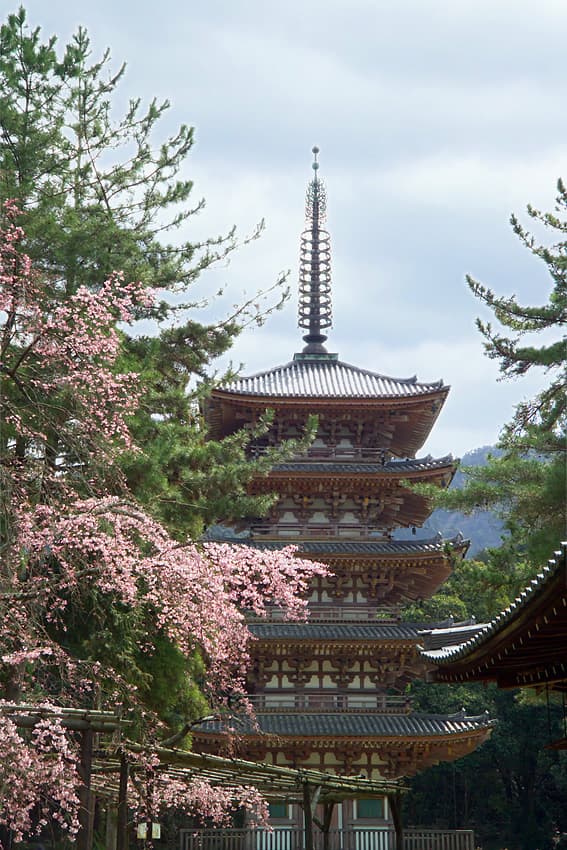
Daigo-ji
Daigo-ji is a sprawling Buddhist temple complex in Kyoto, Japan, renowned for its historical significance, extensive grounds, and rich collection of cultural treasures. It serves as the head temple of the Shingon-shū Daigo-ha sect and is recognized as a UNESCO World Heritage Site, embodying centuries of Japanese Buddhist architecture and garden design.
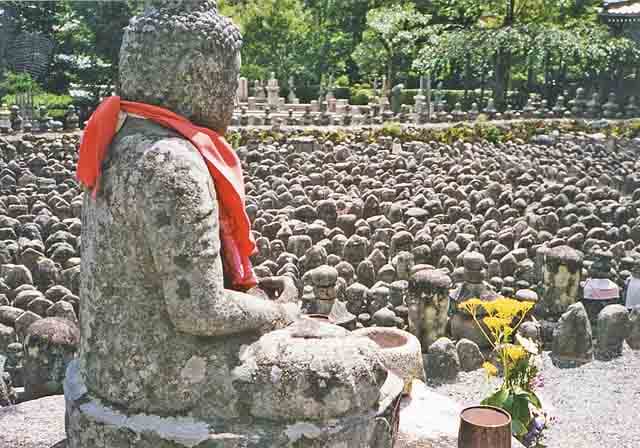
Adashino Nenbutsu-ji
Adashino Nenbutsu-ji is a Buddhist temple in Kyoto, Japan, historically situated in an area where the bodies of the deceased were abandoned. Founded as a temple by Kūkai in 811 and later altered by Hōnen, it now houses approximately eight thousand Buddhist statuettes that memorialize the souls of the dead. The temple is particularly known for its 'sento kuyo' ceremony, where thousands of stone statues are illuminated with candles.

Daikaku-ji
Daikaku-ji is a historic Shingon Buddhist temple in Kyoto, Japan, originally established as Emperor Saga's palace in 814 CE. It later served as an imperial villa and then became a significant temple, notable for its role in cloistered rule by retired emperors. The temple is also recognized as the headquarters of the Saga Go-ryū school of ikebana and features the ancient Ōsawa Pond, a surviving example of Heian period garden design.