
Bishan Temple
Bishan Temple, also known as Guangji Maopeng, is a significant Buddhist temple situated in Taihuai Town, Wutai County, Shanxi, China. It holds the distinction of being a National Key Buddhist Temple in the Han Chinese Area, recognized for its historical importance and architectural features, including a prominent ordination altar.
Key Facts
- ›Bishan Temple was first established during the reign of Emperor Xiaowen of Northern Wei (467-499) and originally named Beishan Temple.
- ›The temple has undergone several name changes throughout its history, including Puji Temple and Guangji Maopeng.
- ›It is referred to as Bishan Temple due to its mountainous surroundings, a name popularized during the reign of the Qianlong Emperor.
- ›The Jietan Hall (Hall of Ordination Altar) is considered the most important hall, featuring a large bluestone ordination altar built in the Ming dynasty.
- ›A sitting statue of Shijiamouni, brought from Burma in 1928, is housed on the ordination altar, flanked by eighteen Arhat statues from the Qing dynasty.
- ›In 1983, Bishan Temple was designated a National Key Buddhist Temple in the Han Chinese Area.

Important Relationships
- Emperor Xiaowen of Northern Wei
- Emperor Yingzong of Ming
- Qianlong Emperor
- Emperor Xuantong
- Master Dayun
- Chan Master Miaojiang
Paifang With Inscribed Board "清凉震萃", Tianwang Dian, Pilu Hall, Zhaobi, Jietan Hall With Bluestone Ordination Altar, Statue of Shijiamouni From Burma, Eighteen Arhat Statues, Zangjing Ge
- First Established During the Reign of Emperor Xiaowen of Northern Wei .
- Renamed Puji Temple During the Reign of Emperor Yingzong of Ming .
- Also Called Bishan Temple During the Reign of the Qianlong Emperor .
- Also Named Guangji Maopeng During the Reign of Emperor Xuantong .
- Designated A National Key Buddhist Temple In the Han Chinese Area In 1983.
- Master Dayun Served As Abbot On August 26, 2017.
About Bishan Temple
Bishan Temple: A Historical Buddhist Sanctuary
Bishan Temple, also known by its alternative name Guangji Maopeng (廣濟茅蓬), is a significant Buddhist temple located in Taihuai Town, Wutai County, within the Xinzhou region of Shanxi, China. Its history stretches back to the Northern Wei dynasty, making it a venerable site with deep roots in Chinese Buddhist tradition. The temple's longevity and architectural significance have earned it recognition as a National Key Buddhist Temple in the Han Chinese Area.
Historical Development and Naming
The origins of Bishan Temple trace back to the reign of Emperor Xiaowen of Northern Wei (467-499), when it was first established as "Beishan Temple" (北山寺). Over centuries, the temple underwent several transformations and name changes. During the Ming dynasty, under Emperor Yingzong (1435-1449 and 1457-1464), it was known as "Puji Temple" (普济寺). The name "Bishan Temple" became more prevalent during the reign of the Qianlong Emperor (1711-1799), a designation inspired by the temple's secluded mountain setting. Later, in the early 20th century, during the reign of Emperor Xuantong (1908-1912), it was also referred to as "Guangji Maopeng" (广济茅蓬).
Key Architectural Features
Bishan Temple is distinguished by several notable architectural elements. A prominent feature is the Paifang, an ornate gateway inscribed with the characters "清凉震萃" (Qingliang Zhen Cui). The Tianwang Dian, or Hall of the Four Heavenly Kings, enshrines Bodhisattva Mi Le, with a statue of Weituo positioned behind it. The Pilu Hall, also known as "Leiyin Baodian" (雷音宝殿), is dedicated to Pilu Buddha, accompanied by twelve Bodhisattvas. A unique Zhaobi (照壁), a decorative screen wall constructed from stones and bricks, is carved with a Chinese poem. The Jietan Hall, or Hall of Ordination Altar, is considered the most crucial structure within the temple complex. It houses a large bluestone ordination altar, measuring 5.1 meters by 5 meters, built during the Ming dynasty. Upon this altar rests a sitting statue of Shijiamouni, which was brought from Burma in 1928. Flanking this statue are the eighteen Arhats, crafted during the Shunzhi period of the Qing dynasty (1644-1661). The Zangjing Ge, or Tower of Buddhist Texts, is a two-story wooden building that holds a statue of Mi Le.
Recognition and Administration
In 1983, Bishan Temple received significant recognition when it was designated a "National Key Buddhist Temple in the Han Chinese Area." This designation underscores its cultural and religious importance. More recently, on August 26, 2017, Master Dayun, a disciple of Chan Master Miaojiang, assumed the role of abbot of Bishan Temple.
Source: Wikipedia ↗
Frequently Asked Questions
What is the original name of Bishan Temple?
Bishan Temple was originally named Beishan Temple. It was established during the reign of Emperor Xiaowen of Northern Wei (467-499).
When was the ordination altar at Bishan Temple built?
The ordination altar in the Jietan Hall was built during the Ming dynasty (1368-1644). It is a large square altar made of bluestone.
What notable statues are housed in Bishan Temple?
The temple houses a sitting statue of Shijiamouni brought from Burma in 1928, and eighteen Arhat statues from the Qing dynasty. The Tianwang Dian features a statue of Bodhisattva Mi Le and a statue of Weituo.
What is the significance of the Jietan Hall?
The Jietan Hall, also known as the Hall of Ordination Altar, is considered the most important hall within Bishan Temple. It contains a significant ordination altar and statues of Buddhist figures.
Has Bishan Temple been recognized as a key Buddhist site?
Yes, in 1983, Bishan Temple was designated as a National Key Buddhist Temple in the Han Chinese Area, highlighting its importance within Chinese Buddhism.
Related Buddhist Temples

Baotong Temple
Baotong Temple is a significant Buddhist temple located on the south hillside of Mount Hong in Wuhan, China, recognized as one of the "Four Buddhist Temples" in the city. Its history spans over 1,500 years, with its origins tracing back to the Liu Song dynasty, and it has undergone numerous restorations and expansions throughout various dynasties, including the Ming and Qing dynasties. The temple is renowned for its Mahavira Hall and the historic Hongshan Pagoda, and it continues to be a vital center for Buddhist practice and education.
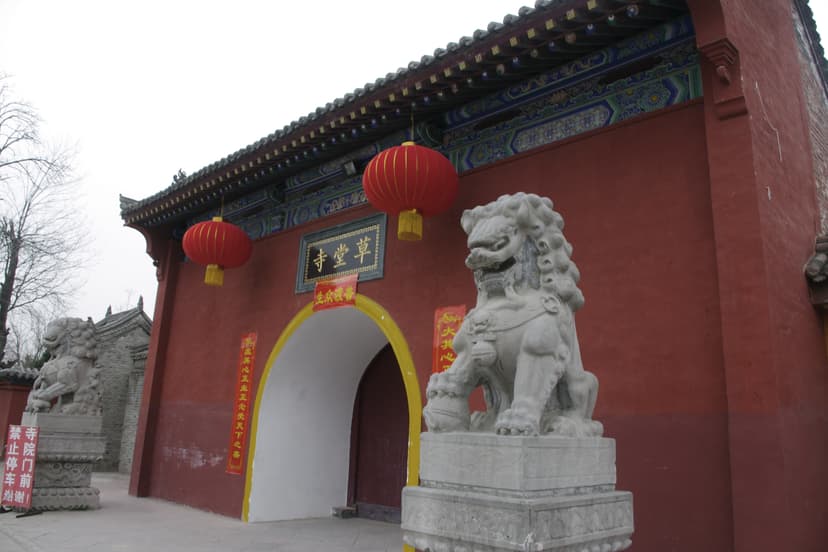
Caotang Temple
Caotang Temple, located on the northern slope of Mount Guifeng in Xi'an, China, is a historically significant Buddhist temple. It holds immense importance as the site where the monk Kumārajīva resided and translated key Mahayana texts in the 4th century, laying the groundwork for East Asian Mādhyamaka. Consequently, Caotang Temple is revered as the cradle of this influential Buddhist school.
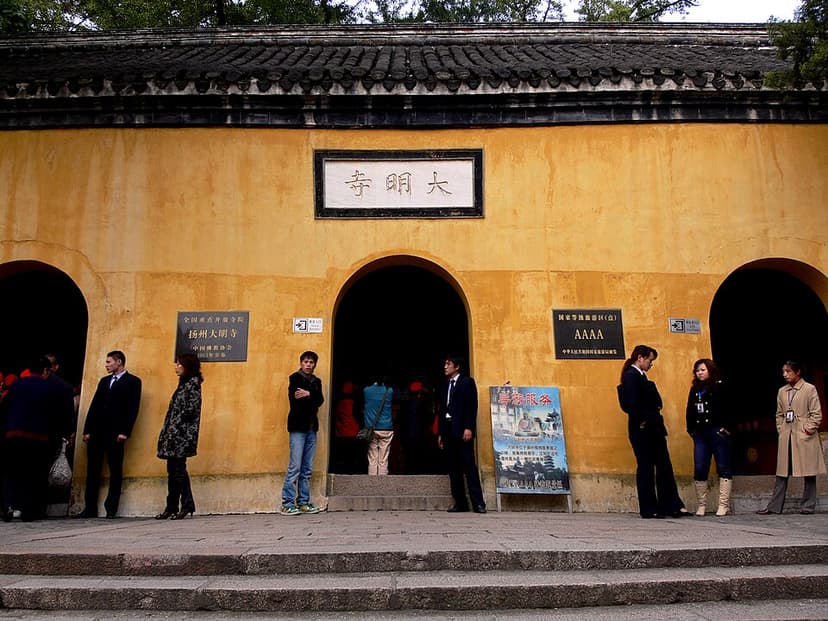
Daming Temple
Daming Temple, situated on the middle peak of Shugang Mountain in Yangzhou, Jiangsu province, China, is a historically significant Buddhist temple. It is particularly renowned as the place where the eminent monk Jianzhen studied and ordained monks in 742 AD before embarking on his journey to Japan. The temple has undergone numerous name changes and reconstructions throughout its history, reflecting its enduring importance in Chinese Buddhism.