
Collegiate Basilica of St Mary of the Seat
Spain·Manresa
The Collegiate Basilica of Santa Maria, also known as La Seu, is a significant church in Manresa, Catalonia, north of Spain, showcasing a blend of Romanesque and Gothic architectural styles. Originally documented in the 9th century, it was rebuilt and expanded over centuries, notably with a Gothic structure added in the 14th century, making it a prominent landmark in the region's religious and architectural history.
Key Facts
- ›The church is documented from 890, with significant devastation by Al-Mansur's troops in 999.
- ›Remains of an 11th-century Romanesque structure include columns with carved capitals.
- ›A new Gothic structure was added starting in 1322, designed by Berenguer de Montagut.
- ›The crypt was constructed in 1578, and the bell tower dates to 1592.
- ›The main façade and baptisteries were completed between 1915 and 1934, based on an idea by Antoni Gaudí.
- ›Notable works of art include altarpieces by Arnau Bassa and Pere Serra.

Romanesque, Gothic, Baroque
Berenguer De Montagut, Alexandre Soler I March
About Collegiate Basilica of St Mary of the Seat
Collegiate Basilica of Santa Maria (La Seu)
The Collegiate Basilica of Santa Maria, commonly known as La Seu, is a historically and architecturally significant church located in Manresa, Catalonia, in northern Spain. Its origins are documented from as early as 890 AD, though the current edifice displays a rich layering of architectural styles, primarily Romanesque and Gothic, with later Baroque and 20th-century additions.
History and Architecture
The site of Santa Maria has a long history, with the original church documented in 890. It suffered devastation in 999 but was subsequently refurbished in the 11th century, of which scanty remains, including 11th-century columns with carved capitals and a 12th-century portal, still exist. A major transformation occurred during the 14th century, a period of expansion for Manresa. Construction of a new Gothic structure commenced in 1322, under the design of Berenguer de Montagut, who had previously contributed to Santa Maria del Mar in Barcelona. This Gothic phase extended into the 15th century and beyond.
Further significant constructions include the crypt built in 1578, the Chapel of the Holiest in 1657, and a quadrangular bell tower from 1592. The early 18th century saw the addition of a Baroque cloister. The main façade and baptisteries were completed between 1915 and 1934, following an architectural concept by Antoni Gaudí and designed by Alexandre Soler i March.
Interior and Artworks
The interior of the basilica features a nave and two narrower aisles separated by eighteen octagonal pilasters topped with capitals bearing vegetable motifs. The space lacks extensive decoration, with the exception of its large polychrome windows. The church houses notable altarpieces, including "St. Mark" by Arnau Bassa (1346), "Holy Spirit" by Pere Serra (1394)—considered a masterpiece of 14th-century Catalan painting—and "St. Michael and St. Nicholas" by Jaume Cabrera (1406). A painting by Lluís Borrassà from 1411 is also present.
La Seu stands as a testament to the evolving architectural and artistic landscape of Catalonia, reflecting centuries of religious devotion and craftsmanship.
Source: Wikipedia ↗
Frequently Asked Questions
What is the history of the Collegiate Basilica of Santa Maria?
The church is documented from 890, but was devastated in 999. It was refurbished in the 11th century with Romanesque elements and significantly expanded with a Gothic structure beginning in the 14th century, with later additions in the crypt, bell tower, and façade.
What architectural styles can be seen at La Seu?
La Seu exhibits Romanesque elements from its earlier phases, such as columns with carved capitals. The most prominent style is Gothic, evident in the large structure added from the 14th century onwards. Later additions include Baroque elements in the cloister and Neogothic influences in its main façade.
Who designed the Collegiate Basilica of Santa Maria?
The Gothic structure was designed by Berenguer de Montagut, who also worked on Santa Maria del Mar in Barcelona. The main façade and baptisteries were designed by Alexandre Soler i March, following an idea by Antoni Gaudí.
What are some notable artworks housed in the basilica?
The basilica contains several significant altarpieces, including 'St. Mark' by Arnau Bassa (1346), 'Holy Spirit' by Pere Serra (1394), which is considered a prime example of Catalan painting, and 'St. Michael and St. Nicholas' by Jaume Cabrera (1406).
When was the Collegiate Basilica of Santa Maria built?
While its origins trace back to the 9th century, the current Gothic structure began construction in 1322 and continued into the 15th century. Subsequent additions were made through the 16th, 17th, and 18th centuries, with the façade completed in the early 20th century.
Related Basilicas
Basilica of St Mary of the Sea
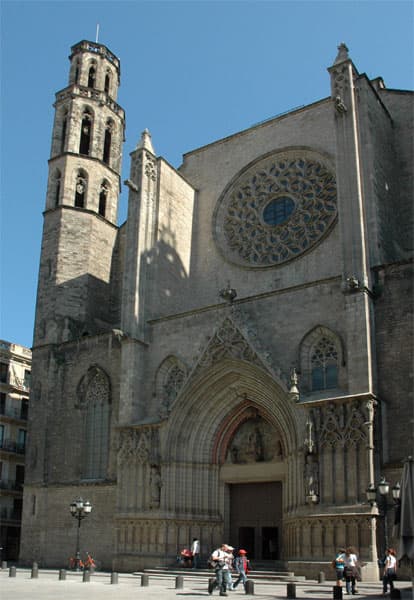
The Basilica of St Mary of the Sea, known in Catalan as Santa Maria del Mar, is a prominent church in Barcelona, Spain, constructed between 1329 and 1383. It stands as a remarkable example of Catalan Gothic architecture, distinguished by its stylistic purity and unity. The basilica holds significance as a testament to the maritime and mercantile power of the Principality of Catalonia during the medieval period, and notably, its construction was supported by the common people rather than the nobility.

Basilica of St Mary the Royal
The Basilica of St Mary the Royal, officially known as Basílica de Santa María la Real de Covadonga, is a Neo-Romanesque Catholic church located in Covadonga, Asturias, Spain. Designated a basilica in 1901, it serves as a monumental sanctuary built to replace an older temple destroyed by fire in 1777, and is dedicated to Our Lady of Covadonga.

Basilica Co-cathedral of St. Mary
The Co-Cathedral of Saint Mary of Vigo, also known locally as A Colexiata, is a Spanish Baroque/Neoclassical Catholic temple serving as a co-cathedral for the Diocese of Tui-Vigo. Its current structure was largely rebuilt in the 19th century following damage from historical events, including an explosion in 1809, and it was designated a basilica by the Vatican in 2020.