
Basilica of St Mary of the Sea
The Basilica of St Mary of the Sea, known in Catalan as Santa Maria del Mar, is a prominent church in Barcelona, Spain, constructed between 1329 and 1383. It stands as a remarkable example of Catalan Gothic architecture, distinguished by its stylistic purity and unity. The basilica holds significance as a testament to the maritime and mercantile power of the Principality of Catalonia during the medieval period, and notably, its construction was supported by the common people rather than the nobility.
Key Facts
- ›Construction began on March 25, 1329, with the laying of the foundation stone by King Alfonso IV of Aragon.
- ›It is an outstanding example of Catalan Gothic architecture, noted for its stylistic purity and unity.
- ›The basilica was notably backed by the common people, a departure from the nobility-supported constructions of many other large medieval buildings.
- ›A fire in 1379 damaged parts of the construction, and the church was consecrated on August 15, 1384.
- ›The 1428 Catalonia earthquake destroyed the original west rose window, which was replaced by a new one in the Flamboyant style by 1459.
- ›Much of its interior was destroyed by fire during anti-clerical riots at the start of the Spanish CIVIL War in 1936, though the structure survived.
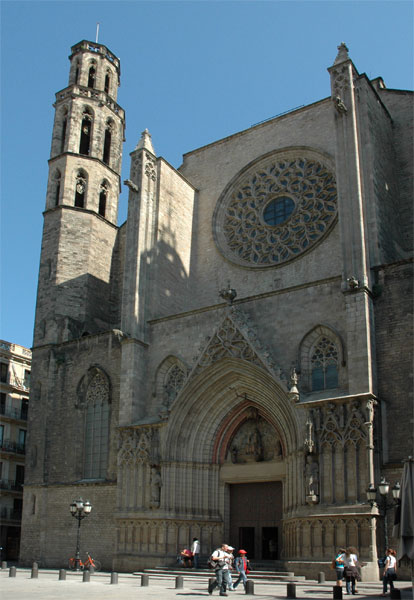
Catalan Gothic, Flamboyant
Berenguer De Montagut, Ramon Despuig
About Basilica of St Mary of the Sea
The Basilica of St Mary of the Sea, known in Catalan as Santa Maria del Mar, is a significant church located in the Ribera district of Barcelona, Spain. Its construction spanned from 1329 to 1383, a period coinciding with the height of the Principality of Catalonia's maritime and mercantile influence. The basilica is celebrated as an exceptional example of Catalan Gothic architecture, remarkable for its unusual purity and stylistic unity among large medieval buildings.
History and Construction
The earliest mention of a church dedicated to Santa Maria by the Sea dates back to 998. The impetus for the present structure came from canon Bernat Llull, who became Archdean of Santa Maria in 1324. A notable aspect of Santa Maria del Mar's construction was its strong support from the common populace, distinguishing it from many other large medieval edifices that relied on noble patronage. Construction commenced on March 25, 1329, marked by the laying of the foundation stone by King Alfonso IV of Aragon. The primary architects were Berenguer de Montagut, who designed the building, and Ramon Despuig. The construction process involved all the guilds of the Ribera quarter, underscoring the community's involvement. The main structural elements, including the walls, side chapels, and façades, were completed by 1350. A fire in 1379 caused damage to significant portions of the work. The final stone was laid in 1379, and the church was consecrated on November 3, 1383, with the consecration ceremony taking place on August 15, 1384.
The Catalonia earthquake of 1428 resulted in casualties and destroyed the rose window at the west end. A new rose window, executed in the Flamboyant style, was finished by 1459, and its glass was installed the following year. In the 19th century, the chapel of the Blessed Sacrament was added adjacent to the apse. A devastating fire, ignited by anti-clerical rioters at the beginning of the Spanish Civil War in 1936, destroyed much of the church's decorative richness, including images and the Baroque altar. Despite being on fire for eleven days, the church structure survived. Renovations began in 1938, with damaged windows being replaced in the 1960s. A fundraising campaign was initiated to support these repairs, which included a contribution from Futbol Club Barcelona, contingent on their coat of arms appearing on one of the stained-glass windows.
Architecture and Design
Externally, Santa Maria del Mar presents an impression of robust severity, which contrasts with its interior. It is situated amidst narrow streets, making it challenging to view the entire structure at once, except from the Fossar de les Moreres and Plaça de Santa Maria, both former burial grounds. The west end, with its rose window, is a dominant feature. Niches on either side of the west door are adorned with images of Saint Peter and Saint Paul, while the tympanum depicts the Saviour flanked by Our Lady and Saint John. The north-west tower was completed in 1496, but its counterpart was not finished until 1902.
Internally, the basilica offers a sense of light and spaciousness. Its basilica plan features three aisles that form a unified space, lacking transepts and any architectural division between the nave and the presbytery. The interior is characterized by a simple ribbed vault supported by slender octagonal columns. Ample natural light floods the space through tall clerestory windows. Following the 1936 fire, the interior is notably sparse in imagery compared to Barcelona's other major Gothic churches, the cathedral and Santa Maria del Pi. Among the notable losses from that period was the Baroque altarpiece by Deodat Casanoves and Salvador Gurri. Some surviving stained-glass windows date from various periods.
Proportions
According to art historian Josep Bracons, the fundamental unit of measurement employed in Santa Maria del Mar was the medieval foot, equivalent to 33 centimeters. Using this measurement, the side chapels are 10 feet deep, the width of the side aisles is double this (20 feet), and the central aisle is four times the depth of the side chapels (40 feet). Consequently, the total width of the church is 100 medieval feet, which also corresponds to the building's maximum height.
Source: Wikipedia ↗
Frequently Asked Questions
When was the Basilica of St Mary of the Sea built?
Construction for the current building began on March 25, 1329, and the church was consecrated on August 15, 1384. The walls, side chapels, and façades were completed by 1350, and the final stone was laid in 1379.
What architectural style is the Basilica of St Mary of the Sea?
The basilica is considered an outstanding example of Catalan Gothic architecture. It is noted for its purity and unity of style, which is unusual for large medieval buildings.
Who supported the construction of Santa Maria del Mar?
A distinctive feature of Santa Maria del Mar was its backing by the common people of the Ribera quarter, rather than by the nobility. All the guilds of the quarter were involved in its construction.
What significant events have impacted the basilica?
The church was damaged by a fire in 1379 and later by the 1428 Catalonia earthquake, which destroyed its west rose window. Most of its decorative richness and altars were destroyed in a fire set by anti-clerical rioters in 1936.
What are the interior characteristics of the Basilica of St Mary of the Sea?
The interior is designed to give an impression of light and spaciousness, featuring three aisles forming a single space without transepts. It is supported by slender octagonal columns and abundant daylight enters through tall clerestory windows.
Related Basilicas

Basilica and Expiatory Church of the Holy Family
The Basilica and Expiatory Church of the Holy Family (Sagrada Família) is a Roman Catholic church in Barcelona, Spain, renowned for its complex and unique design by Antoni Gaudí. Construction began in 1882, and Gaudí dedicated his life to the project, transforming it with a blend of Gothic and Art Nouveau styles. It is the tallest church in the world, with its central tower reaching 172.5 meters, and parts of it have been designated a UNESCO World Heritage Site.
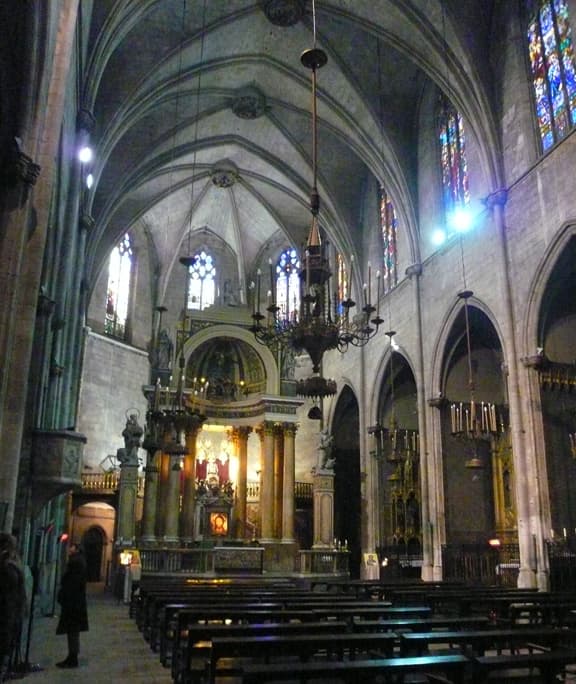
Basilica of SS Just and Pastor
The Basilica of Saints Justus and Pastor is a significant religious site in Barcelona, Catalonia, elevated to the rank of minor basilica in 1948 by Pope Pius XII. Its construction, initiated in the 14th century, showcases Gothic architectural elements and has undergone several renovations and reconstructions over the centuries.
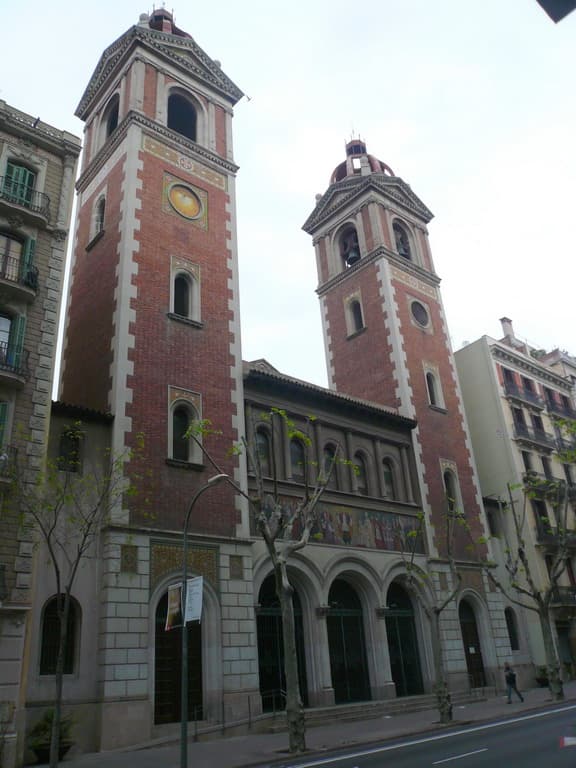
Basilica of St Joseph Oriol
The Basilica of Saint Joseph Oriol is a Roman Catholic church located in Barcelona, Catalonia. It was granted the title of minor basilica by Pope Pius XI in 1936, making it the fifth church in Barcelona to receive this honor. The basilica has a history marked by both construction and significant damage and subsequent rebuilding.