
Basilica and Expiatory Church of the Holy Family
The Basilica and Expiatory Church of the Holy Family (Sagrada Família) is a Roman Catholic church in Barcelona, Spain, renowned for its complex and unique design by Antoni Gaudí. Construction began in 1882, and Gaudí dedicated his life to the project, transforming it with a blend of Gothic and Art Nouveau styles. It is the tallest church in the world, with its central tower reaching 172.5 meters, and parts of it have been designated a UNESCO World Heritage Site.
Key Facts
- ›Construction began on March 19, 1882, under architect Francisco de Paula del Villar.
- ›Antoni Gaudí took over as chief architect in 1883, radically altering the design.
- ›The church is the tallest in the world, with its central tower reaching 172.5 meters.
- ›Parts of the Sagrada Família have been a UNESCO World Heritage Site since 2005.
- ›It is funded solely by private donations and visitor entrance fees.
- ›The church was consecrated by Pope Benedict XVI on November 7, 2010.

Gothic Revival, Art Nouveau, Catalan Modernism
Antoni Gaudí, Francisco De Paula Del Villar, DomèNec SugrañEs I Gras, Francesc Quintana, Isidre Puig Boada, LluíS Bonet I Garí, Francesc Cardoner, Jordi Bonet I Armengol, Jordi Faulí I Oller, Mark Burry
About Basilica and Expiatory Church of the Holy Family
The Basilica and Expiatory Church of the Holy Family, commonly known as Sagrada Família, is an iconic Roman Catholic church located in the Eixample district of Barcelona, Catalonia, Spain. Designed by the visionary Catalan architect Antoni Gaudí, it is celebrated as the tallest church in the world, with its central tower reaching an impressive 172.5 meters. The basilica's construction commenced on March 19, 1882, under the initial direction of Francisco de Paula del Villar, but it was Gaudí, who took over in 1883, that profoundly transformed the project with his distinctive architectural and engineering style, a synthesis of Gothic and curvilinear Art Nouveau forms.
History and Development
Gaudí devoted the latter part of his life to the Sagrada Família, and his burial in the church's crypt underscores his deep connection to the project. At the time of his death in 1926, less than a quarter of the basilica was completed. Construction has notably relied on private donations and has faced interruptions, including the Spanish Civil War, during which parts of the church and Gaudí's original plans were destroyed. Subsequent architects have worked to reconstruct and continue Gaudí's vision, employing modern technologies like computer-aided design to facilitate progress. The church was consecrated by Pope Benedict XVI on November 7, 2010, and parts of it, specifically the Nativity façade and Crypt, were declared a UNESCO World Heritage Site in 2005 as part of the "Works of Antoni Gaudí."
Design and Architectural Significance
The Sagrada Família is renowned for its extraordinary design, which defies conventional architectural categorization. While influenced by Gothic cathedrals, Gaudí's interpretation is highly personal and innovative, featuring no exact right angles and few straight lines. The church is planned to have eighteen spires, representing the Twelve Apostles, the four Evangelists, the Virgin Mary, and Jesus Christ, with the latter being the tallest. It features three grand façades: the Nativity façade, characterized by its ornate, naturalistic sculptures; the Passion façade, stark and angular, depicting Christ's suffering; and the Glory façade, intended to represent humanity's ascent to God. The basilica's unique aesthetic and ambitious scale have led art critics to describe it as unparalleled in art history.
Current Status and Future
Construction of the Sagrada Família continues, with the central tower of Jesus Christ reaching structural completion in February 2026, making it the world's tallest church. The basilica is financed by visitor entrance fees and private contributions. While completion was anticipated for 2026, the centenary of Gaudí's death, ongoing work and challenges may affect the final timeline. Despite its ongoing construction, the basilica is a functioning place of worship, with international masses celebrated regularly.
Source: Wikipedia ↗
Frequently Asked Questions
When was the Sagrada Família consecrated?
The Sagrada Família was consecrated by Pope Benedict XVI on November 7, 2010. This event marked a significant milestone in its long construction history.
What makes the Sagrada Família the tallest church in the world?
The Sagrada Família is the tallest church in the world due to its central tower, the Tower of Jesus Christ, which reaches a height of 172.5 meters. Gaudí designed it to be slightly shorter than Montjuïc hill.
What is the architectural style of the Sagrada Família?
The architectural style of the Sagrada Família is a unique blend of Spanish Late Gothic and Catalan Modernism, often described as Art Nouveau. Gaudí's design incorporates curvilinear forms and naturalistic elements.
Why is the construction of the Sagrada Família taking so long?
Construction has progressed slowly due to reliance on private donations, interruptions like the Spanish Civil War, and the sheer complexity of Gaudí's design. Advancements in technology have since accelerated the process.
Is the Sagrada Família a UNESCO World Heritage Site?
Yes, parts of the Sagrada Família, specifically the Nativity façade and the Crypt, were declared a UNESCO World Heritage Site in 2005. This designation is part of the 'Works of Antoni Gaudí' World Heritage Site.
Who is buried in the Sagrada Família?
Antoni Gaudí, the chief architect, is buried in the church's crypt. He dedicated many years of his life to the Sagrada Família.
What are the three main façades of the Sagrada Família?
The Sagrada Família is designed with three grand façades: the Nativity façade (east), the Passion façade (west), and the Glory façade (south, currently incomplete). Each façade tells a different part of the Christian story.
Related Basilicas
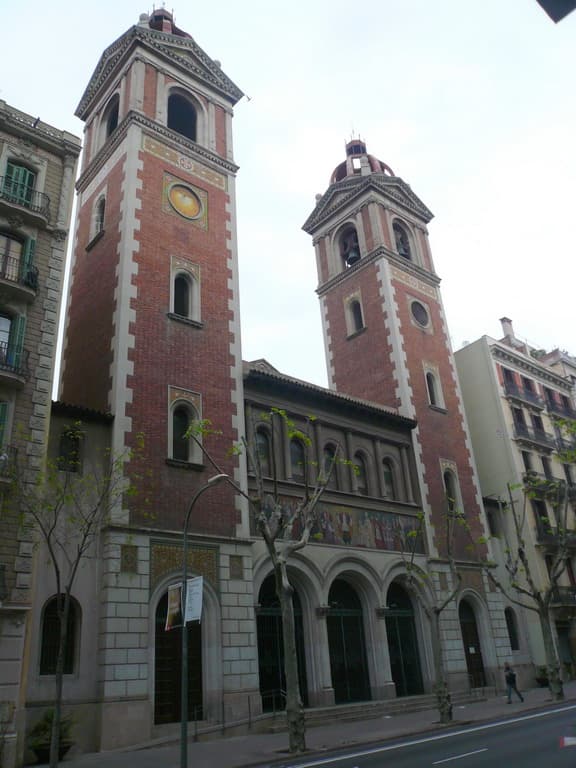
Basilica of St Joseph Oriol
The Basilica of Saint Joseph Oriol is a Roman Catholic church located in Barcelona, Catalonia. It was granted the title of minor basilica by Pope Pius XI in 1936, making it the fifth church in Barcelona to receive this honor. The basilica has a history marked by both construction and significant damage and subsequent rebuilding.

Archcathedral Basilica of the Holy Family
The Cathedral Basilica of the Holy Family, also known as Częstochowa Cathedral, is a significant neo-Gothic religious building located in Częstochowa, Poland. Constructed between 1825 and 1898, and later between 1901 and 1927, it is one of Europe's largest churches of its kind and serves as the metropolitan church for the ecclesiastical province of Częstochowa.

Basilica Co-cathedral of St. Mary
The Co-Cathedral of Saint Mary of Vigo, also known locally as A Colexiata, is a Spanish Baroque/Neoclassical Catholic temple serving as a co-cathedral for the Diocese of Tui-Vigo. Its current structure was largely rebuilt in the 19th century following damage from historical events, including an explosion in 1809, and it was designated a basilica by the Vatican in 2020.