
Cathedral Basilica of St Louis
United States·St. Louis·Archdiocese of St. Louis
The Cathedral Basilica of Saint Louis, also known as the New Cathedral, is the mother church of the Archdiocese of St. Louis. Completed in 1914, it is renowned for its extensive mosaic installations, considered one of the largest in the Western Hemisphere, and its burial crypts for archdiocesan leaders. It was designated a basilica by Pope John Paul II in 1997.
Key Facts
- ›Construction began with ground clearing in 1907 and the cornerstone was laid in 1908.
- ›The cathedral was dedicated in 1914 upon completion of the superstructure, with full consecration occurring in 1926.
- ›Its interior features a vast mosaic collection covering 83,000 square feet, with millions of glass tesserae.
- ›The mosaics were designed by Tiffany Studios and August Oetken, with installation completed by various artisans over many years.
- ›The crypt beneath the cathedral houses the remains of several Cardinals and Archbishops of St. Louis.
- ›The church's organ has undergone multiple significant upgrades and restorations by companies like Geo. Kilgen and Son, M. P. Moller, and Wicks Organ Company.
Saint Louis
Barnett, Haynes & Barnett
About Cathedral Basilica of St Louis
What is the Cathedral Basilica of Saint Louis?
The Cathedral Basilica of Saint Louis, also referred to as the New Cathedral or Saint Louis Cathedral, stands as the principal church of the Archdiocese of St. Louis. Situated in the Central West End neighborhood of St. Louis, Missouri, it serves as the seat for Archbishop Mitchell T. Rozanski.
History and Construction
Planning for this grand cathedral began in the late 19th century under Archbishop Peter Richard Kenrick, with Archbishop John Joseph Kain establishing a fund for its construction. The initiative gained momentum under Archbishop John J. Glennon, leading to the selection of the architecture firm Barnett, Haynes & Barnett, with Thomas P. Barnett heading the design team. Groundbreaking ceremonies took place on May 1, 1907, and the cornerstone was formally laid on October 18, 1908. While the superstructure was completed sufficiently for a dedication ceremony in 1914, the church's full consecration was not celebrated until June 29, 1926. Even after its consecration, the intricate mosaic work continued, with its final completion occurring in 1988.
Architectural and Artistic Significance
The Cathedral Basilica of Saint Louis is particularly celebrated for its immense mosaic installation, one of the largest in the Western Hemisphere. This breathtaking collection encompasses over 83,000 square feet and comprises 41.5 million individual glass tesserae in more than 7,000 colors. The mosaics in the side chapels and sanctuary walls were meticulously crafted by Tiffany Studios, while August Oetken designed the mosaics adorning the main cathedral spaces. Dozens of artisans contributed to the installation, including notable teams and companies like Ravenna Mosaic, Inc., Emil Frei, Inc., and the father-son duo Paul and Arno Heuduck, who dedicated a significant portion of their careers to this project. The narthex visually narrates the life of Saint Louis IX of France, the namesake of the city and cathedral, the rear dome showcases significant archdiocesan events, and the main dome, designed by Jan Henryk de Rosen, depicts pivotal scenes from both the Old and New Testaments.
Crypts, Museum, and Organ
Beneath the cathedral lies a museum dedicated to the church's mosaics and other artifacts. The undercroft also features a chapel honoring past leaders of the Archdiocese, with Cardinals John J. Glennon, Joseph Ritter, and John Carberry, as well as Archbishop John L. May, interred within the cathedral's crypt. The cathedral is also home to a significant pipe organ, originally built by Geo. Kilgen and Son, Inc. in 1915, and has since undergone numerous extensive renovations and expansions by various organ companies, including M. P. Moller and Wicks Organ Company, resulting in a complex instrument with hundreds of ranks of pipes.
Designation and Modern Features
In 1997, Pope John Paul II officially designated the Cathedral Basilica of Saint Louis as a basilica. The grounds also feature the distinctive circular Chancery Building, designed by modernist architect Wenceslaus Sarmiento. In 1999, a stainless steel sculpture known as 'The Angel of Harmony' was installed, symbolizing peace and racial justice, though it was sadly vandalized and destroyed in 2024. The cathedral was officially designated a minor basilica by Pope John Paul II in 1997.
Source: Wikipedia ↗
Frequently Asked Questions
When was the Cathedral Basilica of Saint Louis built?
Ground was cleared for the building in 1907, and the superstructure was completed by 1914, when it was dedicated. The church received its full consecration in 1926.
What is the Cathedral Basilica of Saint Louis famous for?
It is most famous for its extensive mosaic installation, which is one of the largest in the Western Hemisphere, covering 83,000 square feet with over 41.5 million glass tesserae pieces. It is also known for its burial crypts.
Who designed the mosaics in the cathedral?
While Tiffany Studios designed the mosaics in the side chapels and sanctuary walls, August Oetken designed the mosaics for the main cathedral areas. Numerous artisans were involved in their installation.
Where are notable figures buried in the cathedral?
The church basement contains a crypt dedicated to former leaders of the Archdiocese. Cardinals John J. Glennon, Joseph Ritter, and John Carberry, along with Archbishop John L. May, are interred in the cathedral's crypt.
What is the significance of the 'Angel of Harmony' sculpture?
The 'Angel of Harmony' was a 14-foot stainless steel sculpture installed in 1999, symbolizing peace and racial justice. It featured an angel with African-American features standing behind children of diverse ethnicities playing instruments. The sculpture was unfortunately vandalized and destroyed in 2024.
Related Basilicas
Basilica of St Louis, King of France (Old Cathedral)
The Basilica of Saint Louis, King of France, also known as the Old Cathedral, is a historic Catholic church in St. Louis, Missouri. It holds the distinction of being the first cathedral west of the Mississippi River and served as the sole parish church in St. Louis until 1844. Despite being surrounded by Gateway Arch National Park, the basilica was preserved due to its significant historical importance, making it a popular site for weddings and a notable tourist destination.
Basilica of St Fidelis
The Basilica of St. Fidelis, also known as the Cathedral of the Plains, is a Romanesque-style Catholic parish church located in Victoria, Kansas. It was constructed between 1908 and 1911 and was elevated to the status of a minor basilica in 2014. Its impressive architecture and prominent location have made it a significant landmark in western Kansas.
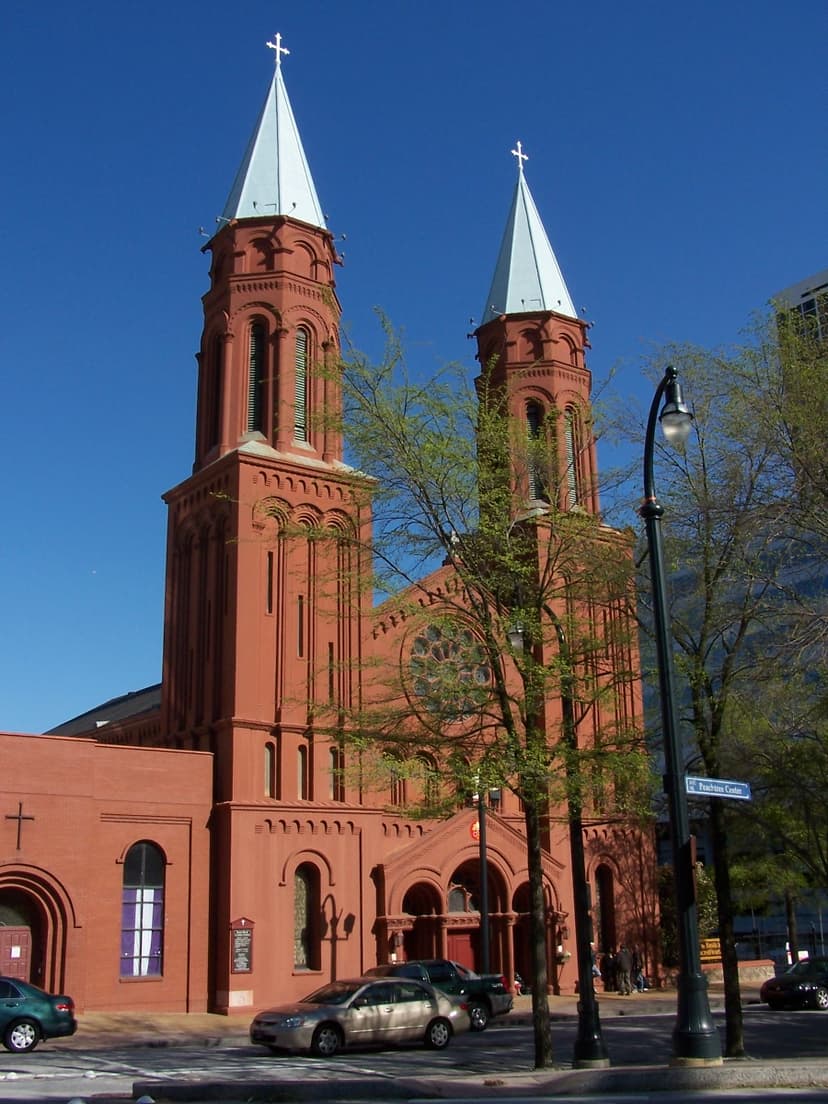
Basilica of the Sacred Heart of Jesus
The Basilica of the Sacred Heart of Jesus is a Roman Catholic church located in downtown Atlanta, Georgia. Completed in 1898, it is recognized for its French Romanesque and Romanesque Revival architecture and was designated a minor basilica in 2010. The church holds historical significance as one of the few remaining structures from Atlanta's early 20th-century development and has served its congregation for over a century.