
Cathedral Basilica of Saint Louis
The Cathedral Basilica of Saint Louis is a prominent Catholic cathedral located in St. Louis, Missouri, serving as the mother church of the Archdiocese of St. Louis. Completed in 1914, it is renowned for its vast mosaic installations, which are among the largest in the Western Hemisphere, and its crypts holding the remains of several archdiocesan leaders.
Key Facts
- ›Construction began with groundbreaking on May 1, 1907, and the superstructure was dedicated on October 18, 1914.
- ›The cathedral's mosaics, completed in 1988, cover 83,000 square feet and feature 41.5 million glass tesserae in over 7,000 colors.
- ›The mosaics in the main cathedral areas were designed by August Oetken, while Tiffany Studios created those in the side chapels and sanctuary.
- ›It is the seat of the Archbishop of St. Louis and was designated a basilica by Pope John Paul II in 1997.
- ›The crypt beneath the cathedral houses the burial sites of Cardinals John J. Glennon, Joseph Ritter, and John Carberry, as well as Archbishop John L. may.
- ›The cathedral features a significant pipe organ, originally built by Geo. Kilgen and Son, Inc., which has undergone multiple renovations and expansions by various organ companies.

- Largest Mosaic Collection In the World
- Burial Crypts For Archdiocesan Leaders
- Circular Chancery Building Designed By Wenceslaus Sarmiento
- the Angel of Harmony Sculpture By Wiktor Szostalo
- Large Pipe Organ With Multiple Consoles and Extensive Pipe Ranks
Barnett, Haynes & Barnett, Thomas P. Barnett
About Cathedral Basilica of Saint Louis
The Cathedral Basilica of Saint Louis, also known as the Saint Louis Cathedral or the New Cathedral, stands as a significant landmark in the Central West End neighborhood of St. Louis, Missouri. Completed in 1914, it holds the distinction of being the mother church of the Archdiocese of St. Louis and serves as the episcopal see for the Archbishop. The cathedral was officially designated a basilica by Pope John Paul II in 1997, recognizing its importance within the Catholic Church.
History and Construction
The initiative to build a new cathedral began in earnest under Archbishop John J. Glennon, with the architecture firm Barnett, Haynes & Barnett selected to design the structure, led by Thomas P. Barnett. Groundbreaking ceremonies took place on May 1, 1907, followed by the laying of the cornerstone on October 18, 1908. While the building's superstructure was sufficiently complete for a dedication ceremony on October 18, 1914, its formal consecration did not occur until June 29, 1926. The completion of its extensive interior mosaics continued for many decades, finally being finished in 1988.
Mosaics and Artistic Treasures
The cathedral is globally recognized for its breathtaking mosaic installations, which collectively represent the largest mosaic collection in the world. Covering an immense 83,000 square feet, these mosaics comprise approximately 41.5 million individual glass tesserae in over 7,000 distinct colors. While Tiffany Studios was responsible for the mosaics in the side chapels and sanctuary walls, the majority of the interior mosaics were designed by August Oetken. These artworks depict various biblical scenes, the life of Saint Louis IX of France, and significant archdiocesan events.
Crypts, Museum, and Organ
Beneath the cathedral lies a crypt area that serves as the final resting place for several influential leaders of the Archdiocese, including Cardinals John J. Glennon, Joseph Ritter, and John Carberry, along with Archbishop John L. May. The church basement also features a museum dedicated to showcasing the cathedral's mosaics and other historical artifacts. The cathedral is further enhanced by a substantial pipe organ, originally installed in 1915 and subsequently expanded and refurbished by various organ builders over the decades, making it a notable feature for both worship and cultural tours.
Source: Wikipedia ↗
Frequently Asked Questions
When was the Cathedral Basilica of Saint Louis completed?
The superstructure of the Cathedral Basilica of Saint Louis was completed in 1914, with a dedication ceremony held on October 18th of that year. However, full consecration of the church did not occur until June 29, 1926, and the extensive mosaic work was not fully finished until 1988.
What is the Cathedral Basilica of Saint Louis famous for?
The cathedral is most famous for its immense mosaic installation, which is the largest in the world, covering 83,000 square feet with 41.5 million glass tesserae. It is also known for its burial crypts where several prominent archdiocesan leaders are interred.
Who designed the mosaics in the Cathedral Basilica of Saint Louis?
The mosaics in the main cathedral areas were designed by August Oetken. The mosaics in the side chapels and sanctuary walls were created by Tiffany Studios. Dozens of artisans contributed to the installation, including Hildreth Meiere and the father-and-son team Paul and Arno Heuduck.
Where is the Cathedral Basilica of Saint Louis located?
The Cathedral Basilica of Saint Louis is located in the Central West End neighborhood of St. Louis, Missouri. It replaced the previous cathedral, the Basilica of Saint Louis, King of France, which was situated along the Mississippi River.
What is the significance of the Cathedral Basilica of Saint Louis?
It serves as the mother church of the Archdiocese of St. Louis and the seat of the Archbishop. Its designation as a basilica by Pope John Paul II in 1997 underscores its importance. The vast mosaic collection and its role as a spiritual center contribute to its significance.
Related Cathedrals

Basilica of St. Louis, King of France
The Basilica of Saint Louis, King of France, formerly the Cathedral of Saint Louis and colloquially known as the Old Cathedral, is a significant Catholic church in St. Louis, Missouri. It holds the distinction of being the first cathedral west of the Mississippi River and played a crucial role as the sole parish church in St. Louis until 1844. Its historical importance is underscored by its preservation amidst the development of Gateway Arch National Park.
Basilica of the Immaculate Conception
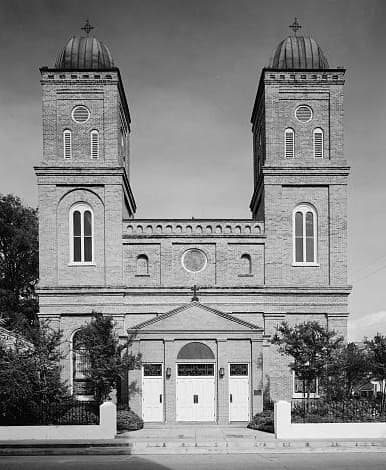
The Basilica of the Immaculate Conception in Natchitoches, Louisiana, is a historic Roman Catholic church that has served multiple roles since its founding in 1728. It was the first cathedral for the Diocese of Natchitoches and was elevated to the status of a minor basilica by Pope Benedict XVI in 2009. The current structure, built between 1857 and 1905, is a significant landmark within the Natchitoches Historic District.

Cathedral Basilica of St. John the Baptist
The Cathedral Basilica of St. John the Baptist is a prominent Roman Catholic cathedral and minor basilica located in Savannah, Georgia, serving as the mother church for the Diocese of Savannah. Its history traces back to the late 18th century, evolving through several church buildings before the current structure, which has undergone numerous renovations and restorations to maintain its architectural integrity and functional capacity.