
Cathedral Basilica of Santa María
Peru·Trujillo
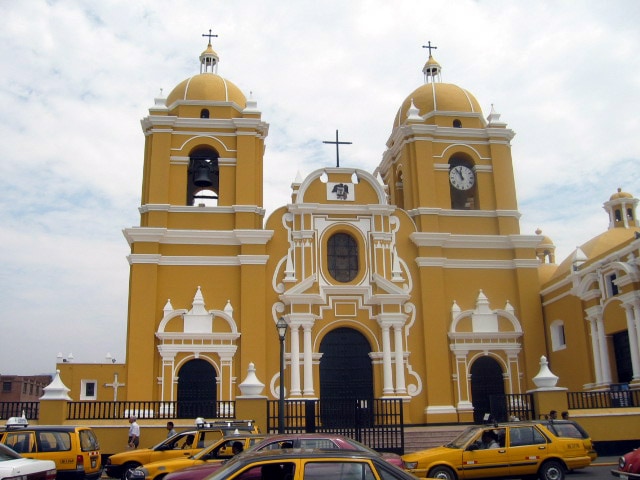
The Cathedral Basilica of Santa María in Trujillo, Peru, is the city's main church and cathedral, located in the Plaza de Armas. Originally founded as a modest mother church, it was elevated to cathedral status in 1616 by Pope Paul V, though it suffered destruction from earthquakes. The current structure, largely built between 1647 and 1666, is renowned for its Churrigueresque Baroque main altarpiece and its interior paintings, earning it the moniker "Sistine Chapel of the Coast."
Key Facts
- ›Construction of the current building took place between 1647 and 1666.
- ›It was elevated to the status of Minor Basilica by Pope Paul VI in 1967.
- ›The cathedral houses an 'exempt' main altarpiece in the Churrigueresque Baroque style, unique in Peru alongside Cusco Cathedral's.
- ›Its interior vault and dome feature notable paintings, leading to comparisons with the Sistine Chapel.
- ›The Cathedral Museum displays religious artworks from the colonial era in gold and silver.
Baroque, Churrigueresque
Francisco De Soto RíOs, Francisco Balboa
About Cathedral Basilica of Santa María
Trujillo Cathedral: A Colonial Masterpiece
The Trujillo Cathedral, officially known as the Cathedral Basilica of Santa María, stands as the principal church and cathedral of Trujillo, Peru, prominently located in the Plaza de Armas. Its history is marked by destruction and rebuilding, with the current edifice largely constructed between 1647 and 1666. This significant religious structure was elevated to the status of a Minor Basilica by Pope Paul VI in 1967.
History and Reconstruction
Originally established as a mother church following the founding of Trujillo between 1535 and 1540, the church initially possessed modest architecture. It was recognized as a Cathedral by Pope Paul V in 1616. However, a devastating earthquake on February 14, 1619, led to its destruction, along with much of the city. Subsequent rebuilding efforts under Bartolomé de las Cuevas were also impacted by another earthquake on February 29, 1635. To address the need for a more substantial building, the episcopate commissioned significant work, with architect Francisco de Soto Ríos leading a large portion of the construction from 1647, and Francisco Balboa completing the work in 1666.
Architectural and Artistic Significance
The interior of the Cathedral Basilica of Santa María is characterized by its sober yet ornate decoration. It features Rococo altarpieces, painted white with gold accents, and a Baroque altarpiece with similar coloring. The canvases housed within the cathedral are attributed to the Cusco school of painting. A notable feature is the "exempt" main altarpiece, which stands independently of any wall. This altarpiece is executed in the Churrigueresque Baroque style and is covered in gold leaf, making it one of only two such surviving examples in Peru, the other being in Cusco Cathedral.
The cathedral's vault and dome are adorned with striking paintings, leading to its popular designation as the "Sistine Chapel of the Coast." This moniker draws a parallel to the Church of San Pedro de Andahuaylillas, known as the "Sistine Chapel of the Andes." Beyond its architectural splendor, the cathedral also houses the Cathedral Museum, which exhibits religious works from the colonial era, including intricate pieces in gold and silver.
Source: Wikipedia ↗
Frequently Asked Questions
When was the Trujillo Cathedral built?
The current structure of the Trujillo Cathedral, also known as the Cathedral Basilica of Santa María, was constructed over 19 years, from 1647 to 1666.
What is the significance of the main altarpiece?
The cathedral features an 'exempt' main altarpiece, meaning it is not attached to any wall. This Churrigueresque Baroque piece, covered in gold leaf, is one of only two such altarpieces remaining in Peru.
Why is it called the 'Sistine Chapel of the Coast'?
The Cathedral Basilica of Santa María is known as the 'Sistine Chapel of the Coast' due to the beautiful paintings found on its vault and in its dome, drawing a parallel to the famous chapel in the Vatican.
What can be seen at the Cathedral Museum?
The Cathedral Museum houses religious works from the colonial era, primarily crafted from gold and silver, offering a glimpse into the region's artistic and religious history.
Has the cathedral always been a cathedral?
Initially founded as a modest mother church after Trujillo's establishment, it was elevated to the category of Cathedral by Pope Paul V in 1616. However, it was destroyed by earthquakes and subsequently rebuilt.
Related Basilicas

Basilica of Saint Francis
The Basilica and Convent of San Francisco in Lima, Peru, is a significant religious and architectural complex, described as "the largest and noblest monument that the conquest erected in these prodigious lands." It is a prime example of viceregal-era architecture, featuring a blend of Baroque and Neoclassical styles, and forms part of the UNESCO World Heritage site of the Historic Centre of Lima.

Basilica Cathedral of Lima
The Cathedral Basilica of Lima, also known as the Metropolitan Cathedral of Lima, is a significant Roman Catholic cathedral in Lima, Peru. It is the seat of the Archdiocese of Lima and is recognized as the oldest and largest church in Peru. Its construction, which began in 1535, spanned centuries and incorporated various architectural styles, reflecting its long and evolving history.

Cathedral Basilica of the Virgin of the Assumption
The Cathedral Basilica of the Virgin of the Assumption, also known as the Cathedral of Cusco, is the principal Catholic church in Cusco, Peru, and the seat of the Archdiocese of Cusco. Constructed on the site of Inca palaces, it is a significant religious monument and a testament to the fusion of Inca and Spanish colonial architectural and artistic traditions. It holds a prominent place in the Historic Center of Cusco, which is recognized as a UNESCO World Heritage Site.