
Basilica of the Twenty-Six Holy Martyrs
Japan·Nagasaki·Catholic Archdiocese of Nagasaki
The Basilica of the Twenty-Six Holy Martyrs of Japan, also known as Oura Church or Oura Cathedral, is a Catholic minor basilica in Nagasaki, Japan. Built shortly after the end of Japan's Seclusion Policy, it is recognized as the oldest Christian church in Japan and was the first Western-style building to be declared a national treasure. The basilica is significant for its role in the re-emergence of Christianity in Japan, particularly its connection to the discovery of hidden Christians.
Key Facts
- ›Construction began in 1863 and was completed in 1864, with the present Gothic structure dating from around 1878.
- ›It was officially a chapel for the French foreign community due to treaty agreements, as Christianity was still outlawed.
- ›In 1865, the church became the site where hidden Christians (Kakure Kirishitans) revealed themselves to Father Bernard Petitjean.
- ›The basilica underwent significant expansion and renovation between 1875 and 1891, adopting a full Gothic style.
- ›It was designated a National Treasure in 1933 and is part of a UNESCO World Heritage Site.
- ›The church was granted status as a minor basilica by the Holy See in 2016.

Gothic
Twenty-Six Martyrs of Japan
SociéTé Des Missions éTrangèRes
Koyama Hidenoshin
About Basilica of the Twenty-Six Holy Martyrs
Oura Church (Basilica of the Twenty-Six Holy Martyrs of Japan)
The Basilica of the Twenty-Six Holy Martyrs of Japan, commonly known as Oura Church or Oura Cathedral, stands as a significant monument to the resurgence of Christianity in Japan. Located in Nagasaki, it is a Catholic minor basilica and co-cathedral, built shortly after the Japanese government's Seclusion Policy ended in 1853. It is named in honor of the 26 Japanese Martyrs, a group of European and Japanese Christians who were crucified in 1597.
History and Construction
In 1863, French priests from the Société des Missions Étrangères were tasked with building a church dedicated to the Twenty-Six Martyrs. The initial structure, completed in 1864, was a modest wooden church with three aisles and three octagonal towers, built by master carpenter Koyama Hidenoshin. The current, more substantial Gothic basilica dates from around 1878. This later version, constructed of white stuccoed brick, features five aisles, vaulted ceilings, and a single octagonal tower. Its design is believed to be based on a Belgian plan used for an earlier church in Osaka, and its stained glass windows were imported from France.
Re-emergence of Christianity
Initially, the church served as a chapel for the French foreign community, as Christianity remained officially outlawed by the Tokugawa shogunate. A pivotal moment occurred on March 17, 1865, when a group of individuals approached the church, seeking to enter. Among them was an old woman who, upon seeing the priest at the altar, declared that their faith was the same as his and asked for the statue of the Virgin Mary. These individuals were identified as Kakure Kirishitans, descendants of early Japanese Christians who had practiced their faith in secret since the Shimabara Rebellion in the 1630s. The discovery of these hidden Christians, who then numbered in the tens of thousands in the Nagasaki area, was hailed by Pope Pius IX as "the miracle of the Orient."
Architectural Evolution and Recognition
The church underwent a major expansion and renovation from 1875 to 1891. During this period, the exterior walls were rebuilt with brick, giving the building its distinct Gothic style and significantly altering its appearance from the original wooden structure. The rebuilt church was consecrated on May 22, 1879, making it the first brick church in Kyushu. In 1891, it became the cathedral for the Catholic Diocese of Nagasaki.
Ōura Cathedral received significant national recognition, being designated a National Treasure in 1933. It was the first Western-style building in Japan to achieve this status and held this distinction until 2009. Although damaged by the atomic bomb on August 9, 1945, it miraculously avoided collapse and fire. In 2012, the precincts of the cathedral were designated a National Historic Site. The church was officially granted the status of a minor basilica by the Holy See on April 26, 2016. Furthermore, on June 30, 2018, Ōura Cathedral, along with eleven other sites associated with Catholic persecution in Japan, was inscribed on the UNESCO World Heritage List.
Source: Wikipedia ↗
Frequently Asked Questions
When was the Basilica of the Twenty-Six Holy Martyrs built?
The original church was finished in 1864. The present, larger Gothic basilica structure was built around 1878, with significant renovations occurring between 1875 and 1891.
What is the significance of the Oura Church in Japanese Christian history?
The Oura Church is known as the site where hidden Christians, descendants of early Japanese Christians who went into hiding, revealed themselves to a French priest in 1865. This event, considered the 'miracle of the Orient,' led to tens of thousands of underground Christians coming out of hiding.
What architectural style is the Basilica of the Twenty-Six Holy Martyrs?
The present structure is a Gothic basilica, rebuilt with white stuccoed brick. The original church was a smaller wooden structure.
Is the Oura Cathedral a UNESCO World Heritage Site?
Yes, on June 30, 2018, Ōura Cathedral, along with 11 other related sites, was added to the UNESCO World Heritage List as part of the 'Hidden Christian Sites in Nagasaki' designation.
What makes this basilica a National Treasure?
Ōura Cathedral was designated a National Treasure in 1933, being the first Western-style building in Japan to receive this honor. Its historical significance, particularly its connection to the re-emergence of Christianity, contributes to this status.
Related Basilicas
Abbatial Basilica of the Monastery of St Benedict
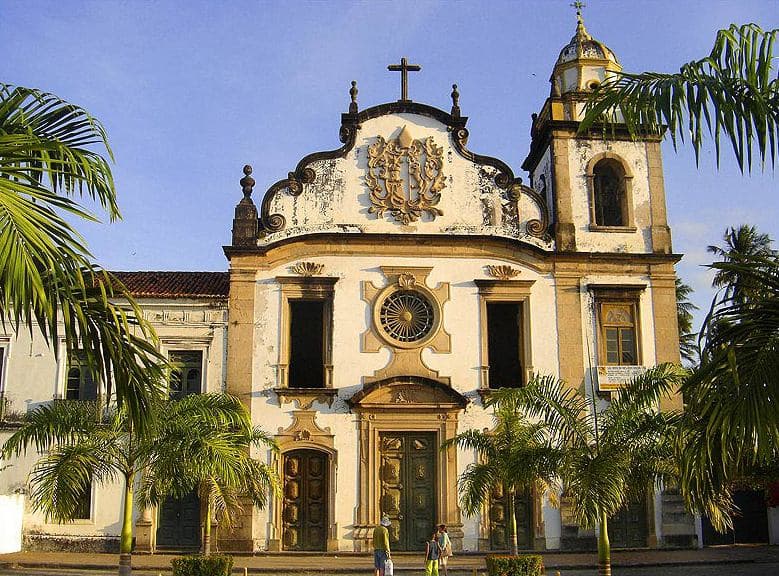
The Basilica and Monastery of St. Benedict is a significant Baroque architectural complex in Olinda, Pernambuco, Brazil. It is part of the historic center of the city, which is recognized as a UNESCO World Heritage Site. The basilica holds importance for its historical roots in Portuguese colonization and its elevated status as a Minor Basilica.

Archcathedral Basilica of St John the Baptist
Archcathedral Basilica of St John the Baptist is a Catholic church located in Warsaw, Poland, serving as the mother church of the Archdiocese of Warsaw and a significant national pantheon. Originally built in the 14th century, it has undergone numerous modifications and destructions, most notably during World War II, before its post-war reconstruction. Its historical importance is underscored by its role as a coronation and burial site for Polish royalty and notable figures, and its inclusion as part of a UNESCO World Heritage Site.

Archcathedral Basilica of St Stanislaus and St Vladislav
The Archcathedral Basilica of St Stanislaus and St Vladislav, also known as Vilnius Cathedral, is the principal Catholic cathedral in Lithuania, serving as the heart of Catholic spiritual life. It has a long and complex history, with evidence of earlier pagan temples and multiple reconstructions, making it a significant historical and religious landmark in Vilnius Old Town.