
Archcathedral Basilica of St John the Baptist
Archcathedral Basilica of St John the Baptist is a Catholic church located in Warsaw, Poland, serving as the mother church of the Archdiocese of Warsaw and a significant national pantheon. Originally built in the 14th century, it has undergone numerous modifications and destructions, most notably during World War II, before its post-war reconstruction. Its historical importance is underscored by its role as a coronation and burial site for Polish royalty and notable figures, and its inclusion as part of a UNESCO World Heritage Site.
Key Facts
- ›Originally constructed in the 14th century in Masovian Gothic style, it served as a coronation and burial site for Dukes of Masovia.
- ›Connected to the Royal Castle by an elevated corridor built in the late 16th century.
- ›Became a Cathedral in 1798 when Warsaw became the seat of a new Diocese.
- ›Severely damaged during the Warsaw Uprising in 1944, with 90% of its walls destroyed by German forces.
- ›Reconstructed after the war, with its exterior based on 14th-century presumed appearance.
- ›Houses the crypts of notable figures including King Stanisław August Poniatowski and composers of the Royal Cappella Vasa.

Masovian Gothic, Gothic Revival, Early Baroque
Wooden Crucifix From Nuremberg
About Archcathedral Basilica of St John the Baptist
St John's Archcathedral, known in Polish as Archikatedra św. Jana w Warszawie, is a significant Catholic church located in the Old Town of Warsaw, Poland. It holds the distinction of being the mother church of the Archdiocese of Warsaw and is one of Poland's national pantheons, making it a site of immense religious and historical importance. The archcathedral is also recognized by UNESCO as part of the Warsaw Old Town World Heritage Site.
History and Reconstruction
The basilica's origins trace back to the 14th century when it was constructed in the Masovian Gothic style. Throughout its history, it served as a crucial site for coronations and burials of numerous Dukes of Masovia. Its connection to the Royal Castle was further solidified by the construction of an elevated corridor in the late 16th century. Over the centuries, the church underwent various modifications, including significant changes in the 19th century that preserved it as an example of Gothic Revival architecture.
During World War II, specifically the Warsaw Uprising of 1944, the cathedral became a battleground. Following the uprising's collapse, German forces deliberately destroyed 90% of the building's walls. The post-war reconstruction aimed to restore the exterior to its presumed 14th-century appearance, drawing from historical illustrations rather than its pre-war state.
Interior and Notable Burials
The interior of St John's Archcathedral, once adorned with profuse Early Baroque decoration and a notable painting by Palma il Giovane, was largely destroyed during the wartime bombing. The reconstruction prioritized a return to a more Gothic aesthetic due to the limited preservation of original furnishings. The cathedral is a three-nave building, with aisles of equal height to the main nave.
Among its most precious elements is a wooden crucifix housed in the Baryczka Chapel, brought from Nuremberg in 1539. The crypts beneath the main aisle are the final resting place for many distinguished individuals. These include members of the ducal families of Masovia, King Stanisław August Poniatowski, composers and musicians of the Royal Cappella Vasa, statesmen, writers such as Henryk Sienkiewicz, presidents of Poland like Gabriel Narutowicz and Ignacy Mościcki, and prominent religious leaders including primates such as Stefan Wyszyński and Józef Glemp.
Source: Wikipedia ↗
Frequently Asked Questions
What is the historical significance of St John's Archcathedral?
St John's Archcathedral has a long history as a coronation and burial site for the Dukes of Masovia and later for Polish royalty and prominent figures. It also holds the title of the mother church of the Archdiocese of Warsaw and is recognized as a national pantheon.
What happened to St John's Archcathedral during World War II?
During the Warsaw Uprising in 1944, the cathedral was a site of conflict and was heavily damaged. German forces later destroyed 90% of its walls with explosives as part of the planned destruction of Warsaw.
When was St John's Archcathedral originally built?
The archcathedral was originally built in the 14th century. Its architectural style at that time was Masovian Gothic.
Who is buried in St John's Archcathedral?
The crypts beneath the main aisle contain the remains of several notable individuals, including Dukes of Masovia, King Stanisław August Poniatowski, composers, statesmen, writers, presidents of Poland, and primates of Poland.
Is St John's Archcathedral part of a UNESCO World Heritage Site?
Yes, along with the Old Town of Warsaw, St John's Archcathedral has been listed by UNESCO as a World Heritage Site, recognizing its historical and cultural importance.
Related Basilicas

Archcathedral Basilica of the Assumption and St John the Baptist
The Archcathedral Basilica of the Assumption and St John the Baptist in Przemyśl is the mother church of the Ukrainian Greek Catholic Archeparchy of Peremyshl-Warsaw. Originally built in the 17th century by the Jesuit order and dedicated to St. Ignatius, the church fell into disrepair and was later reconsecrated as Sacred Heart of Jesus in 1904. It became a focal point of controversy in 1991 when it was designated as the Greek Catholic cathedral, leading to protests by local Polish nationalists.

Basilica of the Holy Cross
The Basilica of the Holy Cross in Warsaw, Poland, is a prominent Roman Catholic church noted for its Baroque architecture and historical significance. It is particularly famous for housing the embalmed heart of composer Frédéric Chopin and serving as a site of important national events and demonstrations. The church has undergone significant destruction and rebuilding throughout its history, most notably after World War II.
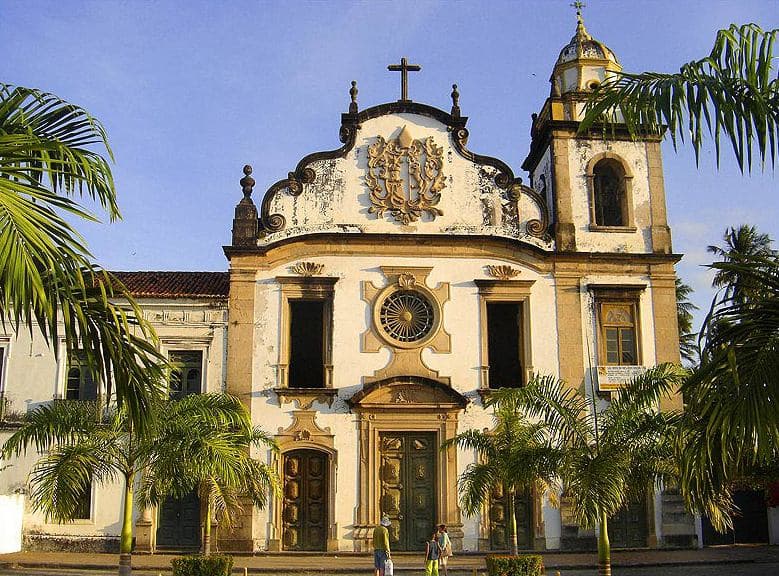
Abbatial Basilica of the Monastery of St Benedict
The Basilica and Monastery of St. Benedict is a significant Baroque architectural complex in Olinda, Pernambuco, Brazil. It is part of the historic center of the city, which is recognized as a UNESCO World Heritage Site. The basilica holds importance for its historical roots in Portuguese colonization and its elevated status as a Minor Basilica.