
Basilica of the Resurrection
The Basilica of the Resurrection in Kaunas, Lithuania, is the largest basilical church in the Baltic states. Conceived as an expression of gratitude for Lithuania's regained independence, its construction spanned decades and faced numerous setbacks, including wartime suspension and repurposing as a factory. Today, it serves as a significant religious and community center, notable for its monumental scale and historical resilience.
Key Facts
- ›Construction began in 1934 with a cornerstone from Jerusalem's Mount of Olives.
- ›Intended as a national pantheon, its design included underground crypts for distinguished Lithuanians.
- ›The building was used as a factory during the Soviet occupation, with its cross and chapel demolished.
- ›Restoration efforts, supported by government funding, began in earnest in 1997.
- ›It was consecrated in 2004 and officially recognized as a minor basilica by Pope Francis in 2015.
- ›The basilica can accommodate approximately 5,000 people and features a columbarium and parish museum.
Roman Catholic
Relic of St. Anthony
Karolis Reisonas
About Basilica of the Resurrection
Kaunas Our Lord Jesus Christ's Resurrection Basilica
The Kaunas Our Lord Jesus Christ's Resurrection Basilica, often referred to as the Resurrection Basilica, is a monumental Roman Catholic minor basilica located in Kaunas, Lithuania. It holds the distinction of being the largest basilical church in the Baltic states. Its construction was initiated after Lithuania regained its independence in 1918, serving as a symbol of gratitude for this renewed freedom.
History and Construction
The vision for a new church to express thanks for regained independence gained momentum in 1926 with the establishment of a committee led by President Antanas Smetona. Kaunas was chosen as the site for this significant undertaking, as it served as the temporary capital during the period when Vilnius was under Polish control. A design competition in 1928 resulted in the selection of Karolis Reisonas's proposal. However, the grand scope and technical challenges of the design led to significant cost escalations, with the final design not being approved until 1933.
The symbolic cornerstone for the church was brought from Jerusalem's Mount of Olives in 1934. Funding for the ambitious project came from both within Lithuania and from abroad, with notable efforts by parson Feliksas Kapočius, who traveled to the United States to gather support from the Lithuanian diaspora. Construction faced numerous setbacks and periods of suspension due to a lack of funds. By 1938, the walls and roof were completed, and the church was largely finished by 1940, having cost approximately one million litas, largely from individual donations. The original intention was for the completed church to serve as a national pantheon, featuring underground crypts for the remains of distinguished Lithuanians.
Wartime and Soviet Era
Further construction was halted by World War II. During the Nazi occupation, the church was used as a storeroom. Under Soviet rule, it was confiscated by the government and, by a decree from Stalin in 1952, was repurposed as a factory. This period saw the demolition of the cross atop the tower and the church's chapel.
Restoration and Re-dedication
The building served as the Banga radio factory until the Lithuanian national awakening in 1988. Following this resurgence, control of the church was returned to a newly formed council, and the factory was eventually ordered to vacate. The church was left in a severely deteriorated state after decades of misuse. The 1990s presented further obstacles to its rehabilitation due to the official separation of church and state and economic challenges. Urgent repairs were carried out between 1993 and 1997 to prevent further decay. Restoration efforts gained momentum in 1997 with government financial support. Holy Mass was celebrated for the first time in 1997 while the church was still under scaffolding. The church was consecrated in 2004, followed by the consecration of its columbarium in 2006. The Chapel of the Blessed Virgin Mary of Šiluva was consecrated on the roof in 2004. The high relief "Risen Christ," created by sculptor Vytautas Kašuba, was consecrated on April 25, 2011, marking the completion of the sanctuary's renovation. In 2015, Pope Francis bestowed the title of minor basilica upon the church.
The Basilica Today
The Basilica of the Resurrection now features two towers, one standing at 70 meters. An elevator provides access to the basilica's roof, offering panoramic views of Kaunas. Situated atop Kaunas's Green Hill (Žaliakalnis), its cellarage contains a columbarium and a parish museum. Beyond its religious functions, the basilica is also utilized for community gatherings, events, and as a preschool. The sanctuary can seat 400 worshippers, with the entire building accommodating approximately 5,000 people.
Source: Wikipedia ↗
Frequently Asked Questions
When was the Basilica of the Resurrection constructed?
Construction began in 1934, with the walls and roof completed by 1938. While largely finished by 1940, further work was suspended. The church was consecrated in 2004 and completed in 2005.
What is the significance of the Basilica of the Resurrection?
It was conceived to express gratitude for Lithuania's regained independence in 1918. It is the largest basilical church in the Baltic states and was intended to be a national pantheon.
What challenges did the basilica face during its history?
Construction faced technical difficulties, funding shortages, and wartime suspension. During the Soviet occupation, it was confiscated and used as a factory, leading to damage and the demolition of its cross and chapel.
What facilities are available at the Basilica of the Resurrection today?
The basilica houses a columbarium and a parish museum in its cellarage. It also features a sanctuary that seats 400 and can accommodate about 5,000 people in total. A chapel dedicated to the Blessed Virgin Mary of Šiluva is located on its roof.
Who was instrumental in the basilica's construction and funding?
President Antanas Smetona led the committee overseeing construction. Prominent parson Feliksas Kapočius was deeply involved in the project's details and funding, traveling to the United States to solicit support from Lithuanian émigrés.
Related Basilicas
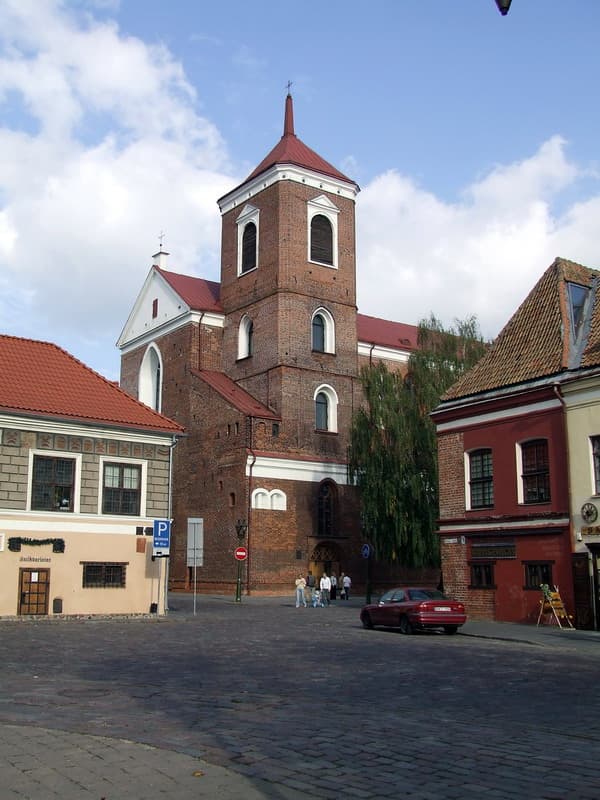
Archcathedral Basilica of SS Peter and Paul
The Archcathedral Basilica of SS Peter and Paul in Kaunas, Lithuania, is the principal church of the Archdiocese of Kaunas and the largest Gothic church in Lithuania. Established by Vytautas the Great, its construction spanned centuries, with significant renovations and stylistic additions, including Gothic, Renaissance, and Rococo elements. It holds historical importance as a site of religious and cultural significance, housing the remains of notable Lithuanian figures.

Archcathedral Basilica of St Stanislaus and St Vladislav
The Archcathedral Basilica of St Stanislaus and St Vladislav, also known as Vilnius Cathedral, is the principal Catholic cathedral in Lithuania, serving as the heart of Catholic spiritual life. It has a long and complex history, with evidence of earlier pagan temples and multiple reconstructions, making it a significant historical and religious landmark in Vilnius Old Town.

Basilica of the Visitation of the Blessed Virgin Mary
The Basilica of the Visitation of the Blessed Virgin Mary, located in Trakai, Lithuania, is a significant Roman Catholic church with a rich history dating back to its founding by Vytautas the Great in 1409. Originally constructed in the Gothic style, it underwent substantial alterations during the Baroque period, which largely define its present architectural character. The basilica is renowned for housing the revered icon of Our Lady of Trakai within its main altarpiece.