
Archcathedral Basilica of SS Peter and Paul
Lithuania·Kaunas·Archdiocese of Kaunas
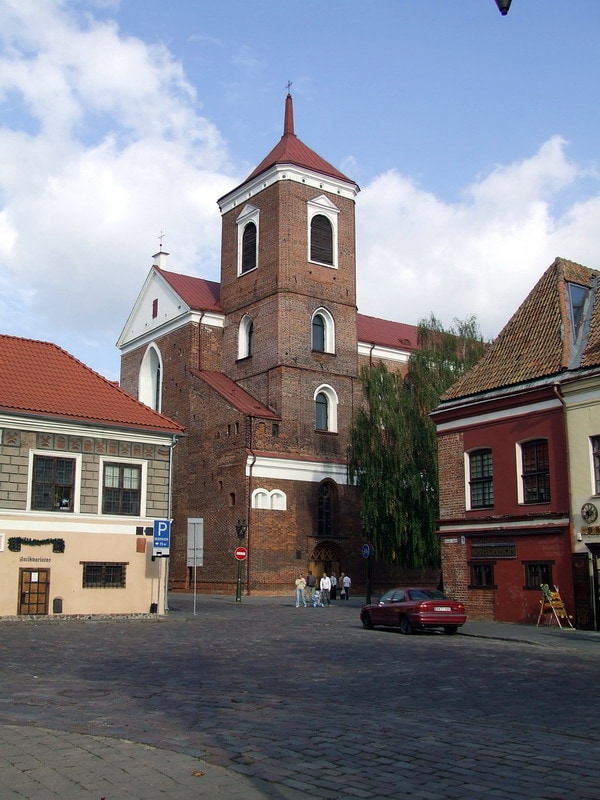
The Archcathedral Basilica of SS Peter and Paul in Kaunas, Lithuania, is the principal church of the Archdiocese of Kaunas and the largest Gothic church in Lithuania. Established by Vytautas the Great, its construction spanned centuries, with significant renovations and stylistic additions, including Gothic, Renaissance, and Rococo elements. It holds historical importance as a site of religious and cultural significance, housing the remains of notable Lithuanian figures.
Key Facts
- ›Construction of the first Gothic church dedicated to Saints Peter and Paul began under Grand Duke Vytautas the Great, with the church documented by 1413.
- ›The church's construction works were concluded in 1624, but it suffered damage and underwent multiple rebuilds and renovations, incorporating Renaissance and Rococo styles.
- ›The present form of the building largely dates from a renovation completed in 1800.
- ›It became the cathedral of the Diocese of Samogitia in the 19th century after the seat was transferred from Varniai.
- ›The church was officially elevated to cathedral status by Pope Leo XIII in 1895 and granted the title of Minor Basilica in 1921.
- ›It served as the principal church of Lithuania when it was reorganized as the Metropolitan Archdiocese of Kaunas until 1939.
Gothic, Renaissance, Rococo, Neo-Gothic
Augustinians
About Archcathedral Basilica of SS Peter and Paul
The Archcathedral Basilica of SS Peter and Paul, known in Lithuanian as Kauno Šv. apaštalų Petro ir Povilo katedra bazilika, is a prominent Roman Catholic basilica located in Kaunas, Lithuania. It serves as the principal church of the Archdiocese of Kaunas and is distinguished as the largest Gothic church in Lithuania.
History and Construction
The origins of the basilica trace back to its establishment by Grand Duke Vytautas the Great. While precise records of the initial Gothic church's construction are lost, it was functional by April 22, 1413. Significant construction phases concluded in 1624. Over the centuries, the basilica endured damage from wars and fires, necessitating multiple reconstructions and renovations. These efforts incorporated elements of Renaissance and Rococo styles, with the current form largely established by 1800. The church was administered by Augustinians from 1808 to 1864.
Religious and Historical Significance
The basilica's role evolved significantly in the 19th century. Following the Uprising of 1863, the seat of the Diocese of Samogitia was moved to Kaunas, making this church its cathedral. Pope Leo XIII officially recognized it as a cathedral in 1895. In 1921, it was granted the title of Minor Basilica. Following the establishment of Lithuania's ecclesiastical province and the reorganization of the Diocese of Samogitia into the Metropolitan Archdiocese of Kaunas in 1926, the basilica became the archcathedral, holding prominence as the principal church of Lithuania until 1939.
Architecture and Notable Features
The basilica is noted for its scale, measuring 84 meters in length, 28 meters in height, and 34 meters in width. Beyond its Gothic foundation, later additions include Renaissance and Rococo decorative elements. The Chapel of the Blessed Sacrament, a neo-Gothic extension built in 1895, features elaborate carved wood furnishings. It was listed on the Registry of Immovable Cultural Heritage Sites of the Republic of Lithuania in 1996. Pope Francis visited the cathedral on September 23, 2018.
Burials
The basilica also serves as a final resting place for several notable Lithuanian figures. Bishop Motiejus Valančius, a historian and writer, was interred in a crypt in 1875. A Neogothic mausoleum near the chapel wall houses the remains of Maironis, a renowned Lithuanian romantic poet. Lithuanian Cardinal Vincentas Sladkevičius was also buried in the Kaunas Cathedral Basilica in 2000.
Source: Wikipedia ↗
Frequently Asked Questions
When was the Archcathedral Basilica of SS Peter and Paul built?
The exact date of the first Gothic church's construction is unknown, but it was in existence by 1413. Construction works were concluded in 1624, with the present form dating from a renovation completed in 1800.
What architectural styles can be seen in the basilica?
While originally a Gothic church, it has been rebuilt and renovated incorporating Renaissance and Rococo styles. The Chapel of the Blessed Sacrament, added in 1895, features neo-Gothic elements.
Who is buried in the Archcathedral Basilica of SS Peter and Paul?
Notable figures interred in the basilica include Motiejus Valančius, the bishop of Samogitia, the poet Maironis in a nearby mausoleum, and Lithuanian Cardinal Vincentas Sladkevičius.
What is the historical significance of this basilica?
It was established by Grand Duke Vytautas the Great, served as the seat of the Archbishop of Kaunas, and was the principal church of Lithuania when it became the Metropolitan Archdiocese of Kaunas. It also became the cathedral of the Diocese of Samogitia.
Has the basilica been officially recognized by the Pope?
Yes, the church was officially elevated to cathedral status by Pope Leo XIII in 1895. It was granted the title of Minor Basilica in 1921, and Pope Francis visited in 2018.
Related Basilicas
Archcathedral Basilica of St Peter and St Paul
The Sts. Apostles Peter and Paul Archcathedral Basilica in Poznań is one of Poland's oldest churches and its oldest cathedral, with origins dating back to the 10th century. It holds significant historical importance as a center for the Christianization of Poland and has served as the burial site for early Polish rulers. The basilica showcases a remarkable evolution of architectural styles, reflecting centuries of rebuilding and renovation.

Archcathedral Basilica of St Stanislaus and St Vladislav
The Archcathedral Basilica of St Stanislaus and St Vladislav, also known as Vilnius Cathedral, is the principal Catholic cathedral in Lithuania, serving as the heart of Catholic spiritual life. It has a long and complex history, with evidence of earlier pagan temples and multiple reconstructions, making it a significant historical and religious landmark in Vilnius Old Town.

"Old" Basilica of Our Lady of Guadalupe
The Insigne y Nacional Basílica de Santa María de Guadalupe, commonly known as the Basilica of Our Lady of Guadalupe, is a prominent Catholic church in Mexico City dedicated to the Virgin Mary under her invocation as Our Lady of Guadalupe. It is one of the most visited Marian shrines in the world, attracting an estimated twenty million pilgrims annually, with a significant portion visiting around December 12th, the feast day of Our Lady of Guadalupe. The sanctuary complex includes the older church, now referred to as the Old Basilica, built in the early 18th century, and the modern New Basilica constructed in the 1970s to accommodate the growing number of devotees.