
Basilica of the Mother of God of Montserrat
Spain·Monistrol de Montserrat
The Basilica of the Mother of God of Montserrat, also known as Santa Maria de Montserrat, is a significant Benedictine abbey and religious retreat located on the mountain of Montserrat in Catalonia, Spain. It is renowned for housing the revered image of the Virgin of Montserrat, the patron saint of Catalonia, and for its historical role as a center of Catalan culture and language, particularly during periods of political repression.
Key Facts
- ›The monastery was founded in 1025 and has been rebuilt multiple times, with significant reconstruction occurring in the 19th and 20th centuries.
- ›It is home to the venerated statue of the Virgin of Montserrat, a patron saint of Catalonia.
- ›The basilica was granted the status of minor basilica by Pope Leo XIII in 1881.
- ›Montserrat played a crucial role in preserving and promoting the Catalan language and culture during the Francoist era.
- ›The Escolania, Montserrat's Boys' Choir, is one of the oldest in Europe and performs regularly.
- ›The basilica houses a museum with significant works of art and an important library.

Plateresque Revival
Virgin of Montserrat
Order of Saint Benedict
Francisco De Paula Del Villar Y Carmona, Francesc Folguera I Grassi, Josep Puig I Cadafalch, Antoni Gaudí
About Basilica of the Mother of God of Montserrat
The Basilica of the Mother of God of Montserrat, known more commonly as Santa Maria de Montserrat, is a historically and culturally significant Benedictine abbey nestled within the iconic 'serrated mountain' of Montserrat in Catalonia, Spain. Founded in 1025, it has evolved into Catalonia's most important religious retreat and a vital center for Catalan identity and culture.
Religious Significance
The basilica is most renowned for enshrining the revered image of the Virgin of Montserrat, who is venerated as the patron saint of Catalonia. This statue has been a focal point of devotion since at least the 9th century, drawing pilgrims from across the region and beyond. The abbey complex includes the basilica itself, along with numerous chapels, a cloister, and a museum, all contributing to its spiritual and artistic importance.
Architectural and Artistic Heritage
While the monastery has ancient origins, the current basilica underwent significant reconstruction, particularly after being destroyed during the Peninsular War. Its facade showcases Plateresque Revival style, with later additions reflecting diverse artistic influences. The interior features a single nave adorned with sculptures and paintings by prominent Catalan artists. The basilica also houses the Escolania, one of Europe's oldest boys' choirs, which performs during religious services, adding to the sacred atmosphere.
Cultural and Historical Role
Beyond its religious functions, Santa Maria de Montserrat has played a pivotal role in preserving and promoting Catalan language and culture, especially during the Francoist era when Catalan was suppressed. The abbey actively published in Catalan and provided sanctuary for intellectuals and political activists. Its historical importance is further underscored by its designation as a minor basilica by Pope Leo XIII in 1881. The complex also contains a museum with significant collections of modern and ancient art, as well as archaeological artifacts.
Accessibility and Surroundings
Located at an altitude of 1,236 meters, Montserrat offers breathtaking views and is accessible via road, rack railway, and funiculars. The mountain itself is a natural park, crisscrossed by hiking trails, making it a destination for both religious pilgrimage and nature exploration.
Source: Wikipedia ↗
Frequently Asked Questions
Where is the Basilica of Montserrat located?
The Basilica of Montserrat is situated on the mountain of Montserrat in Monistrol de Montserrat, Catalonia, Spain. It is located approximately 48 kilometers northwest of Barcelona and is accessible by road, train, and cable car.
What is the significance of the Virgin of Montserrat?
The Virgin of Montserrat, often referred to as 'La Moreneta' due to her dark complexion, is Catalonia's patron saint. Her image is enshrined in the sanctuary next to the Benedictine monastery and is a focal point of pilgrimage and devotion.
When was the basilica rebuilt?
The basilica underwent a complete reconstruction starting in 1811, after being destroyed during the Peninsular War. Further significant work on its facade was completed between 1942 and 1968.
What is the architectural style of the Basilica of Montserrat?
The facade of the basilica exhibits Plateresque Revival style, with later additions incorporating elements from various periods. The interior features a single nave supported by wooden columns carved to represent prophets.
Does the Basilica of Montserrat house any notable relics?
While not explicitly termed relics, the basilica houses significant historical artifacts and artworks. These include 16th-century sepulchres, sculptures by various artists, and the 15th-century cross by Lorenzo Ghiberti on the main altar.
What is the role of the Escolania choir?
The Escolania is Montserrat's Boys' Choir, one of the oldest in Europe. They perform during religious ceremonies and communal prayers within the basilica, contributing to its spiritual atmosphere.
Related Basilicas

Basilica and Expiatory Church of the Holy Family
The Basilica and Expiatory Church of the Holy Family (Sagrada Família) is a Roman Catholic church in Barcelona, Spain, renowned for its complex and unique design by Antoni Gaudí. Construction began in 1882, and Gaudí dedicated his life to the project, transforming it with a blend of Gothic and Art Nouveau styles. It is the tallest church in the world, with its central tower reaching 172.5 meters, and parts of it have been designated a UNESCO World Heritage Site.

Basilica Co-cathedral of St. Mary
The Co-Cathedral of Saint Mary of Vigo, also known locally as A Colexiata, is a Spanish Baroque/Neoclassical Catholic temple serving as a co-cathedral for the Diocese of Tui-Vigo. Its current structure was largely rebuilt in the 19th century following damage from historical events, including an explosion in 1809, and it was designated a basilica by the Vatican in 2020.
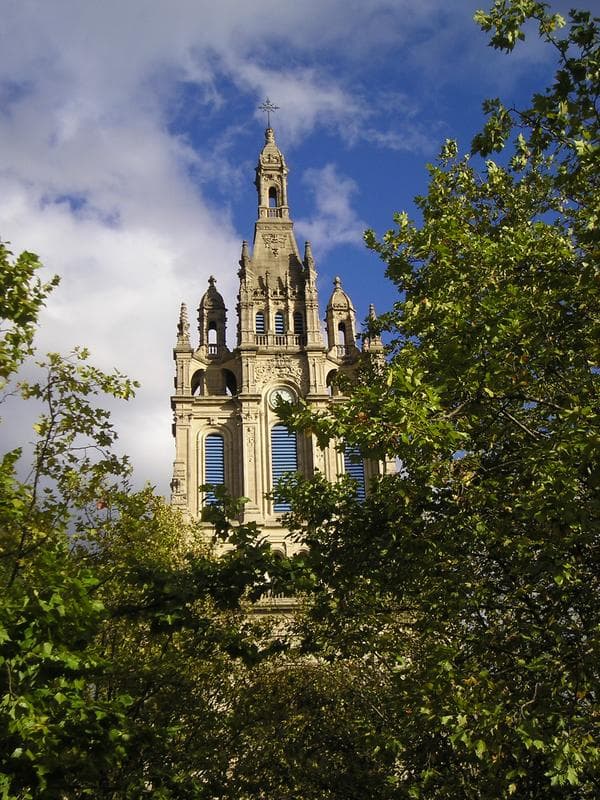
Basilica of Our Lady of Begoña
The Basilica of Our Lady of Begoña is a significant religious site in Bilbao, Spain, dedicated to the patroness saint of Biscay. Its construction began in the 16th century, showcasing a blend of Gothic and Renaissance architectural influences, and it holds deep historical and spiritual importance for sailors and the local community.