
Basilica of the Holy Sepulchre
The Basilica of the Holy Sepulchre, also known as the Church of the Resurrection, is a fourth-century church in Jerusalem believed by Christians to contain the sites of Jesus's crucifixion, burial, and resurrection. It is one of Christianity's holiest sites and has been a major pilgrimage destination since its construction. The church's control is shared among multiple Christian denominations under a complex agreement known as the Status Quo.
Key Facts
- ›Built under Emperor Constantine the Great in the 4th century, it contains the traditional sites of Jesus's crucifixion (Calvary) and burial/resurrection.
- ›The original church was destroyed in 1009 by Fatimid caliph al-Hakim and later reconstructed.
- ›The Crusader period saw significant renovations, unifying various holy sites under one roof and adding a bell tower.
- ›Control of the church is shared by the Roman Catholic, Greek Orthodox, Armenian Apostolic, Coptic, Syriac, and Ethiopian Orthodox churches.
- ›The tomb itself is enclosed within a shrine called the Aedicule, most recently restored in 2016-2017.
- ›It has been a major pilgrimage site for Christians since the 4th century.

Romanesque, Ottoman Baroque
Tomb of Jesus, Calvary, True Cross
Franciscans
Zenobius, Nikolaos Ch. Komnenos
About Basilica of the Holy Sepulchre
The Basilica of the Holy Sepulchre, also known as the Church of the Resurrection or the Church of the Anastasis, stands as one of Christianity's holiest sites, located in the Christian Quarter of the Old City of Jerusalem.
Historical Significance and Construction
Tradition holds that the church encompasses both the site of Jesus's crucifixion at Calvary (Golgotha) and his empty tomb, where he was buried and resurrected. The first church was built under Emperor Constantine the Great, commencing around 326 AD, and consecrated on September 13, 335 AD. This initial structure, planned by architect Zenobius, comprised a rotunda known as the Anastasis and a large basilica (Martyrium) to its east, separated by a courtyard. The site has been a crucial pilgrimage destination for Christians since its inception.
The Constantinian church suffered destruction by fire in 614 AD during the Sasanian invasion. It was rebuilt by Emperor Heraclius around 630 AD. Subsequent centuries saw the church damaged by earthquakes and fires, and notably, it was ordered completely destroyed in 1009 by Fatimid caliph al-Hakim bi-Amr Allah. Reconstruction, initiated by Emperor Constantine IX Monomachos, was completed in 1048, though it primarily focused on the rotunda, leaving much of the great basilica in ruins.
Crusader Period and Later Modifications
Following its capture by the First Crusade in 1099, the church underwent significant modifications. During the 12th century, under Queen Melisende, renovations unified the various holy sites under one roof for the first time, incorporating Romanesque elements and adding a bell tower. The church also served as the seat for the first Latin Patriarchs of Jerusalem.
Later periods saw further changes, including renovations by the Franciscans in 1555, who rebuilt the Aedicule. After this, control of the church often oscillated between the Franciscans and the Orthodox communities, leading to disputes and the establishment of the Status Quo in 1757, which governs the complex's administration to this day. A major fire in 1808 necessitated extensive rebuilding of the rotunda and the Aedicule, undertaken by architect Nikolaos Ch. Komnenos in an Ottoman Baroque style. The dome was again restored in 1868 with iron construction.
Contemporary Status
The church's management is a complex arrangement shared by several denominations, including the Roman Catholic, Greek Orthodox, Armenian Apostolic, Coptic, Syriac, and Ethiopian Orthodox churches. The Status Quo, a set of understandings dating back to 1757, dictates the rights and responsibilities of each community, ensuring a delicate balance of power. Recent restoration efforts, including a major project on the Aedicule from 2016 to 2017, have aimed to preserve this vital religious and historical monument. The site was temporarily closed to the public in March 2020 due to the COVID-19 pandemic, marking its first closure since the Black Death in 1349.
Source: Wikipedia ↗
Frequently Asked Questions
What is the Basilica of the Holy Sepulchre?
The Basilica of the Holy Sepulchre, also known as the Church of the Resurrection, is a significant Christian site in Jerusalem. It is believed to contain the locations of Jesus's crucifixion, burial, and resurrection, making it one of Christianity's holiest places.
When was the Basilica of the Holy Sepulchre built?
Construction of the first church began under Emperor Constantine the Great in the 4th century, with the initial consecration taking place in 335 AD. The structure has undergone numerous reconstructions and modifications throughout history.
Who controls the Basilica of the Holy Sepulchre?
Control of the Basilica of the Holy Sepulchre is shared among several Christian denominations, including the Roman Catholic, Greek Orthodox, and Armenian Apostolic churches, under an arrangement known as the Status Quo dating back to 1757.
What is the significance of the Aedicule?
The Aedicule is a 19th-century shrine built around the traditional site of Jesus's tomb. It encloses the rock-cut tomb and has been a focal point of devotion and pilgrimage for centuries, having undergone significant restoration in 2016-2017.
Why is it also called the Church of the Resurrection?
It is also known as the Church of the Resurrection, or Church of the Anastasis (Greek for 'resurrection'), because it is traditionally believed to be the site where Jesus was resurrected after his burial.
Has the church always been in its current state?
No, the church has a long and tumultuous history, including destruction by fire and earthquakes, and deliberate demolition in 1009. It has been rebuilt, reconstructed, and renovated multiple times, notably by the Byzantines, Crusaders, and under Ottoman rule.
Related Basilicas

Basilica of the Agony (Church of All Nations)
The Basilica of the Agony, also known as the Church of All Nations or Church of Gethsemane, is a Catholic church on the Mount of Olives in East Jerusalem. It is significant for enshrining the bedrock where Jesus is said to have prayed before his arrest and was constructed between 1919 and 1924 with international donations. The church incorporates elements from earlier Byzantine and Crusader structures on the site.
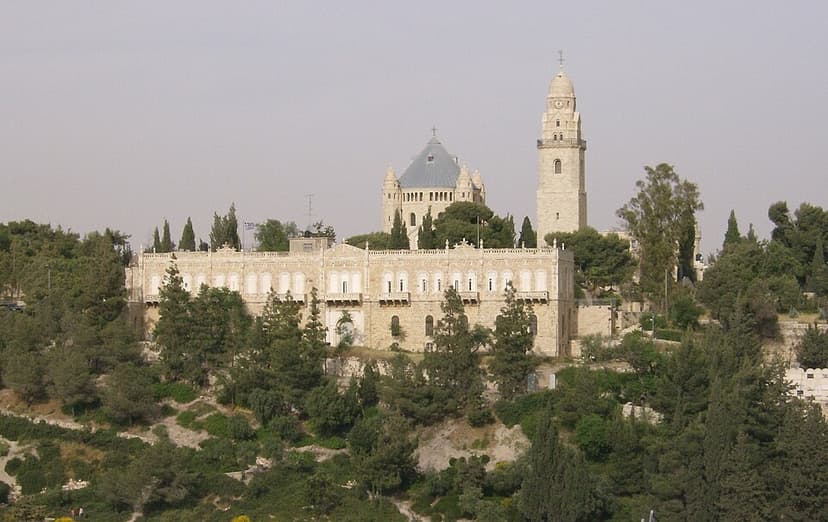
Basilica of the Dormition of the Virgin Mary, Hagia Maria Sion Abbey
The Basilica of the Dormition of the Virgin Mary, Hagia Maria Sion Abbey is a Catholic abbey located in Jerusalem on Mount Zion, believed to mark the spot of Mary's earthly end. The current neo-Romanesque basilica was constructed between 1900 and 1910, built on the foundations of earlier Byzantine and Crusader churches, and serves as a significant pilgrimage site.

St Anne's Church
The Church of Saint Anne is a French Catholic church located in the Muslim Quarter of Jerusalem's Old City, near the Lions' Gate and the start of the Via Dolorosa. Built between 1131 and 1138, it stands as a significant example of Romanesque architecture and is believed by tradition to be the site of the childhood home of the Virgin Mary. It is part of the French national domain in the Holy Land.