
Basilica of the Agony (Church of All Nations)
The Basilica of the Agony, also known as the Church of All Nations or Church of Gethsemane, is a Catholic church on the Mount of Olives in East Jerusalem. It is significant for enshrining the bedrock where Jesus is said to have prayed before his arrest and was constructed between 1919 and 1924 with international donations. The church incorporates elements from earlier Byzantine and Crusader structures on the site.
Key Facts
- ›Enshrines the bedrock where Jesus is believed to have prayed before his arrest.
- ›Built between 1919 and 1924 on the foundations of earlier Byzantine and Crusader churches.
- ›Funded by donations from twelve countries, whose coats-of-arms are featured in the ceiling and mosaics.
- ›Designed by Italian architect Antonio Barluzzi.
- ›Features alabaster windows dyed violet to evoke a mood of depression, and a deep blue ceiling simulating a night sky.
- ›An arson attack occurred in December 2020, causing minimal damage.

Neoclassical
Bedrock of Jesus' Prayer In Gethsemane
Franciscan Custody of the Holy Land
Antonio Barluzzi
About Basilica of the Agony (Church of All Nations)
The Basilica of the Agony, also widely known as the Church of All Nations or the Church of Gethsemane, is a significant Catholic church situated on the Mount of Olives in East Jerusalem. Its primary importance stems from its location next to the Garden of Gethsemane, enshrining a section of bedrock believed to be where Jesus prayed intensely before his arrest, as recounted in the Gospel of Mark.
History and Construction
The current basilica's construction took place between 1919 and 1924. It was built upon the foundations of two earlier ecclesiastical structures: a 4th-century Byzantine basilica that was destroyed by an earthquake in 746, and a smaller 12th-century Crusader chapel that was abandoned in 1345. During the excavation for the new church's foundations in 1920, remnants of the earlier Byzantine church, including fragments of a mosaic, were discovered. This led to a revision of the architectural plans, and work commenced on the present basilica, culminating in its consecration in June 1924. The church has also been the site of an arson attack in December 2020, which caused minimal damage.
Design and International Significance
The Church of All Nations is a testament to international cooperation, having been funded by donations from numerous countries. The coats-of-arms of twelve of these donating nations are prominently displayed in the ceiling and interior mosaics, reflecting its global patronage. Notable architectural features include its facade, supported by Corinthian columns topped with statues of the Four Evangelists, and a modern mosaic depicting Jesus Christ as a mediator between God and humanity, designed by Professor Giulio Bargellini. The interior design, by architect Antonio Barluzzi, utilizes alabaster windows dyed violet to create a mood of sorrow, and a deep blue ceiling to evoke a night sky, setting a contemplative atmosphere analogous to Christ's agony. The church is currently held in trust by the Franciscan Custody of the Holy Land.
Religious Use
Beyond its Catholic affiliation, the Basilica of the Agony serves as a site of pilgrimage and prayer for various Christian denominations. An open altar in the church gardens is utilized by followers of Roman Catholic, Eastern Orthodox, Armenian Apostolic, Protestant, Lutheran, Evangelical, and Anglican traditions, underscoring its role as a shared Christian holy site.
Source: Wikipedia ↗
Frequently Asked Questions
What is the significance of the Basilica of the Agony?
The Basilica of the Agony is significant because it enshrines the bedrock where Jesus is said to have prayed before his arrest. It is also known as the Church of All Nations due to the international donations that funded its construction.
Where is the Basilica of the Agony located?
The Basilica of the Agony is located on the Mount of Olives in East Jerusalem, adjacent to the Garden of Gethsemane.
What is the history of the site of the Basilica of the Agony?
The current church is built on the foundations of a 4th-century Byzantine basilica, which was destroyed by an earthquake, and a 12th-century Crusader chapel. Archaeological work during the construction of the current church revealed remains of these earlier structures.
Who designed the Church of All Nations?
The Church of All Nations was designed by Italian architect Antonio Barluzzi.
What is unique about the design of the Basilica of the Agony?
The church's design includes alabaster windows dyed violet to create a somber atmosphere and a deep blue ceiling meant to resemble a night sky. The facade features statues of the Four Evangelists and a mosaic depicting Jesus as a mediator.
Are there any notable relics at the Basilica of the Agony?
The basilica enshrines a section of bedrock where Jesus is said to have prayed before his arrest.
Is the Basilica of the Agony used by different Christian denominations?
Yes, an open altar in the gardens is used by many Christian denominations, including Roman Catholic, Eastern Orthodox, Armenian Apostolic, Protestant, Lutheran, Evangelical, and Anglican followers.
Related Basilicas

Basilica of the Holy Sepulchre
The Basilica of the Holy Sepulchre, also known as the Church of the Resurrection, is a fourth-century church in Jerusalem believed by Christians to contain the sites of Jesus's crucifixion, burial, and resurrection. It is one of Christianity's holiest sites and has been a major pilgrimage destination since its construction. The church's control is shared among multiple Christian denominations under a complex agreement known as the Status Quo.
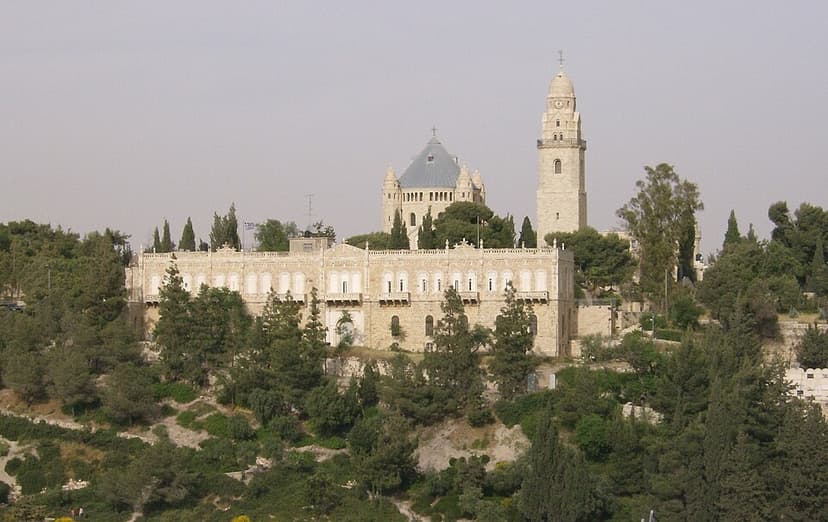
Basilica of the Dormition of the Virgin Mary, Hagia Maria Sion Abbey
The Basilica of the Dormition of the Virgin Mary, Hagia Maria Sion Abbey is a Catholic abbey located in Jerusalem on Mount Zion, believed to mark the spot of Mary's earthly end. The current neo-Romanesque basilica was constructed between 1900 and 1910, built on the foundations of earlier Byzantine and Crusader churches, and serves as a significant pilgrimage site.

Basilica of St Stephen
The Basilica of St Stephen, also known as the Church of St. Stephen or Saint-Étienne, is a Catholic church located outside Jerusalem's Old City. An ancient tradition identifies it as the site of Saint Stephen's martyrdom, the deacon mentioned in the Book of Acts.