
Swaminarayan Mandir, Gadhada
Swaminarayan Mandir, Gadhada, also known as Gopinathji Dev mandir, is a significant Hindu temple in Gadhada, Gujarat, India. It is one of the six temples established by the founder of the Swaminarayan Sampradaya, Swaminarayan himself, and is dedicated primarily to Radha and Krishna.
Key Facts
- ›One of six temples built under the supervision of Swaminarayan, founder of the Swaminarayan Sampradaya.
- ›Constructed on land donated by the court of Dada Khachar, within the courtyard of his residence.
- ›Swaminarayan personally supervised construction and participated in manual labor.
- ›The central shrine houses idols of Gopinath, Radha, and Harikrishna (Swaminarayan).
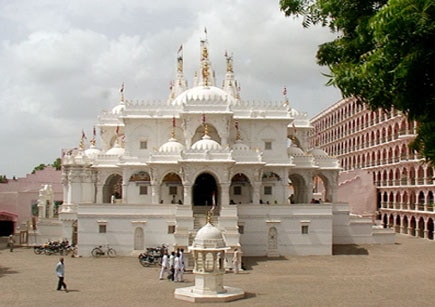
- ›Features two stories and three domes, adorned with carvings and placed on a high plinth.
- ›The temple complex includes dharamshalas and kitchens for ascetics and pilgrims.
Radha Krishna, Gopinath, Harikrishna, Dharmadeva, Bhaktimata, Vasudeva, Revti-Baldevji, Suryanarayan, Ghanshyam
- One of the six primary temples founded by Swaminarayan
- Deeply associated with the life and teachings of Swaminarayan
- Site of important spiritual events and discourses by Swaminarayan
- Features golden spires, being the first temple in Gujarat to do so
Stones, Mortar
Swaminarayan, Dada Khachar
Carvings
Ghela River, Gangajalio Well
About Swaminarayan Mandir, Gadhada
Swaminarayan Mandir, Gadhada, also referred to as Gopinathji Dev mandir, is a prominent Hindu temple located in Gadhada, Gujarat, India. It holds a special place within the Swaminarayan Sampradaya as one of the six principal temples established under the direct supervision of the sect's founder, Bhagwan Swaminarayan. The temple is consecrated to the worship of Radha and Krishna, with the central shrine housing idols of Gopinath (a manifestation of Krishna), along with his consort Radha, and Harikrishna, representing Swaminarayan himself.
Construction and Features
The construction of Swaminarayan Mandir, Gadhada, was a significant undertaking that received direct guidance and consultation from Swaminarayan. The land for the temple was generously donated by the court of Dada Khachar, a devoted follower, and the temple was erected within the courtyard of his residence. Swaminarayan was deeply involved in the temple's creation, even participating in manual labor by lifting stones and mortar. The temple itself is a two-story structure featuring three domes and is embellished with intricate carvings. It is built on a high plinth, encompassing a spacious square area, and includes an assembly hall along with substantial dharamshalas and kitchens intended to accommodate ascetics and visiting pilgrims.
Spiritual Significance and Associated Sites
The temple is a repository of numerous memories associated with Swaminarayan's life and teachings. The idols within the central shrine were installed by Swaminarayan on October 9, 1828. Beyond the main temple, the complex and its surroundings are rich with spiritually significant locations. Lakshmiwadi, situated a short distance away, marks the site of Swaminarayan's cremation and features a temple with a single dome. Nearby, a canopy is preserved where Swaminarayan delivered discourses, now recorded in the Vachanamrut scripture, and the original chamber of Dada Khachar has been maintained. The Ghela River, where Swaminarayan and his saints would bathe, flows to the south of the temple, and sacred riverbeds such as Narayan Dharo and Sahasra Dharo, frequently visited by Swaminarayan, are also found in the vicinity. In a more recent development, in May 2012, the temple's spires were plated with gold, making it the first temple in Gujarat to achieve this distinction.
Source: Wikipedia ↗
Frequently Asked Questions
Who is Swaminarayan Mandir, Gadhada dedicated to?
Swaminarayan Mandir, Gadhada is primarily dedicated to Radha and Krishna. The central shrine specifically enshrines idols of Gopinath (a form of Krishna), his consort Radha, and Harikrishna (a form of Swaminarayan).
What is the historical significance of Swaminarayan Mandir, Gadhada?
This temple holds significant historical importance as it is one of the six temples personally established and supervised by Swaminarayan, the founder of the Swaminarayan Sampradaya. Swaminarayan himself engaged in manual labor during its construction and installed the idols in 1828, making it a place deeply connected to his life and teachings.
When were the idols installed at Swaminarayan Mandir, Gadhada?
The idols at Swaminarayan Mandir, Gadhada were installed by Swaminarayan himself on October 9, 1828. This event marks a pivotal moment in the temple's history and its spiritual significance.
What architectural features does Swaminarayan Mandir, Gadhada possess?
The temple is characterized by its two-story structure and three domes, all adorned with intricate carvings. It is situated on a high plinth and features a spacious square layout, complemented by an assembly hall and extensive dharamshalas and kitchens.
Are there any other related holy sites near Swaminarayan Mandir, Gadhada?
Yes, several sites around the temple are related to Swaminarayan's life. These include Lakshmiwadi, the site of his cremation, where a single-domed temple stands; a canopy where he delivered discourses; and the room of Nishkulanand Swami. The Ghela River, where Swaminarayan and his saints bathed, also flows nearby, along with sacred riverbeds and small temples.
Related Temples (Hindu)

Satyanarayana Temple, Annavaram
The Satyanarayana Temple in Annavaram, Andhra Pradesh, is a prominent Hindu pilgrimage site dedicated to Lord Satyanarayana Swamy, an incarnation of Lord Vishnu. Situated atop Ratnagiri Hill, the temple is renowned for attracting thousands of devotees daily, particularly for the Satyanarayana Vratham, and is considered one of the wealthiest and most visited religious sites in the state.

Jhandewalan Temple
The Jhandewalan Temple in Delhi, dedicated to Vaishno Devi, was founded in the 19th century by Badri Bhagat. Originally located near a spring where Bhagat discovered an idol, the temple gained its name from a large flag (jhanda) hoisted to mark the site. It remains a significant religious center, particularly during the Navratri festival, and is known for its extensive charitable work.

Mata Mansa Devi Mandir
Mata Mansa Devi Mandir is a significant Hindu temple dedicated to Goddess Mansa Devi, a form of Shakti, located in the Panchkula district of Haryana, India. The temple complex, spread across 100 acres in the Shivalik foothills, was established in its current form between 1811 and 1815 by Maharaja Gopal Das Singh of Mani Majra and has been managed by the Shri Mata Mansa Devi Shrine Board since 1991.