
Sanwaliaji temple
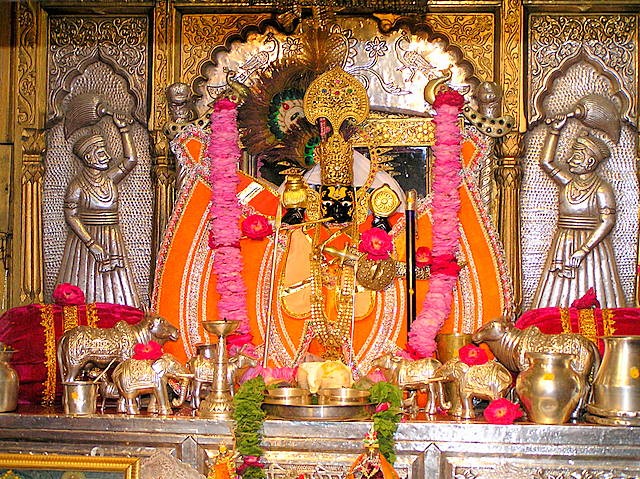
Sanwaliya Ji Temple, also known as Sawariya Seth temple or Shri Sanwaliya Seth, is a significant Hindu pilgrimage site located in the Chittorgarh district of Rajasthan, India. Dedicated to Lord Krishna, it is considered the main shrine among three discovered divine idols, drawing devotees from across Rajasthan, Madhya Pradesh, and Gujarat.
Key Facts
- ›The temple is primarily dedicated to Lord Krishna.
- ›It is situated in the Chittorgarh district of Rajasthan, India.
- ›The temple is considered the main shrine among three idols discovered in 1840.
- ›It is a major pilgrimage destination for devotees from Rajasthan, Madhya Pradesh, and Gujarat.
- ›Sanwaliya Ji Temple is regarded as the second most important pilgrimage site for Vaishnav tradition followers after Shrinathji Temple in Nathdwara.
Krishna
Major Pilgrimage Site, Important Site For Vaishnav Tradition
Bholaram
About Sanwaliaji temple
Sanwaliya Ji Temple
Sanwaliya Ji Temple, also known as Sawariya Seth temple or Shri Sanwaliya Seth, is a prominent Hindu temple located in the Chittorgarh district of Rajasthan, India. It is dedicated to Lord Krishna and holds significant religious importance as a major pilgrimage destination.
Legend and Discovery
The origins of the temple are rooted in a legend from 1840, when a cowherd named Bholaram reportedly dreamed of three divine idols of Lord Krishna buried in the Chhapar area of Bagund village. Following this dream, excavations were conducted, leading to the discovery of three exquisite idols of Krishna. Temples were subsequently built at the locations of these discoveries: one in Mandfiya, another in Bhadsoda, and the third at the original site in Chhapar, Bagund. These three sites are situated within approximately five kilometers of each other.
Main Shrine and Pilgrimage
Among the three temples, the one located in Mandfiya is recognized as the main shrine, often referred to as Sanwaliya Ji Dham. This temple serves as a crucial pilgrimage site, attracting a large number of devotees from the Indian states of Rajasthan, Madhya Pradesh, and Gujarat. Following the Shrinathji Temple in Nathdwara, Sanwaliya Ji Temple is considered the second most important pilgrimage center for followers of the Vaishnav tradition.
Source: Wikipedia ↗
Frequently Asked Questions
When was the Sanwaliya Ji Temple discovered?
According to legend, the divine idols dedicated to Lord Krishna were discovered in 1840. A cowherd named Bholaram dreamed of three divine idols buried in the Chhapar area of Bagund village, and excavations at the site revealed them.
Where is Sanwaliya Ji Temple located?
Sanwaliya Ji Temple is located in the Chittorgarh district of Rajasthan state, India. It is situated approximately 41 km from Chittorgarh Railway Station and 65 km from Dabok Airport.
What deity is worshipped at Sanwaliya Ji Temple?
The primary deity worshipped at Sanwaliya Ji Temple is Lord Krishna. The temple houses one of three divine idols of Lord Krishna that were discovered according to local legend.
Is Sanwaliya Ji Temple an important pilgrimage site?
Yes, Sanwaliya Ji Temple is a major pilgrimage site, particularly for devotees from Rajasthan, Madhya Pradesh, and Gujarat. It is considered the second most important pilgrimage site for followers of the Vaishnav tradition after Shrinathji Temple in Nathdwara.
Related Temples (Hindu)

Satyanarayana Temple, Annavaram
The Satyanarayana Temple in Annavaram, Andhra Pradesh, is a prominent Hindu pilgrimage site dedicated to Lord Satyanarayana Swamy, an incarnation of Lord Vishnu. Situated atop Ratnagiri Hill, the temple is renowned for attracting thousands of devotees daily, particularly for the Satyanarayana Vratham, and is considered one of the wealthiest and most visited religious sites in the state.

Jhandewalan Temple
The Jhandewalan Temple in Delhi, dedicated to Vaishno Devi, was founded in the 19th century by Badri Bhagat. Originally located near a spring where Bhagat discovered an idol, the temple gained its name from a large flag (jhanda) hoisted to mark the site. It remains a significant religious center, particularly during the Navratri festival, and is known for its extensive charitable work.

Mata Mansa Devi Mandir
Mata Mansa Devi Mandir is a significant Hindu temple dedicated to Goddess Mansa Devi, a form of Shakti, located in the Panchkula district of Haryana, India. The temple complex, spread across 100 acres in the Shivalik foothills, was established in its current form between 1811 and 1815 by Maharaja Gopal Das Singh of Mani Majra and has been managed by the Shri Mata Mansa Devi Shrine Board since 1991.