
New Swaminarayan temple, Bhuj
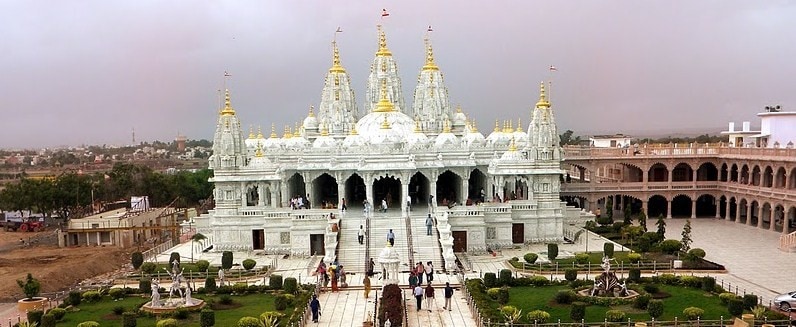
The Shri Swaminarayan Mandir in Bhuj, Gujarat, is a prominent temple complex managed by the Nar Narayan Dev Gadi of the Swaminarayan Sampraday. Rebuilt after the devastating 2001 earthquake destroyed the original temple, the new structure was inaugurated in May 2010 and is renowned for its opulent construction using marble and gold.
Key Facts
- ›The temple complex is located in Bhuj, Kutch district, Gujarat, India.
- ›It is managed by the Nar Narayan Dev Gadi of the Swaminarayan Sampraday.
- ›The new temple was constructed following the destruction of the original temple by the 2001 earthquake.
- ›The rebuilding effort utilized marble for pillars and ceilings, and gold for the idol's throne, domes, and doors.
- ›The inauguration ceremony took place from May 15 to 23, 2010.
- ›The temple was built at a cost of 1 billion Indian rupees on 5 acres of land.
Swaminarayan, Nar Narayan, Radha Krishna, Hari Krishna, Ghanshyam, Sukh Shaiya
- Reconstruction of A Historically Significant Temple Destroyed By Earthquake
- Example of Opulent Temple Construction Using Marble and Gold
Marble, Gold
Swaminarayan
About New Swaminarayan temple, Bhuj
Shri Swaminarayan Mandir, Bhuj
The Shri Swaminarayan Mandir in Bhuj, located in the Kutch district of Gujarat, India, is a significant temple complex overseen by the Nar Narayan Dev Gadi of the Swaminarayan Sampraday, a sect within Hinduism. The original temple, established by Swaminarayan himself in 1824, was tragically destroyed in the devastating earthquake that struck Bhuj on January 26, 2001.
Following this destruction, a new temple was meticulously constructed, with its inauguration ceremony taking place from May 15 to 23, 2010. This rebuilding effort was notable for its lavish use of materials, incorporating marble for its pillars and ceilings, and gold for the throne of Swaminarayan's idol, as well as the temple's domes and doors. The cost of this ambitious reconstruction amounted to 1 billion Indian rupees, spread across a 5-acre site.
Central deity images, including Nar Narayan and Swaminarayan as Hari Krishna, were carefully transferred from the old temple to the new one. The complex also houses idols of Radha Krishna, Swaminarayan as Ghanshyam, and Sukh Shaiya. The temple's opening ceremony drew a large international attendance, highlighting its importance as a pilgrimage destination and a testament to the enduring faith and resilience of its community.
Source: Wikipedia ↗
Frequently Asked Questions
When was the new Shri Swaminarayan Mandir in Bhuj inaugurated?
The inauguration ceremony for the new Shri Swaminarayan Mandir in Bhuj was held from May 15 to 23, 2010. This marked the opening of the temple complex after its reconstruction.
What happened to the original Shri Swaminarayan Mandir in Bhuj?
The original Shri Swaminarayan Mandir, built by Swaminarayan in 1824, was shattered by the earthquake that struck Bhuj on January 26, 2001. The new temple was built to replace it.
What materials were used to build the new temple?
The new temple was constructed using only marble and gold. Marble was used for the pillars and ceilings, while gold was used for the throne of Swaminarayan's idol, the temple domes, and doors.
How much did the new temple cost to build?
The new Shri Swaminarayan Mandir in Bhuj was built at a cost of 1 billion Indian rupees (100 crore). It was constructed on 5 acres of land.
What deities are worshipped at the temple?
The central deity images moved from the old temple to the new one include Nar Narayan and Swaminarayan in the form of Hari Krishna. Images of Radha Krishna, Swaminarayan in the form of Ghanshyam, and Sukh Shaiya are also present.
Related Temples (Hindu)

Satyanarayana Temple, Annavaram
The Satyanarayana Temple in Annavaram, Andhra Pradesh, is a prominent Hindu pilgrimage site dedicated to Lord Satyanarayana Swamy, an incarnation of Lord Vishnu. Situated atop Ratnagiri Hill, the temple is renowned for attracting thousands of devotees daily, particularly for the Satyanarayana Vratham, and is considered one of the wealthiest and most visited religious sites in the state.

Jhandewalan Temple
The Jhandewalan Temple in Delhi, dedicated to Vaishno Devi, was founded in the 19th century by Badri Bhagat. Originally located near a spring where Bhagat discovered an idol, the temple gained its name from a large flag (jhanda) hoisted to mark the site. It remains a significant religious center, particularly during the Navratri festival, and is known for its extensive charitable work.

Mata Mansa Devi Mandir
Mata Mansa Devi Mandir is a significant Hindu temple dedicated to Goddess Mansa Devi, a form of Shakti, located in the Panchkula district of Haryana, India. The temple complex, spread across 100 acres in the Shivalik foothills, was established in its current form between 1811 and 1815 by Maharaja Gopal Das Singh of Mani Majra and has been managed by the Shri Mata Mansa Devi Shrine Board since 1991.