
Kapaleeshwarar Temple
South Indian Architecture·7th century·India
The Kapaleeshwarar Temple, located in Mylapore, Chennai, Tamil Nadu, is a Hindu temple dedicated to Lord Shiva. Built around the 7th century CE, it is a significant example of South Indian architecture and holds deep religious importance, being a site where Goddess Parvati is believed to have worshipped Shiva in the form of a peahen. The temple is renowned for its prominent shrines, daily rituals, and vibrant annual festivals, most notably the Aṟupatimūvar festival.
Key Facts
- ›Dedicated to Lord Shiva, worshipped as Kapaleeshwarar, and Goddess Parvati, worshipped as Karpagambal.
- ›Constructed around the 7th century CE during the reign of the Pallava dynasty.
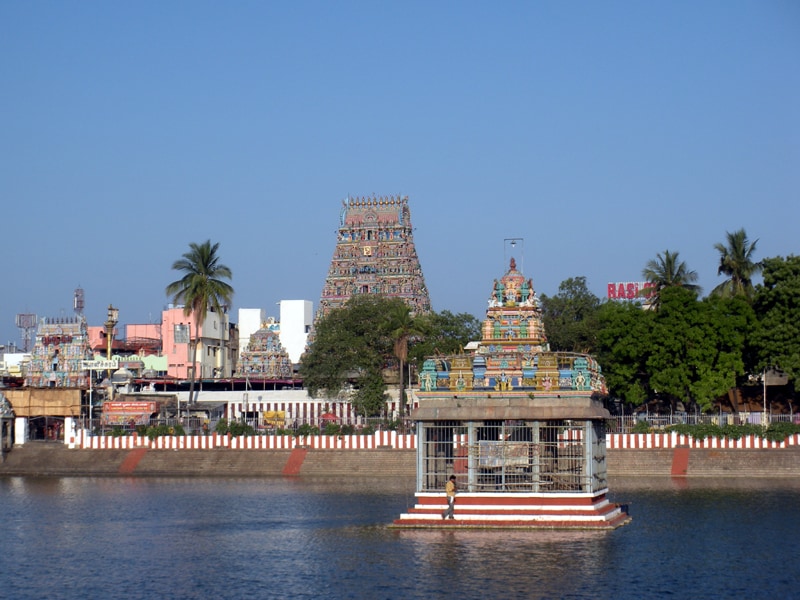
- ›Features a prominent 40-meter high East gopuram and a smaller Western gopuram facing the temple tank.
- ›The temple complex includes numerous shrines, halls, and a large temple tank (theppakulam).
- ›Celebrates six daily rituals and four yearly festivals, with the Aṟupatimūvar festival being the most significant.
- ›Maintained and administered by the Hindu Religious and Charitable Endowments Department of the Government of Tamil Nadu.
Shiva, Parvati
- Religious Pilgrimage Site
- Example of South Indian Architecture
- Mentioned In 7th-Century Tamil Shaiva Canonical Work, Tevaram
- Associated With the Legend of Parvati Worshipping Shiva As A Peahen
Pallava Dynasty
AṟUpatimūVar Festival, Brahmotsavam, Panguni Peruvila, Terotsavam, Tirukkalyanam
Granite
Pallavas
Stucco Figures Adorning the Gopuram
Kapaleeshwarar Tank
About Kapaleeshwarar Temple
The Kapaleeshwarar Temple is a significant Hindu temple located in the Mylapore neighborhood of Chennai, Tamil Nadu, India. Dedicated to Lord Shiva, worshipped here as Kapaleeshwarar, and his consort Goddess Parvati, known as Karpagambal, the temple is a prime example of South Indian Dravidian architecture. Historical and legendary accounts suggest the temple's origins date back to around the 7th century CE, possibly built by the ruling Pallava dynasty.
Legend and Mythology
According to Puranic lore, the area known as Mylapore derives its name from 'mayil,' the Tamil word for peahen. It is believed that Goddess Parvati, in the form of a peahen, performed penance here to worship her husband Shiva. Another legend associated with the temple's name states that Shiva plucked off one of Brahma's heads, leading Brahma to perform penance at this site by installing a lingam to appease Shiva. The temple is also revered as one of the "Paadal Petra Sthalam," sacred abodes mentioned in the 7th-century Tamil Shaiva canonical work, the Tevaram.
History and Architecture
The temple is generally believed to have been constructed around the 7th century CE. Inscriptions dating back to the 12th century have been found within the complex. The temple's architecture is characteristic of the Tamil style, with a towering 40-meter high East gopuram that dominates the streetscape, and a smaller Western gopuram facing the sacred tank. The temple complex features numerous shrines, including prominent ones for Kapaleeshwarar and Karpagambal, along with various halls.
Religious Practices and Festivals
The Kapaleeshwarar Temple is an active place of worship, conducting six daily rituals and four major annual festivals. The most important of these is the Aṟupatimūvar festival, celebrated during the Tamil month of Panguni as part of the grand Brahmotsavam. This festival involves elaborate processions with idols of Shiva, Parvati, and the sixty-three Nayanar saints.
Temple Tank and Administration
Adjacent to the temple is the Kapaleeshwarar Tank, also known as the Mylapore Tank. This large water body is central to religious observances, especially during the annual float festival. The temple is managed and administered by the Hindu Religious and Charitable Endowments Department of the Government of Tamil Nadu.
Source: Wikipedia ↗
Frequently Asked Questions
What is the origin of the name Kapaleeshwarar Temple?
The temple's name is derived from 'kapala' meaning head and 'Ishvara,' an epithet for Shiva. According to legend, Shiva plucked off one of Brahma's heads, and Brahma performed penance at this site by installing a lingam to appease Shiva.
What is the legend behind Parvati worshipping Shiva here?
Regional legend states that Shiva's consort, Parvati, due to a curse, took the form of a peahen (mayil in Tamil) and performed penance at this location to regain her original form. This is also believed to be the origin of the area's name, Mylapore.
What is the architectural style of the Kapaleeshwarar Temple?
The Kapaleeshwarar Temple is built in a typical Tamil architectural style. Its towering gopuram (gateway tower) impressively overlooks the street it faces, showcasing the craftsmanship of the vishwakarmas sthapathis.
What are the main festivals celebrated at the temple?
The most prominent festival is the Aṟupatimūvar festival, celebrated during the Tamil month of Panguni as part of the brahmotsava. Other significant events include the nine-day Panguni Peruvila (Spring festival), which includes flag hoisting, chariot festivals, and the marriage ceremony of Kapaleeshwarar and Karpagambal.
What is the significance of the temple tank?
The temple tank, known as the Kapaleeshwarar Tank or Mylapore Tank, is one of the oldest and best-maintained in the city. It is central to the annual three-day float festival, where idols of deities are taken around the tank amidst Vedic chants.
Which ancient Tamil literature references the Kapaleeshwarar Temple?
The temple is referenced in Sangam literature from the 1st to 5th centuries and has early post-Sangam mentions in 6th-century Tamil literature. Poet saints like Thirugnana Sambanthar (7th century) and Arunagirinathar (15th century) have immortalized the temple and its deity in their Tamil poetry.
Related Temples (Hindu)

Mundeshwari Temple
The Mundeshwari Devi Temple, located on the Mundeshwari Hills in Bihar, India, is an ancient Hindu temple dedicated to Goddess Durga and Lord Shiva. It is recognized by the Archaeological Survey of India as a protected monument and is claimed by some scholars to be the oldest functional Hindu temple in the world, with evidence suggesting continuous worship since at least the 6th-7th century CE.

Uttaresvara Siva Temple
The Uttaresvara Siva Temple is a 12th-century Hindu temple dedicated to Lord Shiva, located in Bhubaneswar, Odisha, India. While its original structure from the 7th century has undergone renovations, it remains a significant site featuring various deities and architectural elements. The temple is part of a larger precinct that includes other shrines and a sacred tank.

Vaitheeswaran Koil
Vaitheeswaran Koil is a significant Hindu temple in Tamil Nadu, India, dedicated to Lord Shiva, who is worshipped as Vaidyanathar, the "God of Healing." The temple is renowned for its belief that prayers and rituals performed here can cure diseases, and it is also recognized as one of the nine Navagraha temples, associated with the planet Mars (Angaraka).