
Gingee Venkataramana Temple
Vijayanagara style·16th century·Tamil Nadu
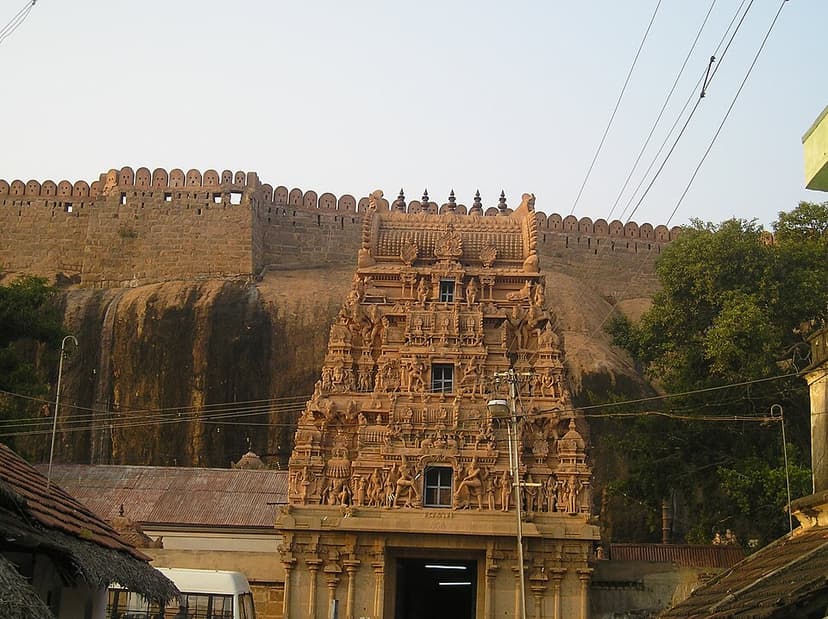
The Gingee Venkataramana Temple, constructed in the 16th century, is the largest temple in Gingee, Tamil Nadu. Originally built by Muthialu Nayakan and dedicated to Venkateshwara, it is known for its well-planned structure and intricate carvings depicting scenes from the Ramayana and Vishnu's incarnations. Despite parts being dismantled for other constructions, its architectural significance remains.
Key Facts
- ›Built in the 16th century by Muthialu Nayakan.
- ›Dedicated to the deity Venkateshwara.
- ›Features notable carvings of Ramayana scenes and Vishnu's incarnations.
- ›Located within the Gingee Fort complex in Tamil Nadu.
- ›Parts of the temple were dismantled and used in other structures, including the Sittamur Jain temple and the statue of Governor Dupleix.

Venkateshwara, Vishnu
- Largest Temple In Gingee
- Architectural Carvings Depicting Religious Narratives
- Historical Significance Due To Dismantling and Reuse of Materials
Nayaka Dynasty
Stone
Muthialu Nayakan, Krishnappa Nayaka
Ramayana Scenes, Vishnu's Incarnations, Samudra Manthan Legend, Krishna, Rukmani and Satyabhama Panel
Varahanadi
About Gingee Venkataramana Temple
The Gingee Venkataramana Temple is a significant historical and architectural site located in Gingee, within the Viluppuram district of Tamil Nadu. Constructed in the 16th century, it stands as the largest temple in the region and was originally built by Muthialu Nayakan between 1540 and 1550 CE. The temple is primarily dedicated to Venkateshwara, a form of the Hindu deity Vishnu.
History and Architecture
The temple is part of the larger Gingee Fort complex. Its architecture is characterized by a well-planned structure, largely built in a single phase. The most admired carvings are found on the panels flanking the entrance gateway, which vividly depict scenes from the Ramayana, various incarnations of Vishnu, and the puranic legend of samudra manthan. The temple complex also includes shrines for goddesses and a shrine with carvings of Narasimha and Krishna.
Over time, parts of the temple have been dismantled. In 1761, during French occupation, several ornamental pillars were removed and taken to Pondicherry. Later, in 1860, stone pieces, including large stone elephants, were repurposed for the Sittamur Jain temple. Despite these alterations, the temple's original design and the quality of its carvings remain notable.
Associated Structures and Waterworks
To the west of the temple lies the Anaikulam tank, historically used for bathing elephants. Nearby are the Chakrakulam and Chettikulam tanks, renowned for their perennial springs that supply water even in summer. These water bodies are integral to Senji's historical water management systems, which included dams and canals constructed by rulers like Krishnappa Nayaka. East of the temple is the Kalyanamahal, an architectural piece built in the Vijayanagara style, featuring a square court with rooms and an eight-story tower.
Other Structures and Mentions
Remnants of the Venugopalaswami shrine, a remarkable sculpture depicting Krishna, Rukmani, and Satyabhama, exist in a state of ruin within the inner fort. The Jesuit traveler Father Pimenta noted the temple in his accounts during his visit in 1599 AD. The Pattabhirama shrine, located at the foot of Chakkali Durgam hill, also features carvings of interest.
Source: Wikipedia ↗
Frequently Asked Questions
When was the Gingee Venkataramana Temple built?
The Gingee Venkataramana Temple was built in the 16th century, specifically between 1540 and 1550 CE. It was commissioned by Muthialu Nayakan.
To which deity is the Gingee Venkataramana Temple dedicated?
The temple is dedicated to Venkateshwara, a form of the Hindu deity Vishnu. It is also known as the Venkataramana Temple.
What are the notable architectural features of the temple?
The temple is a large, well-planned structure. Its most admired carvings are found on the entrance gateway panels, illustrating scenes from the Ramayana, Vishnu's incarnations, and the legend of samudra manthan. Shrines for goddesses and Narasimha and Krishna are also present.
Has any part of the temple been dismantled or relocated?
Yes, parts of the temple have been dismantled over time. In 1761, ornamental pillars were taken to Pondicherry for Governor Dupleix's statue, and later, stone pieces and elephants were used for the Sittamur Jain temple.
What is the significance of the water bodies near the temple?
West of the temple lies the Anaikulam tank for bathing elephants. Further west are the Chakrakulam and Chettikulam tanks, which are fed by perennial springs and are a key feature of Gingee's waterworks, showcasing dams and canals constructed by earlier rulers.
Related Temples (Hindu)
Sathyamurthi Perumal Temple
The Sathyamurthi Perumal Temple in Thirumayam, Tamil Nadu, is an ancient Hindu temple dedicated to Lord Vishnu. Renowned for its Dravidian architecture and significant presence in early Tamil devotional literature, it is recognized as one of the 108 Divya Desams. The temple complex features a majestic rajagopuram, a temple tank within its premises, and is under the administration of the Archaeological Survey of India.

Jakath Rakshaka Perumal temple, Thirukkoodaloor
The Jakath Rakshaka Perumal temple, also known as Thirukoodaloor, is a Hindu temple located in Vadakurangaduturai, Tamil Nadu, dedicated to Lord Vishnu. It is renowned for its Dravidian architecture and its significance as one of the 108 Divya Desams, sacred abodes of Vishnu glorified in the early medieval Tamil canon.

Yathothkari Perumal Temple
The Yathothkari Perumal Temple, also known as Tiruvekkaa Temple, is a historic Hindu temple in Kanchipuram, Tamil Nadu, dedicated to Lord Vishnu. It is celebrated in the Naalayira Divya Prabandham and is recognized as one of the 108 Divya Desams, signifying its importance in Vaishnavism. The temple is notable for its ancient origins, believed to date back to the 8th century CE, with later contributions from various dynasties.