
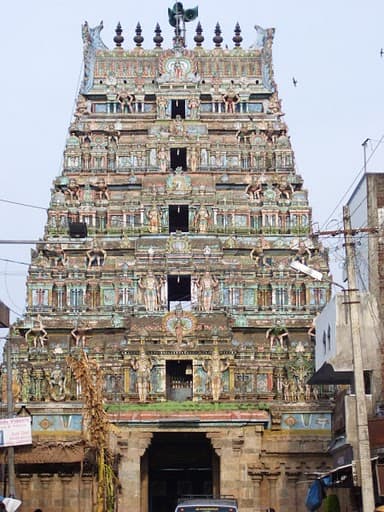
Adi Srinivasa perumal temple
The Adi Srinivasa Perumal Temple, also known as Adi moola Venkataramanaswamy Temple, is a Hindu temple dedicated to Vishnu located in Mookanur, Tamil Nadu. Constructed in the Dravidian style and attributed to the Pallava dynasty, it is revered as one of the 108 Abhimana Kshethrams in the Vaishnavate tradition.
Key Facts
- ›Dedicated to Lord Vishnu, it is considered one of the 108 Abhimana Kshethrams.
- ›The temple architecture is in the Dravidian style, with origins possibly dating back to the 8th century during the Pallava dynasty.
- ›Legend states that Lord Vishnu stepped on this mountain after Goddess Lakshmi departed Vaikuntha, leaving a large footprint.
- ›The temple follows the Vaikhanasa agama and is maintained by the Hindu Religious and Charitable Endowments Department.
- ›It is a Kula-devata for many Brahmins and Gounders in the Dharmapuri district.
- ›Separate shrines exist for Perumal and Padmavathi Thayar, as well as for the Alvars and Acharyars.

Vishnu, Perumal, Padmavathi Thayar
- Considered One of the 108 Abhimana Kshethrams of Vaishnavate Tradition.
- Believed To Be Older Than Venkateswara Temple, Tirumala.
- Site of Lord Vishnu's Footprint, Considered Sacred.
- Visited By Ramanuja.
Pallava Dynasty, Pandya Dynasty, Vijayanagara Empire
Weekly Rituals, Monthly Rituals, Fortnightly Rituals, Abishekam During Saturdays
Pallava Dynasty
Footprint of Maha Vishnu
Vatra Kulam
About Adi Srinivasa perumal temple
The Adi Srinivasa Perumal Temple, also referred to as Adi moola Venkataramanaswamy Temple, is a significant Hindu place of worship located in the village of Mookanur within the Dharmapuri district of Tamil Nadu, India. Dedicated to Lord Vishnu, the temple is a revered site within the Vaishnavate tradition, recognized as one of the 108 Abhimana Kshethrams.
Legend and Origins
The temple's origins are steeped in legend, with priests asserting its antiquity predates the famous Venkateswara Temple in Tirumala, hence its name "Adi Srinivasa Perumal." According to local lore, the temple owes its existence to Lord Vishnu's footstep upon the mountain. The narrative describes Goddess Lakshmi departing Vaikuntha after an incident involving the sage Bhrigu. Lord Vishnu, in his sorrow, followed her, and it is believed he first set foot on this mountain, leaving behind a colossal footprint that can still be seen atop the hill. This imprint is considered a sacred manifestation of Vishnu's presence.
Architecture and History
Constructed in the traditional Dravidian architectural style, the temple exhibits carvings and symbols reminiscent of the Pallava and Pandya periods. Historical assessments suggest the temple's construction may date back to the 8th century, during the reign of the Pallava dynasty. The main sanctum is thought to be from this era, while later additions, such as the Kalyanam cum annadhanamandapa, were built around the 1900s or possibly under the patronage of the Vijayanagara Empire. The temple features two entrances, with the main one facing East and another facing North. The primary deity faces East, while a separate shrine on the mountain faces North, in the direction of Tirupati.
Deities and Worship
The temple complex houses separate shrines for Perumal and Thayar (Padmavathi Thayar), both depicted with four arms. The temple strictly adheres to the Vaikhanasa agama and is administered by the Hindu Religious and Charitable Endowments Department. It serves as the Kula-devata (family deity) for numerous Brahmin and Gounder communities in the Dharmapuri district. Additionally, shrines dedicated to the twelve Alvars and prominent Acharyars like Ramanuja and Nathamuni are present, underscoring its importance in the devotional lineage of Vaishnavism.
Significance and Practices
The Adi Srinivasa Perumal Temple holds considerable religious significance, not only as an Abhimana Kshethram but also as a site believed to have been visited by the philosopher Ramanuja. A unique feature is the Vatra Kulam, a pond on the mountain that is said to never dry up, even in extreme heat. Daily rituals and special observances, including Abishekam on Saturdays, are performed by priests from the Tenkalai sect of the Vaishnavite community. The temple attracts a modest number of visitors on weekdays, with crowds increasing significantly on Saturdays.
Source: Wikipedia ↗
Frequently Asked Questions
What is the legend behind the Adi Srinivasa Perumal Temple?
The temple's legend recounts Goddess Lakshmi's departure from Vaikuntha after a sage, Bhrigu, kicked Vishnu. Lord Vishnu, saddened, followed her and is said to have stepped on this mountain, leaving a large footprint visible today.
What is the architectural style of the Adi Srinivasa Perumal Temple?
The temple is constructed in the Dravidian style of architecture. Carvings and symbols within the temple bear similarities to the architecture of the Pallava and Pandya dynasties.
When was the Adi Srinivasa Perumal Temple built?
The sanctum sanctorum is believed to have been built by the Pallavas in the 8th century. Other sections, such as the Kalyanam cum annadhanamandapa, were built later, possibly around the 1900s or during the Vijayanagara Empire.
What makes this temple significant in the Vaishnavate tradition?
It is considered one of the 108 Abhimana Kshethrams, which are sacred Vishnu temples revered by Vaishnavites. The temple is also believed to have been visited by Ramanuja.
Are there any special features related to Vishnu in this temple?
A prominent feature is a large footprint attributed to Lord Vishnu, located on top of the mountain where the temple stands. This footprint is considered sacred, and it is believed only those with good deeds can see it.
What are the main deities and shrines within the temple?
The main deity is Lord Vishnu (Perumal), who is depicted with four arms. There is also a shrine for Padmavathi Thayar, who also has four hands. Shrines for all twelve Alvars and Acharyars like Ramanuja are also present.
Related Temples (Hindu)

Koodal Azhagar temple
The Koodal Azhagar Temple in Madurai, Tamil Nadu, is a significant Hindu temple dedicated to Lord Vishnu. Constructed in the Dravidian architectural style, it is celebrated in early Tamil devotional literature and is recognized as one of the 108 Divya Desams. The temple is notable for housing the deity Vishnu in three distinct postures within its main shrine.

Shore Temple
The Shore Temple, located in Mahabalipuram, Tamil Nadu, India, is an 8th-century AD structural stone temple complex overlooking the Bay of Bengal. Built from granite blocks during the reign of the Pallava king Narasimhavarman II, it is one of the oldest such temples in South India and a significant UNESCO World Heritage Site.
Oppliyappan Temple
The Oppliyappan Temple, also known as Thiruvinnagar, is a Hindu temple dedicated to Lord Vishnu, located in Tamil Nadu, India. It is renowned for its legend of Vishnu marrying Lakshmi, who was raised as the daughter of sage Markandeya, a story that influences the temple's culinary offerings.